6 effective ways to reduce customer service calls
Reduce phone calls with sustainable solutions like self-service, proactive analysis, and ongoing agent training.


Although customer journeys are now largely digitized, the phone remains the preferred channel for consumers to report an issue. In reality, customer service departments are often overwhelmed by call spikes, resulting in high costs and sometimes limited added value.
In this context, reducing incoming call volume is essential to control costs and relieve pressure on teams, while maintaining a high level of service quality. How can you limit calls without compromising the customer experience? Here are 6 solutions to achieve this!
1. Develop effective and tailored self-service solutions

The Self-service or customer self-care, allows users to resolve their own issues without needing to contact an advisor. According to a study Zendesk, 69% of customers try this route before calling, which could reduce call volume by up to 30%. However, to be effective, this self-service solution must meet one condition: it must be built on an ecosystem of appropriate tools that meet performance criteria.
A variety of tools to suit all profiles
To be effective, self-service must rely on a range of complementary tools, adapted to different uses and levels of digital literacy:
Dynamic FAQ : intelligently structured and updated based on the most frequent requests.
Knowledge base : guides, technical articles, and tutorials available 24/7.
Video tutorials : educational content to support users who are less comfortable with digital tools.
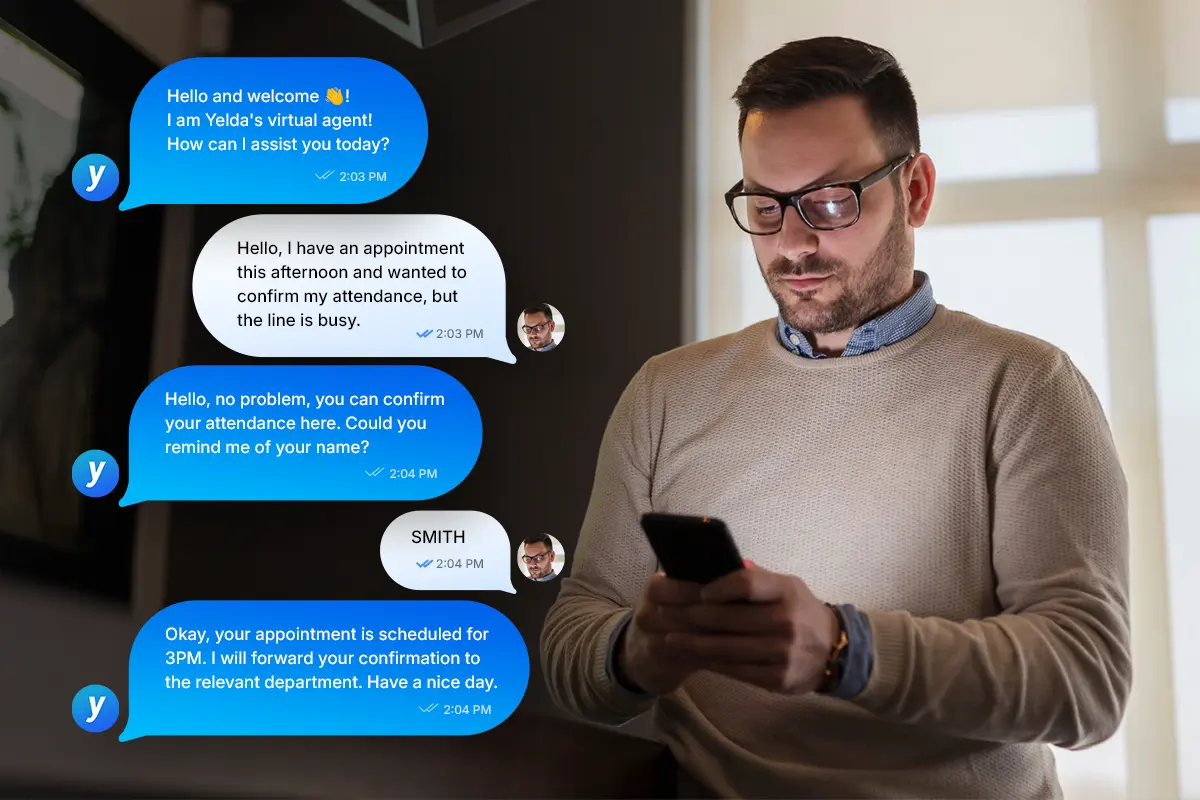
Intelligent chatbots : capable of handling simple requests or directing users to an advisor.
Community forums : to encourage peer-to-peer support among customers.
Personalized customer portal : allowing everyone to access their specific data, orders, or services.
Interactive guides : designed step-by-step to prevent errors during processes.
These tools can also be supplemented by an internal search engine and a system for categorizing questions by topic.
Self-service solutions implemented based on specific criteria
Offering self-service tools is not enough to guarantee that customers can resolve issues entirely on their own. To reduce incoming phone calls to customer service, these solutions must also meet a few effectiveness criteria:
Accessibility : from their personal account or directly from the homepage, the customer must be able to access the tool;
Usability : a poorly structured database, a callbot that is too rigid, or a confusing FAQ can frustrate the customer and lead to a call. For this reason, navigation within the tool must be intuitive to ensure a seamless experience;
Comprehensive answers : the answers provided by the software must not be incomplete, poorly phrased, or overly technical, but rather simple and written for the user;
Continuous updates : based on customer feedback, procedural changes, or new product features, self-service solutions must be updated regularly.
2. Limit repeat calls through first-contact resolution
When a customer has to call back because their initial request wasn't handled correctly, it leads to frustration and unnecessarily increases call volume. First Contact Resolution (FCR) is therefore a strategic metric. According to the SQM Group, a 1% improvement in this rate leads to a corresponding decrease in call volume. Optimizing this metric requires action in several areas:
Ongoing advisor training : covering products, procedures, and managing difficult situations;
Shared knowledge base : updated and accessible to the entire team to ensure consistent responses;
Precise resolution scripts : detailed guides to follow based on the type of request;
Callbots : to automate the handling of simple queries and allow agents to focus on more complex cases;
Centralized customer information : direct access to history to avoid repetition and personalize the response;
Motivating qualitative goals : encouraging advisors to aim for resolution on the first call by prioritizing quality over volume.
3. Anticipate reasons for contact through proactive communication

The proactive communication involves reaching out to customers before they even feel the need to contact customer service. This anticipation can be managed via SMS, email, notification, or call, depending on the context. It is particularly useful in various scenarios:
Order tracking : providing updates at every stage to prevent follow-up calls;
Technical incidents : alerting customers in the event of a known malfunction;
Scheduled maintenance : notify users of interruptions to limit requests for clarification;
Service updates : notify users of updates, changes to offers, or new features.
When used wisely, this strategy helps absorb call spikes and build trust. However, be careful not to over-solicit the customer, as this could have the opposite effect.
4. Analyze call reasons to target actions
To effectively reduce call volume, it is essential to understand the reasons behind them. This requires a precise classification of requests based on their frequency and nature. Conversational analysis tools can help to:
Measure average call duration;
Identify customer pain points;
Identify recurring topics;
Analyze the content of interactions.
This analysis then allows for the implementation of targeted actions, including improving contracts, clarifying processes, adjusting products, and more. Each initiative must be monitored over time to measure its impact, particularly by comparing call volumes before and after.
5. Train, equip, and support customer service agents

A well-trained advisor is one who can respond quickly and accurately, thereby reducing the need for customers to call back multiple times. To achieve this, it is essential that agents have a perfect command of the products and services offered, the internal tools (such as callbot solutions) provided to them, as well as best practices in communication.
However, training should not be a one-off event. It must be part of a strategy of continuous learning to enable advisors to adapt to changes in offerings or procedures.
Furthermore, it is just as crucial to provide them with high-performance tools. An up-to-date knowledge base, a seamless user interface, and an efficient search engine are all essential elements for increasing speed and reliability.
➡️ Quickly estimate the profitability of your project with a personalized simulation.
Estimate the gains of a voice agent based on your own call volumes with our ROI simulator.
6. Diversify and optimize asynchronous contact channels
If customer service phone lines are overwhelmed, it is often because that is the only way to get in touch. To reduce call volume, you must offer consumers alternatives, particularly asynchronous channels:
Online forms;
Social media;
Instant messaging;
Email.
These alternatives allow customers to ask their questions at any time and receive answers within a reasonable timeframe. They also help reduce call volume by redirecting simple requests to more appropriate channels.
FAQ
Why does call volume increase despite self-service tools?
Self-service tools do not always meet customer expectations, especially when it comes to complex requests. Consequently, consumers prefer to contact customer service, which increases call volume.
How can the effectiveness of a call reduction strategy be measured?
The effectiveness of a call reduction strategy is evaluated based on the following criteria:
self-service tool adoption rate;
first-contact resolution rate;
number of calls before and after the actions taken.
Which KPIs should be tracked to manage the decrease in inquiries?
To manage the decrease in inquiries, here are the key indicators to track:
Satisfaction rate;
Average handling time;
Number of calls per customer;
First-contact resolution rate.
How can you reconcile call reduction with maintaining a high level of customer satisfaction?
You need to offer simple, effective alternatives to phone calls while still providing a satisfying response when a customer does call.
What mistakes should you avoid when implementing self-service solutions?
When implementing self-service solutions, don't neglect keeping your tools up to date. Likewise, avoid choosing tools that are unintuitive or difficult to access.
How many calls can your voice agent absorb?
Estimate in one minute the number of automated calls and the savings on your own volumes, with our ROI calculator.