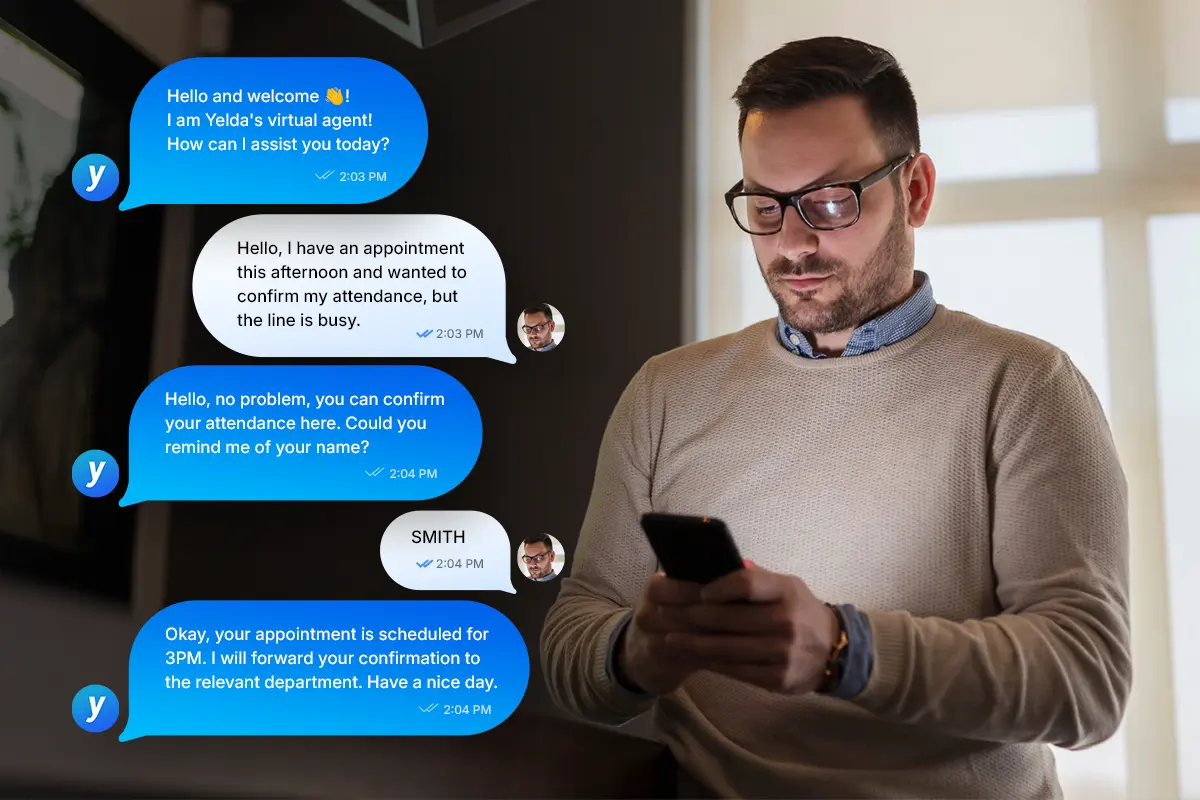
How do you choose your voice AI agent?
Discover how to choose the right voice AI agent for your needs: essential criteria, tips, and a comparison to optimize your experience and performance.

Conversational artificial intelligence is profoundly transforming customer relations. Where companies once struggled to answer every call, intelligent voice agents now provide continuous, seamless, and personalized support.
Available 24/7, these assistants can answer frequently asked questions, route callers, schedule appointments, or provide real-time information. The result is a more responsive, efficient, and cost-effective customer service.
However, not all solutions are created equal. Between technical performance, integration with business tools, and regulatory compliance, choosing a voice AI agent requires careful consideration. Here is a closer look at the key parameters for selecting the solution best suited to your customer service strategy.
What technical and functional criteria should you use to choose a voice AI agent?
To be effective, your callbot solution must adapt to your processes, your customers, and your business tools. Several dimensions directly influence its effectiveness and the user experience it will provide.
Evaluating the quality of the user experience
The primary mission of a voice AI agent is to streamline exchanges with the end customer. The quality of the synthetic voice is therefore paramount. The more natural, fluid, and expressive it is, the more human the interaction feels.
But a good voice isn't enough. Intonation, speaking rate, and responsiveness play an equally important role. Ideally, response latency should never exceed one second.
The system must also be able to handle interruptions, rephrasing, and unexpected questions to establish a credible and pleasant dialogue.
Customization capability
It is important to study the flexibility of the solution so that it best reflects the specifics of your business. In this context, your virtual phone agent must be configurable from a system clear (specifying its role, tone, and objectives) to generate conversations that align with your values.
Furthermore, the chosen solution must allow you to build conversational workflows tailored to your needs, whether it's a simple appointment-booking scenario or a complex call qualification tree. It is also preferable to opt for a no-code platform so you can modify or enhance your scenarios without needing to involve your developers, such as YeldaAI.
Callbot automations and integrations
A high-performing AI voice agent must integrate easily with your business software. It’s not just about answering a call, but being able to take action accordingly. The voice agent must therefore be able to connect to your CRM, calendars, databases or SMS messaging platforms to automatically execute certain actions.
Thanks to these advanced integrations, it will be possible to schedule an appointment, send an order summary, or create a support ticket without human intervention.
Additionally, when a customer makes a complex request, your callbot must be able to effectively redirect the conversation to a human agent. This routing mechanism ensures both service continuity and total satisfaction.
Security and privacy
Before any implementation, try to verify the GDPR compliance of the chosen platform. In practical terms, this means that the processing of voice and text data must be carried out within a strictly European framework to limit exposure risks.
Furthermore, it is imperative that the solution offers effective encryption of communications as well as granular user access management.
Cost
Beyond functional performance, the costs associated with setting up and operating the agent must be carefully studied. The initial setup can include:
- creating scenarios,
- training teams,
- connecting to internal systems, etc.
Next comes the operating cost which is often expressed per minute or per handled call. Some solutions, such as YeldaAI, offer pay-as-you-go billing, which makes the business model more flexible.
As a guide, the cost of a callbot (the setup deployment) varies between €15,000 and €250,000, depending on the desired features and functionality. Conversely, other platforms require a fixed monthly subscription, an option better suited to high volumes.
Estimate the gains of a voice agent based on your own call volumes with our ROI simulator.
Key steps for deploying a voice AI agent in your customer service department

To successfully integrate a voice AI agent, it is important to follow a clear roadmap.
1. Analyze business needs
To best identify your needs, first analyze the types of incoming phone calls. The goal is to identify recurring reasons for calls, call volumes, and priority expectations in terms of quality and customer satisfaction.
This phase also helps to clarify business objectives, including cost reduction and the First Call Resolution (First Call Resolution) or even increasing the conversion rate.
2. Defining priority use cases
Once your needs have been identified, select the use cases that your voice AI agent should handle as a priority. Common examples include:
- scheduling appointments,
- managing technical support,
- customer follow-ups,
- lead qualification, etc.
The ideal approach is to focus first on a few key scenarios to ensure a gradual, controlled, and high-value deployment.
3. Choosing technologies and partners
A voice AI agent relies primarily on the combination of several components:
- Speech-to-Text (STT) which converts voice to text,
- Text-to-Speech (TTS) which generates the synthetic voice,
- and a Large Language Model (LLM) optimized for understanding and generating responses.
On the other hand, the orchestration platform coordinates the dialogue and integration with business systems. Choosing the right technology partner is therefore crucial to ensure the fluidity and robustness of the service.
4. Building and customizing the agent
At this stage, defining the prompt system (role, tone, objectives) is paramount. Subsequently, try to build conversational workflows to organize the customer journey with precise and tailored dialogues.
Furthermore, customizing the voice,, style, and tools used will be useful in allowing the agent to fully reflect your brand identity.
5. Testing, iteration, and validation
Before going live, you will need to test the agent with real-world scenarios. The goal is to measure the quality of responses, the fluidity of exchanges, and the ability to handle interruptions and unexpected questions.
6. Integration with business tools and automation
Once the tools have been validated, the voice AI agent must be integrated into the various business applications you use. This primarily includes CRMs, calendars, SMS messaging tools, or even industry-specific APIs.
Automating tasks such as appointment scheduling, follow-ups, data synchronization, or report generation becomes much easier as a result.
7. Team training and change management
Deployment doesn't stop at the technology. It is also wise to train teams on new working methods and the hybrid interactions between human agents and voice AI.
Furthermore, clear communication must be established to explain the evolution of processes, both internally and to your customers.
8. Post-deployment KPI monitoring
The success of your voice AI agent depends on rigorous tracking of key performance indicators. Among the customer service KPIs to monitor are
- the first-contact resolution rate,
- customer satisfaction via feedback,
- and the volume of calls handled automatically.
- In addition to this list, real-time monitoring of conversation quality is essential.
How many calls can your voice agent absorb?
Estimate in one minute the number of automated calls and the savings on your own volumes, with our ROI calculator.