Callbot vs voicebot: what are the differences?
A callbot works only over the phone, a voicebot on many devices. Differences, similarities, comparison table and how to choose.

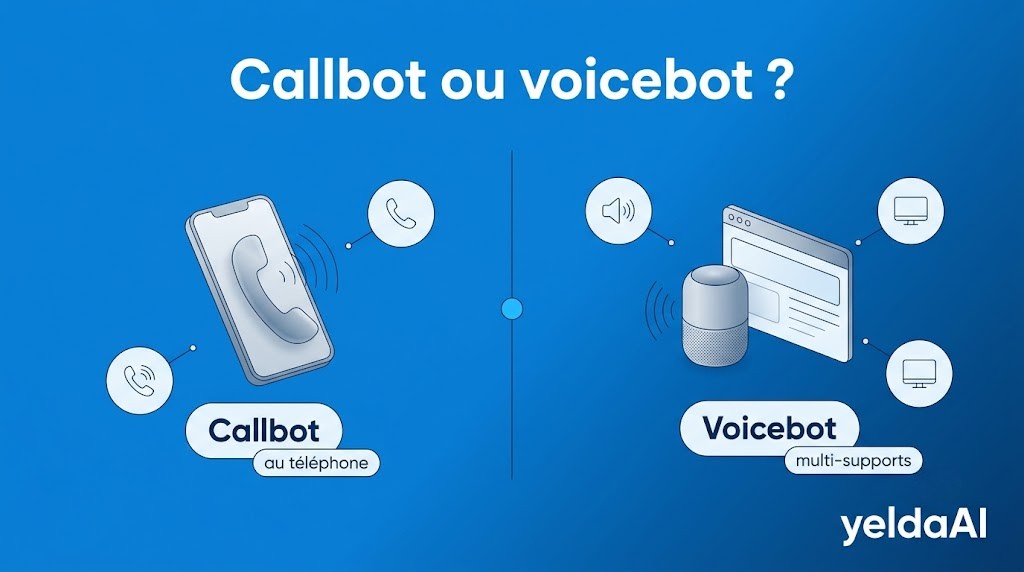
You may have come across the terms voicebot and callbot and still wonder how they differ. In this article, we cover what they have in common, how they differ, their use cases and how to choose between them.
In short: a callbot works only over the phone and aims to relieve call centers, while a voicebot runs on many devices (smart speakers, apps, websites) and is best for quick answers rather than long conversations.
What is a voicebot?
A voicebot, or voice bot, is an intelligent virtual agent that uses voice to interact: it receives spoken requests and answers out loud. It works as follows:
- Receiving the request: the user speaks and the voicebot's microphone picks up the request.
- Transcribing the request: the voicebot converts the audio into text (speech-to-text) with automatic speech recognition (ASR). This is the transcript.
- Understanding the intent: the bot understands the transcript and the user's intent.
- Processing the request: the voicebot handles the request (providing information, performing an action) and builds an answer.
- Generating the answer: the text answer is converted into speech (text-to-speech).
- Delivering the answer: the voicebot replies to the user with a synthetic voice.
Well-known voicebots include Alexa, Siri and Google Home.
What is a callbot?
A callbot works like a voicebot, with one major difference: it is deployed only on the phone. It relies on two main technologies: voice activity detection (VAD), which detects the user's voice, and natural language understanding (NLU), which understands the request so it can be handled.
The YeldaAI callbot is an AI voice agent that answers the phone in natural language.
Let's look in detail at how voicebots and callbots differ.
What are the differences?
Callbots and voicebots are easy to confuse. They have a lot in common, but there are also differences.
How they work
A callbot is in fact a voicebot that uses the phone as its channel. Unlike voicebots such as Alexa, a callbot cannot be called up instantly by voice: the user has to place a call and wait for the callbot to invite them to speak. A callbot can hold a conversation for more than 5 minutes, and users can speak as they would with another person.
A voicebot on a smart speaker or another device, on the other hand, can answer in under 3 seconds. Conversations are usually shorter, as users often have a single question at a time.
Goals
Each bot serves specific goals. In a business context, both bring economic value and improve brand image.
For a voicebot, the goals are to:
- give customers a short, precise answer as quickly as possible;
- make customer service available 24/7 instead of during standard working hours;
- improve the customer experience: smoother exchanges, shorter waits.
For a callbot, the goals are mostly linked to its channel:
- absorb high call volumes in your customer service call center;
- prepare the call for a human agent: collect the information needed to handle the request, qualify the type of request and so on;
- reduce agents' workload and increase your call center's capacity: a large share of requests can be handled autonomously by a bot;
- improve the customer experience by reducing waiting times.
Platforms
This is the most obvious difference: the platform used.
A callbot is deployed only on the phone channel and used in call centers. A voicebot can run on a smart speaker, a smartphone, a computer, or within apps and websites.
In short, a callbot is a specific kind of voicebot, but a voicebot is not necessarily a callbot.
Use cases
A callbot's main use case is supporting call center agents in customer service or after-sales service. Voicebots have more use cases since they run on more platforms:
- voicebots integrated into a contact center;
- WhatsApp voicebots on WhatsApp Business;
- chatbots with voice AI;
- the many voice assistants.
Callbot vs voicebot
| Criteria | Callbot | Voicebot |
|---|---|---|
| Channel and platform | Phone only, within a call center. | Multiple devices: smart speaker, smartphone, computer, app or website. |
| How it starts | The user places a call and waits for the callbot's signal before speaking. | Called up instantly by voice (Alexa, Siri, Google Home). |
| Type of exchange | Ongoing conversation that can exceed 5 minutes, close to a human exchange. | Short exchanges, often one question at a time. |
| Response speed | At the pace of the call, for an in-depth exchange. | Answer in under 3 seconds. |
| Main goal | Absorb call volumes, qualify requests and prepare the handover to an agent. | Give a short, quick answer, available 24/7. |
| Typical use cases | Customer service and after-sales in call centers, appointment booking, complaints. | Contact center, WhatsApp Business, voice AI chatbot, voice assistants. |
| Key technologies | VAD (voice activity detection) and NLU (natural language understanding). | ASR / speech-to-text, intent understanding, then text-to-speech. |
| Implementation cost | Simpler if the interaction happens over the phone. | More versatile, but more complex to design, with costs varying by channels covered. |
What do they have in common?
Since a callbot is a specific kind of voicebot, they share many features:
- Voice interaction: both are designed to interact with users by voice. They understand spoken commands and answer out loud.
- Automation: both are automated solutions that aim to handle requests without direct human intervention.
- Artificial intelligence: both can use AI and natural language processing (NLP) to understand and interpret requests.
- Customer support: they are often used in customer service to answer frequent questions automatically and guide users through specific processes. They can also route customers to the right agent or department based on the information provided.
- Operational efficiency: they automate repetitive tasks so human agents can focus on more complex requests.
- System integration: both can connect to existing systems such as databases and CRM software to access relevant information during conversations.
Callbot or voicebot: which one should you choose?
To make the right choice, ask yourself these questions.
1. What is the goal of the interaction?
- Callbot: if your main channel is the phone and you want to automate incoming calls or relieve your call center, a callbot is likely the better fit.
- Voicebot: if you plan voice interactions across several channels, including online voice apps and connected devices, a voicebot offers a more versatile solution.
2. What kind of interactions?
- Callbot: suited to customer support, appointment booking, complaints and similar use cases.
- Voicebot: can be used for more varied interactions, including voice games and voice commands in apps.
3. What is your budget?
- Callbot: it can be simpler and less expensive to deploy if interactions mainly happen over the phone. If keeping costs to a minimum is your priority, a chatbot may be enough.
- Voicebot: more versatile, but requires more complex design and higher costs depending on the scope, if you want the bot on several channels.
How many calls can your voice agent absorb?
Estimate in one minute the number of automated calls and the savings on your own volumes, with our ROI calculator.