Conversational agents for city halls: 7 key benefits
Discover how conversational agents are modernizing municipal services, simplifying administrative procedures, and strengthening relationships with citizens.


6 out of 10 French people are dissatisfied with the quality of public services (61%), primarily citing excessively long processing times and overly complex procedures (Opinion Way). Faced with this challenge, conversational agents (chatbots, voicebots, and AI callbots) are emerging as a leading technological solution.
Indeed, their ability to answer questions instantly, simplify access to information and procedures, and automate repetitive tasks helps to free up human agents, who can then focus on the more complex requests from citizens.
At YeldaAI, we specialize in conversational AI for local authorities, and this article will present the 7 concrete benefits we observe in the field.
1. Simplifying access to information and procedures
One of the main advantages of conversational agents for municipalities is their ability to make public information more accessible.
Technically, this is reflected in the following points:
- 24/7 availability and multi-platform accessibility : No more navigating complex or outdated websites. Conversational agents provide instant access to information from any device (chatbot on the website, callbot via phone, interactive kiosk on-site), including essential details like news, events, schedules, or administrative documents.
- Personalized responses : These tools adapt their responses to the profiles and needs of users. For example, a voice AI deployed on a voicebot can automatically detect the spoken language (French, English, Arabic, etc.) and respond in the corresponding language.
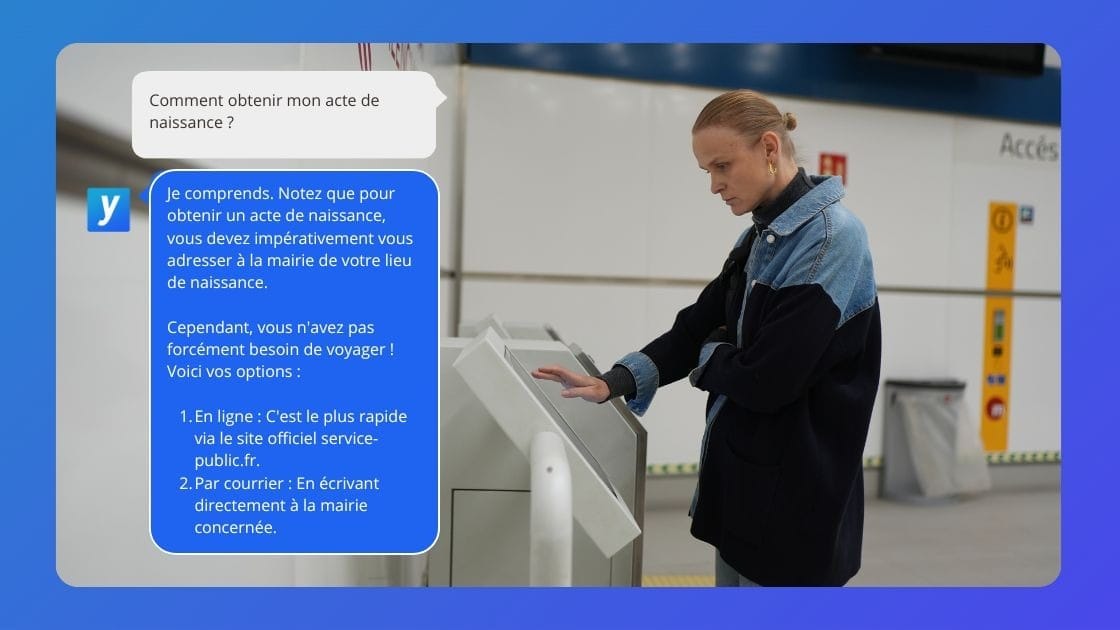
- Geographic adaptation : The agent can tailor its responses based on the user's municipality of residence. For example, a citizen living abroad can be guided through their birth certificate request, obtain the list of required documents, and receive the certificate directly by email.
This ability to adapt to the context and the user is particularly valuable for rural, remote, or mobile populations. In fact, 54% of French citizens, including those living abroad, have already used a chatbot to interact with an administration, according to the 2023 barometer from the Observatoire des Usages Digitaux.
2. Handling all requests for town halls
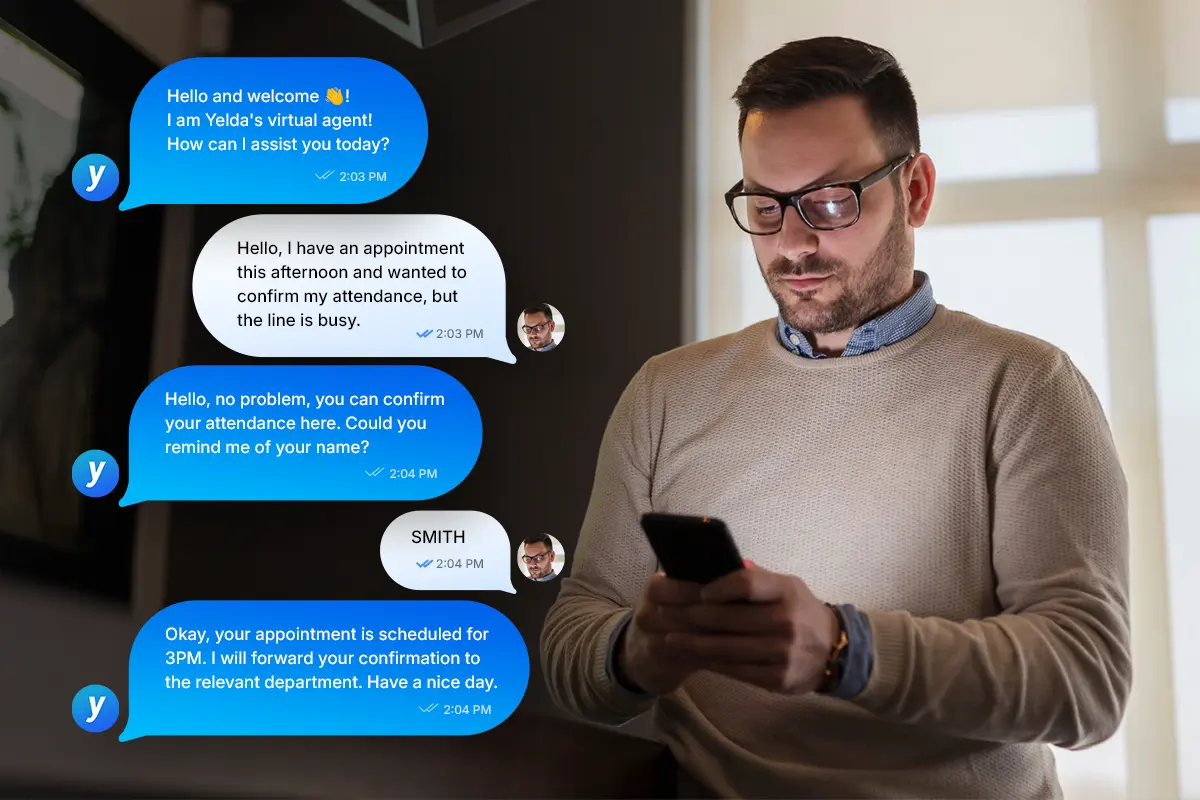
Far from being limited to simple informational questions, conversational agents stand out for their ability to handle all citizen requests addressed to town halls. Acting as true administrative assistants, intelligent virtual agents are capable of interacting autonomously with citizens across a wide range of services, including:
- Appointment scheduling (civil status, urban planning, passports, etc.)
- Requesting and sending official documents
- Paying invoices or fees
- Waste management (collection, bulky items, bin distribution)
- Receiving and tracking citizen complaints
Take the example of waste management. Beyond providing collection schedules, a chatbot can assist users with registering for bulky item pickup, guide them in ordering a specific bin, or alert them in the event of an unexpected schedule change.
Regarding urban planning, these intelligent agents can advise citizens on local regulations, the types of permits required for specific projects, how to prepare applications, average processing times, and even available financial aid.
Estimate the gains of a voice agent based on your own call volumes with our ROI simulator.
3. Reducing the operational burden on staff
Whether it's to reduce the workload of municipal staff or boost their productivity, conversational agents are a real asset for internal efficiency in town halls. Here is how:
- Automating repetitive tasks : these tools can effectively automate your customer service handle a large portion of the workload. They take care of routine complaints, frequently asked questions, simple administrative requests, and more. Human staff are freed from repetitive tasks and can focus on complex missions that require analysis, judgment, and human interaction.
- Optimizing internal efficiency : with conversational agents, it becomes easier to manage task coordination, communication, and activity tracking. Among other things, they allow staff to access the information, documents, and statistics needed to carry out their duties.
- These tools facilitate internal coordination, by centralizing access to documents, statistics, or request histories. Thanks to API integrations, they can communicate with existing business software (e.g., waste management, urban planning, citizen CRM) for precise and immediate access to information and updates.
- Facilitated communication : By integrating contextual communication channels (chat, automated email, collaborative dashboards), conversational agents facilitate the flow of information between colleagues, with line managers, or with institutional partners.
Regarding activity tracking, these intelligent tools allow for the integration of dashboards and automatic alerts that help monitor the progress of projects and procedures. Naturally, this approach is beneficial as it ensures better resource management and increases team responsiveness to citizen requests.
4. Compliance with privacy and accessibility standards
Compliance with privacy and accessibility standards is an absolute priority for city halls. Conversational agents must meet this requirement. At YeldaAI, our voice AI is fully GDPR compliant. Therefore, ensure that your provider collects only the necessary data, ensures transparency in processing and respect for individual rights, and hosts data within the EU.
Another positive aspect is that conversational agents like callbots are designed to be accessible to everyone, regardless of the citizen's age or any potential disability. The interfaces are typically available in both text and voice formats and are compatible with RGAA requirements.
Finally, in terms of cybersecurity, these tools incorporate protection protocols such as an authentication step, encryption of exchanges, traffic monitoring, WAFs, and permission management to prevent risks of leaks, hacking, or data misuse.
5. Strengthening proximity and user relations

Conversational agents contribute directly to improving user relations. Simple requests are handled instantly, with no wait time, and information about procedures is easily accessible and explained in plain language... common user pain points are therefore drastically reduced.
For their part, municipal staff, less burdened by repetitive questions, can dedicate more time to complex requests, which strengthens the quality of the relationship and ensures users are better heard when they truly need it.
Thanks to this smarter allocation of resources, administrative procedures are no longer seen as a burden, but as a smooth and fast process. As a result, citizens are more inclined to use the services offered by their town hall, rather than searching for information from unofficial sources or giving up on certain procedures altogether.
6. A modern and innovative image for the town hall
Integrating conversational agents into municipal services helps strengthen the municipality's innovative image in several ways:
- Tourist attraction : using these tools demonstrates the city hall's commitment to embracing new technologies and better meeting the expectations of its users. This modernity also helps to attract more tourists. For example, integrating a callbot or a chatbot into municipal services can help provide visitors with information on places to visit, available transport options, must-do activities, and more.
- High investment potential : a dynamic municipality focused on innovation is seen as a hub for growth and development, a boon for business.
- Talent detection and promotion : the innovative and modern image of a municipality also attracts more talent looking for a stimulating and collaborative work environment.
7. Ability to analyze and continuously improve services
Beyond all the advantages mentioned above, conversational agents offer a valuable database for city halls. They allow for:
- Collecting various information on user interactions. Once analyzed, this data allows the municipality to gain a better understanding of its citizens' needs and satisfaction levels.
- Evaluating service efficiency by identifying the strengths and weaknesses of each process to make informed decisions.
- Properly assessing the impact of municipal actions and adjusting strategies accordingly.
To illustrate these points, let's take the example of a city hall that uses a chatbot to manage grant applications for citizens. With this tool, it can easily collect information on requests received, grants approved, and rejections. Once analyzed, this data can help identify the most requested types of grants, the most complex eligibility criteria, and opportunities to improve the process itself.
Conclusion
The benefits of conversational agents for city halls and municipalities are clear, and implementing them is not an insurmountable technical challenge. The process is simple and consists of 3 steps:
Define clear and priority use cases : prioritize the most requested or time-consuming services (scheduling appointments, requesting documents, waste management), taking into account the concrete expectations of citizens and the constraints of internal departments.
Customize the agent according to the community's identity : choosing the tone, language, and appearance, as well as adapting content to local realities. A generic chatbot will quickly be perceived as useless.
Establish regular performance monitoring : interaction analysis, resolution rates, reasons for dissatisfaction... Measuring this data is essential to know where to take action and continuously evaluate the impact of your efforts.
The success of such a project goes far beyond the technical aspect. It relies on a clear strategic vision, a cross-departmental management, and a culture of continuous improvement. These are the elements that will transform a simple conversational tool into a true driver for modernizing public services.
How many calls can your voice agent absorb?
Estimate in one minute the number of automated calls and the savings on your own volumes, with our ROI calculator.