What is a voicebot? Definition, benefits, and how it works
Wondering if a voicebot is the right choice for your business? Read our article!

Is your customer service overwhelmed, and you're unable to handle every request or complaint? In a world where efficiency and speed are essential to ensuring customer satisfaction, many call centers are turning to a new solution brought about by the rise of artificial intelligence: the voicebot.
In fact, implementing a voicebot in your call center helps support your agents and increase their productivity by up to 59%, while reducing wait times to just a few seconds (compared to over 12 hours via email or 2 minutes via live chat).
Without further ado, let's discover how this technology can transform your customer service and significantly boost your customer satisfaction.
Article summary
A voicebot interacts with the customer via voice: it transcribes their request, identifies their intent, searches for the necessary information, and then responds in natural language. Unlike a chatbot, which is limited to written exchanges, it relies on speech recognition and synthesis. Solutions like YeldaAI allow customer service teams to automate common requests, reduce wait times, and limit the volume of calls requiring agent intervention.
What is a voicebot?
A voicebot, or voice-based conversational agent, is a robot capable of talking to your customers via voice. Equipped with speech recognition and speech processing technology, the voicebot can hold a verbal conversation with its interlocutor in natural language.
How does a voicebot work?
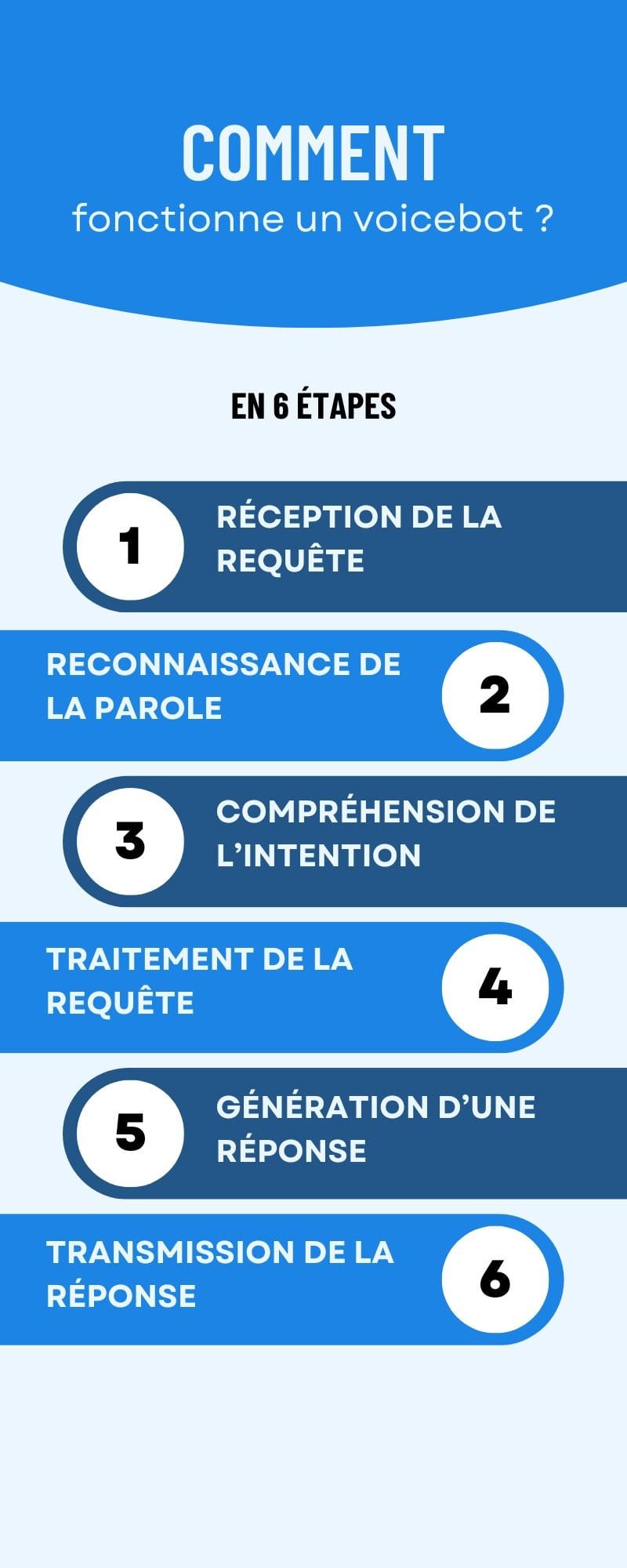
Here is how a voicebot (or a callbot) would, for example, respond to a customer request as a voice assistant for your call center:
Input - receiving the request: your customer makes a voice request. They activate the voicebot, which receives their request.
Automatic Speech Recognition (ASR) : the voicebot converts the audio request into text.
Intent understanding : once the input is transcribed, the voicebot understands the content of the request.
Request processing : the voicebot processes the request (searching for information in a database, executing an action, etc.).
Generating a response : the text response is converted into speech (TTS).
Output - Transmitting the response : the robot formulates an audio response in natural language that is played to the user.
This system has a 95% request processing success rate.
What are the differences between a voicebot and a chatbot?
Many people confuse voicebots and chatbots. However, there are several differences between these two types of conversational agents.
| Voicebot | Chatbot |
|---|---|
| Uses voice commands for input and output. | Uses text for input and output. |
| Requires additional components and technologies: automatic speech recognition (ASR) and text-to-speech (TTS). | Can only be used through the internet or an application. |
| Is often connected to a conversational AI solution that converts spoken input into text. | Does not necessarily use artificial intelligence, except in more advanced chatbots. |
What are the benefits of a voicebot for customer service?
Significantly reduced response time
The numbers speak for themselves: a voicebot (or voice AI agent) takes less than 3 seconds to respond to your customer's request, compared to an average of 4 hours and 35 minutes by email and 1 minute and 9 seconds by phone. In fact, 98% of customers feel that wait times on the phone or via live chat are too long.
You can therefore understand why the impact on customer satisfaction is so significant when integrating intelligent virtual agents into customer service. This is even more essential during high season or peak call periods!
The voicebot is available 24/7
Your customer can access voicebot information at any time. This allows them to submit their request immediately and resolve their issue quickly. In fact, customer satisfaction increases by 8% simply by implementing a voicebot in a call center. Among our clients, we see an average increase of 60% in NPS.
A personalized customer experience
According to the Customer Service Observatory by BVA, in 2022, 69% of French people felt that access to customer service in France was a factor that encouraged them to purchase a product or service. A customer service department with a customizable voicebot can set you apart from your competitors!
With YeldaAI, a voicebot solution, thanks to the many modules available on our platform, you can make your customer experience ultra-personalized to meet the most specific demands of your clientele.
Cost reduction for businesses
Using a callbot (or a voicebot) saves an average of 29% in time, according to a study by Siècle Digital. This time saved by the robot allows you to invest your human resources in high-value-added tasks. This generates a significant reduction in your company's costs. It is estimated that human agent intervention will be reduced by 30% by 2026 thanks to AI technologies and customer service automation.
Estimate the gains of a voice agent based on your own call volumes with our ROI simulator.
Voicebots know when to hand over to humans
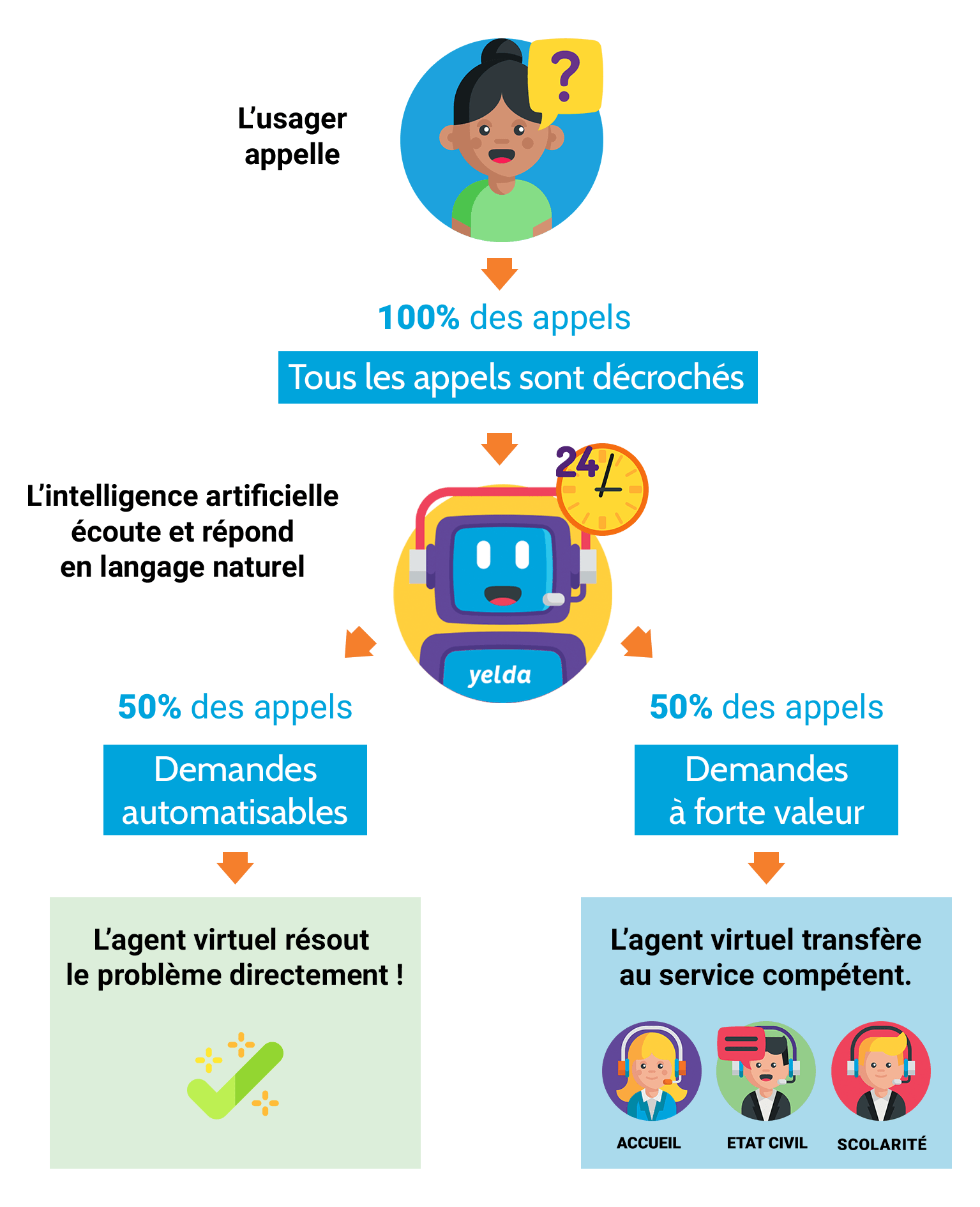
Did you know that 50% of requests can be handled entirely by a voicebot? Depending on your customer's request, the robot is able to identify whether it can answer independently or if it needs to redirect the caller to a human agent. This helps you avoid call overflows to your agents.
What are the common uses for a voicebot?
A voicebot can be used in many ways, and its value lies particularly in its ability to fully customize each of its uses, for example:
Frequently Asked Questions : You can directly import frequently asked questions from your customers, and the voicebot will handle them autonomously, freeing up your agents.
Content : You can broadcast a wide range of audiovisual content using the voicebot, such as podcasts, streaming, or even immersive experiences.
Customer Service : You can delegate routine customer inquiries to the voicebot.
E-commerce Service : The voicebot can connect to e-commerce systems to assist your customers with their purchasing journey or after-sales support (order tracking, return management, etc.).
Human Resources Service : With the voicebot, you can automate the application process. Candidates can apply by voice.
Leads : You can automatically generate quotes, contests, or quizzes to generate leads.
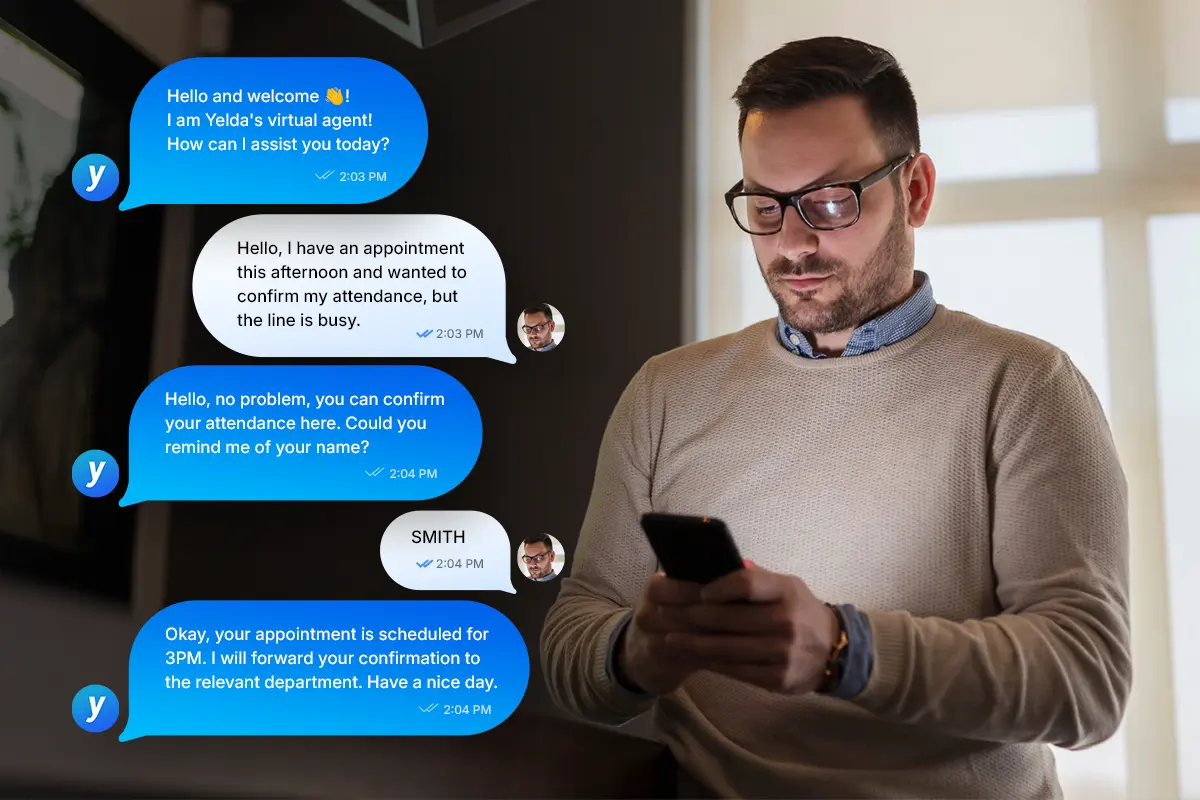
- Appointment Scheduling: The voicebot can book, cancel, or reschedule appointments over the phone.
The use cases for voicebots are nearly endless.
What are the potential drawbacks of a voicebot?
Like any technological tool, a voicebot may have some drawbacks. It is important to consider these, especially if you are choosing between a voicebot and a callbot or a voicebot and a chatbot.
Here are the weaknesses of a voicebot:
You cannot guarantee privacy if your user is in a public space, as they will have to speak their request to the robot, and the voicebot's response will also be delivered via voice command.
If your customer needs active listening and a wide range of information on specific topics, a voicebot won't be enough. The bot will need to redirect the caller to one of your agents.
How do you integrate a voicebot into your company?
To set up a voicebot, the YeldaAI team recommends following these steps:
Company goals and needs : start by clearly defining your company's goals and requirements. This will help you identify common customer queries and priority use cases, allowing you to develop a plan for an effective voicebot implementation.
Selecting the right provider : choose the right voicebot provider. Among the various solutions available, you could opt for our voicebot platform, which stands out for its ease of setup and 100% customizability.
Implementation planning : the planning phase is crucial to ensure that the voicebot implementation meets your long-term needs and stays on schedule.
Configuring the voicebot : using our no-code YeldaAI platform, customize your use-case scenarios with various modules, such as FAQ management, customer support, human resources, marketing, lead management, and more. Plus, YeldaAI integrates with all your existing tools (CRM, ERP, HR tools, etc.).
Voicebot testing and adjustments : the testing phase is essential to ensure your voicebot is operational from the very first call and ready to satisfy your customers.
Launching the voicebot : before deploying the voicebot, be sure to proactively communicate its launch to your entire customer base.
Monitoring metrics and collecting feedback : closely track the bot's results using performance indicators and evaluate user satisfaction.
Continuous improvement and optimization of the voicebot : in line with step 7, make sure to gather customer feedback regarding the voicebot.
How many calls can your voice agent absorb?
Estimate in one minute the number of automated calls and the savings on your own volumes, with our ROI calculator.