What is an interactive voice response (IVR) system and how does it work?
An IVR greets callers, identifies their request and routes them. How it works, the different types, its benefits and how it compares with an AI callbot.

With ever-growing call volumes and less and less patient customers, every company needs to automate its phone interactions intelligently to stay competitive. That is where the interactive voice response system (IVR) plays a central role.
Much more than a simple voice menu, a modern IVR can understand, route and handle a large share of requests through speech recognition or keypad choices. The result: a smoother customer experience, no waiting at reception and internal teams relieved of repetitive, low-value tasks.
Today, call automation goes far beyond the traditional welcome message. It has become a real lever for operational efficiency and customer satisfaction. But how can you make the most of an IVR to transform your customer service?
In short: an IVR answers calls, identifies the customer's request and routes it to the right department. Connected to the CRM, it can also personalize the journey based on the caller. With a voice AI solution such as YeldaAI, it can go further and handle part of the requests automatically, without human intervention.
What is an interactive voice response (IVR) system?
An interactive voice response system (IVR) lets callers interact with an automated phone application using voice commands or keypad input. In other words, it sits between the customer and the company's information system.
It can route incoming calls, share information or carry out simple operations without human intervention. An IVR is made of modules that:
- recognize user input (voice or keypad);
- process the request according to a predefined scenario;
- provide an automated answer.
The answer can be an audio message, a call transfer or data being sent. The term voice server sometimes refers to a simpler version limited to pre-recorded information such as opening hours or an account balance.
An interactive voice response system, on the other hand, includes decision logic. It can recognize the caller's profile, collect data and interact dynamically with other systems such as CRMs and ERPs.
The first IVRs appeared in the 1980s. Banks and public services used them to handle high call volumes. Today, they are at the heart of modern contact centers and play an active role in automating the customer journey.
Typical uses include smart call routing to the right department or agent, customer identification and authentication with a code, customer number or voice biometrics, and automated information such as account balance, order status or opening hours. IVRs can also collect customer data before transferring the call to an advisor.
How does an IVR work?
An IVR relies on an architecture with several technology layers. It needs a connection to the phone network (PSTN or VoIP) to receive and make calls, and an application server that runs the scripts and voice scenarios.
It also includes databases and a CRM that retrieve and store customer information, plus a management interface to configure call flows and analyze performance. Beyond its architecture, an IVR follows a specific processing logic.
1. The interaction process
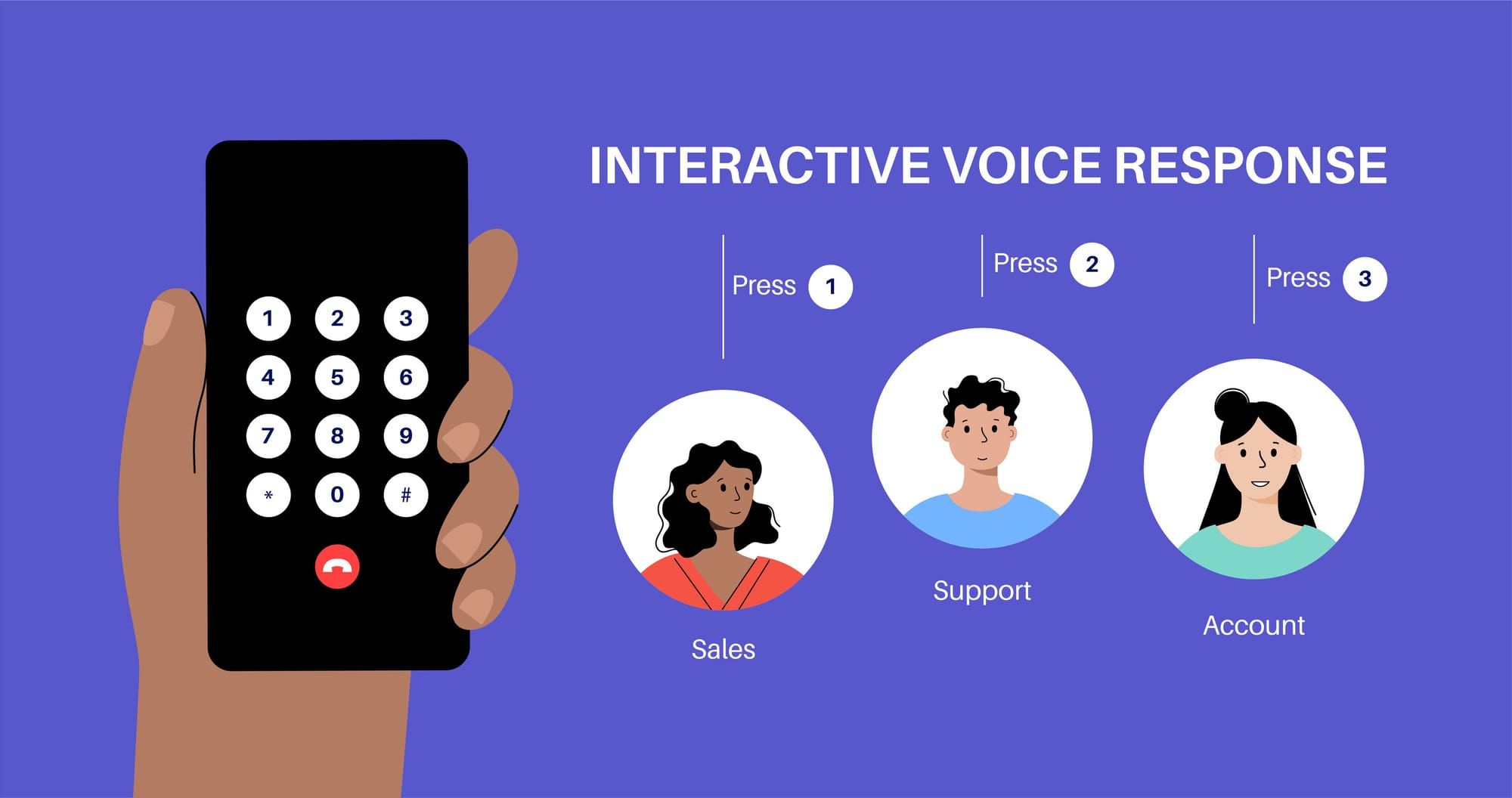
When a call comes in, the system greets the caller with a personalized voice message, then offers a menu, for example: "Press 1 for sales, 2 for technical support."
2. Scenario programming
After interpreting the answer, the IVR sends the call to the matching branch or transfers it to a human agent. This navigation relies on a decision tree, programmed in advance with scripts or graphical interfaces.
3. Output management
Depending on the scenario, the IVR can play dynamic audio messages personalized to the caller's profile, transfer the call to a specific agent or external service, or trigger additional actions such as sending a text message or email, or creating a ticket in the CRM.
4. Logs and security
Every interaction is tracked and recorded to feed performance reports: waiting time, abandonment rate, most-used menus and more. Security matters too: login authentication, voice biometrics and data encryption are common measures.
What are the types of IVR systems?

IVRs come in several categories, which differ in how users interact and in their technical architecture.
DTMF (keypad) IVR
A DTMF IVR relies on detecting the tones generated by phone keys. When the user presses a key, the IVR interprets the signal and routes the call. It is very reliable, simple and low-cost.
However, the experience feels unnatural and menus can be long and tedious. It is generally used for PIN authentication, simple choice menus or phone surveys.
Directed speech recognition IVR
These systems recognize predefined voice commands. The user must say an expected word or phrase, such as "Say 1 for banking, 2 for insurance." This type of IVR is more user-friendly and reduces the number of steps, but interactions are still limited to fixed keywords. It is used in banking, booking services and automated after-sales service.
Natural language IVR
The most advanced generation of voice systems relies on natural language understanding. The system analyzes complete sentences such as: "I'd like to know where my order is."
It offers a smooth experience, contextual understanding and personalized service, using technologies such as AI, natural language processing (NLP) and machine learning. It is used for smart self-service and automated handling of complex requests.
On-premise, cloud and hybrid IVR
The deployment model strongly affects an IVR's cost and flexibility. An on-premise IVR is installed at the company's site and offers full control and stronger security, but requires technical resources and a high upfront investment.
A cloud IVR is hosted remotely and offers fast scaling, simpler maintenance and pay-as-you-go pricing. A hybrid IVR combines both approaches for a good balance of performance, security and flexibility.
What are the benefits of an IVR?
A well-designed IVR brings many strategic benefits. It enables large-scale call automation by handling thousands of interactions at once. It also offers:
- lower costs: fewer staff tied up with repetitive tasks;
- 24/7 availability, with no service interruption;
- a better customer experience: shorter waits and instant answers;
- conversation data: logs help analyze needs and adjust scenarios;
- smooth integration with CRMs, ERPs and other business tools;
- flexibility: scenarios can be changed with graphical interfaces or cloud solutions without interrupting service.
It also brings significant productivity gains, as agents focus on complex requests.
IVR vs AI callbot: which performs better?
An AI callbot is an intelligent voice assistant that automates phone conversations using artificial intelligence, natural language processing (NLP) and machine learning. It understands the meaning of sentences, detects callers' intent and adapts its answers to the context.
A traditional IVR relies on a tree structure. Users navigate through pre-recorded menus. Speech recognition is often limited to a few keywords and scenarios are entirely linear.
This works for simple requests but quickly reaches its limits when the conversation becomes complex or callers phrase their request freely. The experience can become frustrating, especially when customers have to listen to long menus or start the call over to go back.
Unlike an IVR, a callbot solution understands natural language and handles complex dialogues. It does not wait for the caller to choose an option: it analyzes the request directly and steers the conversation accordingly, and it improves with each interaction.
On first call resolution, the AI callbot clearly outperforms the traditional IVR. Because it understands requests as a whole, it resolves many of them without transferring to a human advisor.
Estimate what a voice agent could save on your own call volumes with our ROI calculator.
Limits of the traditional IVR
The IVR is still useful for some tasks, but it is limited by its rigidity. Its tree-based scenarios do not adapt to unexpected phrasing and speech recognition is often limited to keywords. This can create negative experiences, especially when customers must go through several menus before getting a relevant answer.
Limits of AI callbots
Developing AI voice agents and integrating them into the company's information systems requires investment. They also need a training and supervision phase to avoid misunderstandings and keep answers consistent. And even though they keep improving, some complex cases still need a human agent to guarantee the quality of the customer relationship.
When to choose a traditional IVR
The IVR remains relevant for simple, repetitive uses such as balance checks, routing to a department or collecting basic information. It suits companies with moderate call volumes that want to limit automation costs.
When to choose an AI callbot
The AI callbot is ideal when a company handles a high volume of calls or a wide variety of requests. It is particularly suited to customer-intensive sectors (banking, e-commerce, telecoms, healthcare). Its ability to keep improving makes it a powerful way to boost customer service efficiency.
How many calls can your voice agent absorb?
Estimate in one minute the number of automated calls and the savings on your own volumes, with our ROI calculator.