AI-powered call routing: how to set it up?
Discover how artificial intelligence is transforming call routing by improving request understanding and reducing wait times.


Have your customers ever been transferred multiple times without getting an answer, forced to repeat their information, or left waiting too long before being connected to the right person?
These situations have a significant impact on the customer experience.
In fact,83% of customers expect to be connected immediately when contacting a company, 82% want to resolve their issues with the first person they speak to and 96% expect to be able to switch channels without having to repeat their information.
To meet these expectations, AI-powered call routing has emerged as a highly effective solution. By combining natural language processing with predictive algorithms, this technology makes it possible to direct every call to the right person, instantly and seamlessly.
But how do you deploy such a system?
What is call routing?

The call routing refers to the process of automatically directing an incoming phone call to the right department or person. This routing is generally based on several criteria:
the reason for the request ;
agent availability ;
required skills ;
the caller's language.
Furthermore, it should be noted that call routing has a dual purpose: reducing wait times by directing the call to an available agent, as well as ensuring relevant handling by the right department.
Traditionally, this task relies on tools such as the interactive voice response (IVR) or manual transfer performed by a switchboard operator. While widespread, these approaches have limitations in terms of responsiveness, personalization, and efficiency. In other words, faced with complex call volumes and growing expectations for seamless service, the arrival of conversational AI is widely welcomed by many customer service departments.
Why is an AI callbot the best solution for call routing?
Unlike a rigid system like an IVR, a callbot solution solution based on artificial intelligence acts as a virtual interlocutor capable of interpreting natural language and interacting with the caller in real time. This voice AI agent allows calls to be routed more quickly, more accurately, and without friction.
According to Gartner, integrating AI into contact centers can reduce average call handling time by up to 30%, while increasing the First Contact Resolution (FCR) rate. These results are due to the callbot's ability to anticipate, understand, and execute the right action without relying on a pre-formatted decision tree. But to fully grasp the tool's effectiveness, it is worth comparing it to other available options.
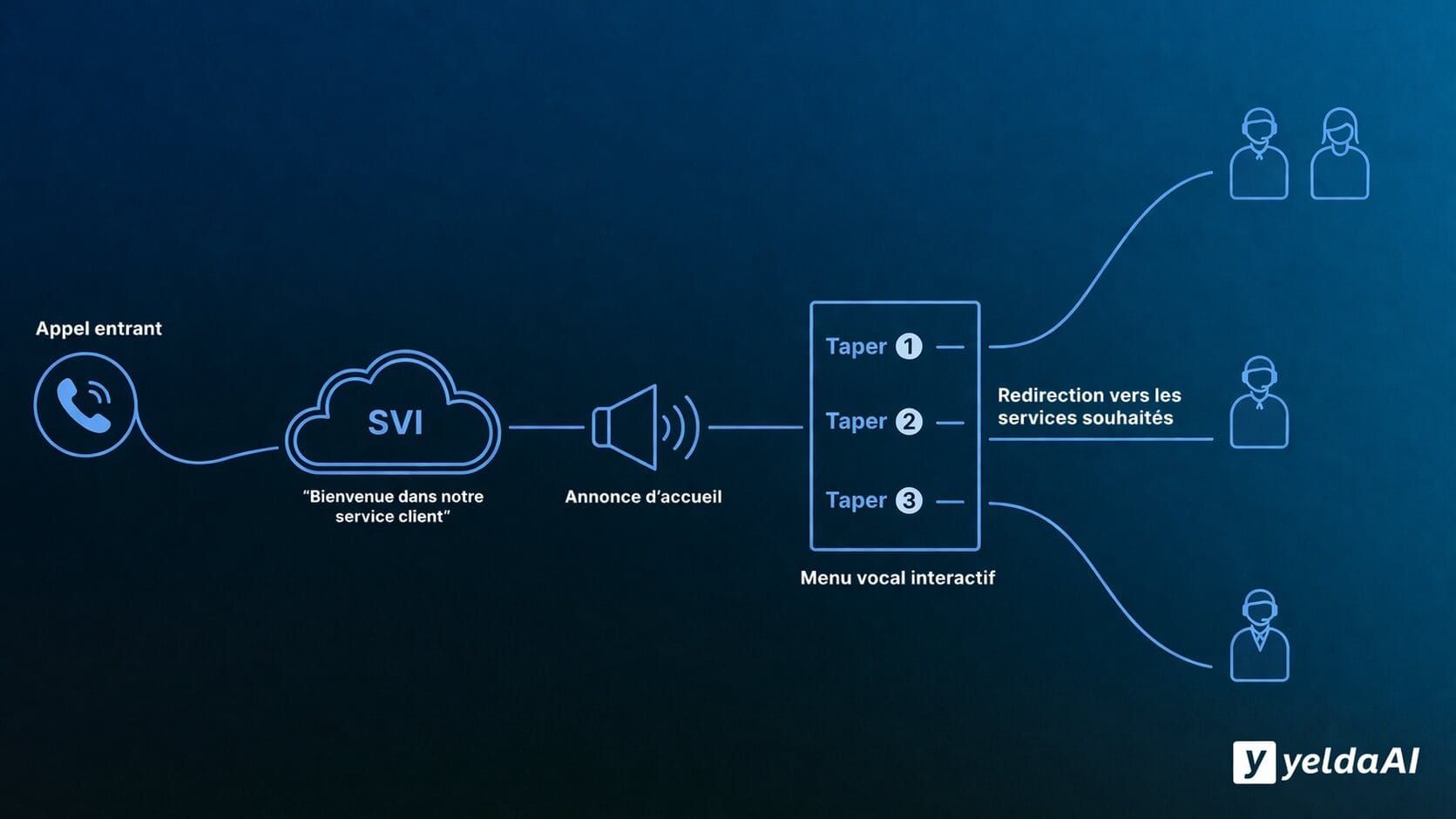
A traditional Interactive Voice Response (IVR) system
The IVR relies on a rigid menu tree, which is often not very user-friendly. The caller must follow a series of choices that can be long, impersonal, and unintuitive.
This type of navigation does not account for the diversity of intents or the complexity of requests. Lacking semantic understanding, the IVR is unable to interpret natural queries like "I want to change my order" or "I want to speak to an English-speaking advisor."
Conversely, an AI callbot understands the intent directly and autonomously redirects the call to the correct department.
A callback
A callback is a deferred return call system that helps smooth out call spikes and improve queue management. However, it creates a break in the customer experience, given that the customer must wait to be called back, with a risk of being unavailable at the time of the return call, potentially leading to lost business opportunities.
In contrast, the callbot handles calls from the very first second, processes simple requests without human intervention, and can intelligently route to an agent when needed.
Traditional human reception
A customer service fully human interaction provides a high level of personal connection, but remains subject to several constraints : limited operating hours, mental workload, variability in service quality, and the agent's energy or mood...
Likewise, it involves significant costs for staffing, scheduling dependencies, and errors caused by fatigue or lack of procedural knowledge.
Conversely, an AI callbot operates 24/7, without interruption, while offering a high level of personalization. It ensures consistent service while freeing up advisors for higher-value tasks.
How does intelligent call routing work?

Intelligent routing relies on a combination of artificial intelligence, natural language processing (NLP), and real-time decision algorithms. This system analyzes the caller's request, understands their intent, and then triggers the most relevant action: transfer, automated response, or contact qualification.
Intent identification using NLP
The Natural Language Processing (NLP) makes it possible to capture the caller's true intent from their statement. For example, a user who says I want to report a damaged package will be automatically routed to customer service, without going through a voice menu. Similarly, the conversational AI will recognize a request of the type I want to cancel my order from this morning as a customer service request regarding a cancellation, rather than just a simple complaint or a product inquiry.
This intelligent understanding is based on precise semantic analysis, powered by AI models trained to recognize various phrasings, synonyms, and even ambiguous expressions.
Intelligent assignment based on multiple criteria
Once the intent is identified, the AI triggers a process of dynamic matching with available resources. Several parameters are taken into account simultaneously:
agent availability;
customer priority level;
request complexity;
interaction history, etc.
This operation relies on scoring algorithms that prioritize the available options to ensure relevant routing on the very first attempt. This is referred to as a "zero-touch" approach, where the first person you speak to is the right one.
➡️ Easily evaluate your return on investment by running a simulation tailored to your project:
Estimate the gains of a voice agent based on your own call volumes with our ROI simulator.
Optimized user experience
Unlike traditional systems, the caller does not have to navigate any menus or press any keys. The interaction unfolds naturally and fluidly, without interruption. However, it is important to understand that the AI does not work alone. It also integrates with the company's internal tools (CRM, ERP, databases), which allows for responses to be personalized based on the caller's profile. It is also capable of improving with every interaction by refining its models based on feedback.
What are the challenges of AI call routing?

While effective, AI-powered call routing faces certain technical and organizational challenges. Implementing such a system requires rigorous planning and tailored support.
Technical obstacles
AI can struggle to understand vague or ambiguous phrasing. The performance of NLP therefore depends largely on the quality of the training data provided. Furthermore, certain complex cases, particularly those involving emotions or legal matters, remain difficult to interpret without human intervention.
Integration with existing systems
Connecting an voice AI to existing business environments (CRM, ERP, corporate telephony) can be a significant engineering challenge. Since every company has its own specific needs, the configuration must be finely tuned. This can involve implementation delays and rigorous testing phases.
Ethical and compliance issues
Any AI-based solution must comply with personal data protection regulations (GDPR). Callers must be informed of the use of artificial intelligence, and their consent must be obtained transparently.
Finally, some users or employees may be reluctant to embrace automation for fear of dehumanization or loss of control. Therefore, it is advisable to integrate a hybrid system with human oversight for sensitive cases.
How does YeldaAI's AI ensure natural language call transfers?
The technology developed by YeldaAI is based on advanced conversational artificial intelligence, designed specifically to understand and respond to sentences phrased in everyday language. Thanks to its system of intelligent transfer It accurately identifies intent, evaluates customer context in real time, and then routes the call to the right person without menus or errors.
Every interaction is optimized to provide an experience similar to that of a human agent and improve overall satisfaction. For example, a call containing « I am no longer receiving your emails » is automatically redirected to the technical department, with a pre-alert regarding potential server issues.
How many calls can your voice agent absorb?
Estimate in one minute the number of automated calls and the savings on your own volumes, with our ROI calculator.