Inbound phone calls: How to manage them perfectly?
Learn how to improve your customer service: strategies for effectively managing incoming phone calls and ensuring customer satisfaction.


More than just a contact channel, managing incoming phone calls plays a central role in customer satisfaction, loyalty, and brand image.
Your customers and prospects demand immediate, 24/7 availability and clear, personalized answers... The slightest friction can quickly lead to frustration and dissatisfaction. And when the phone experience falls short, the risk is clear: losing a customer to the competition.
So, how can you meet these challenges without ballooning your costs or complicating your operations?
In this article, YeldaAI we share the best practices and concrete solutions to implement seamless, high-performance, and wait-free incoming call management, while keeping a controlled budget.
1. Managing wait times
90% of consumers consider response speed essential to their satisfaction. A customer who wants to ask a question, learn more about a service, or get a quote will feel frustrated if they have to wait a long time for their call to be answered.
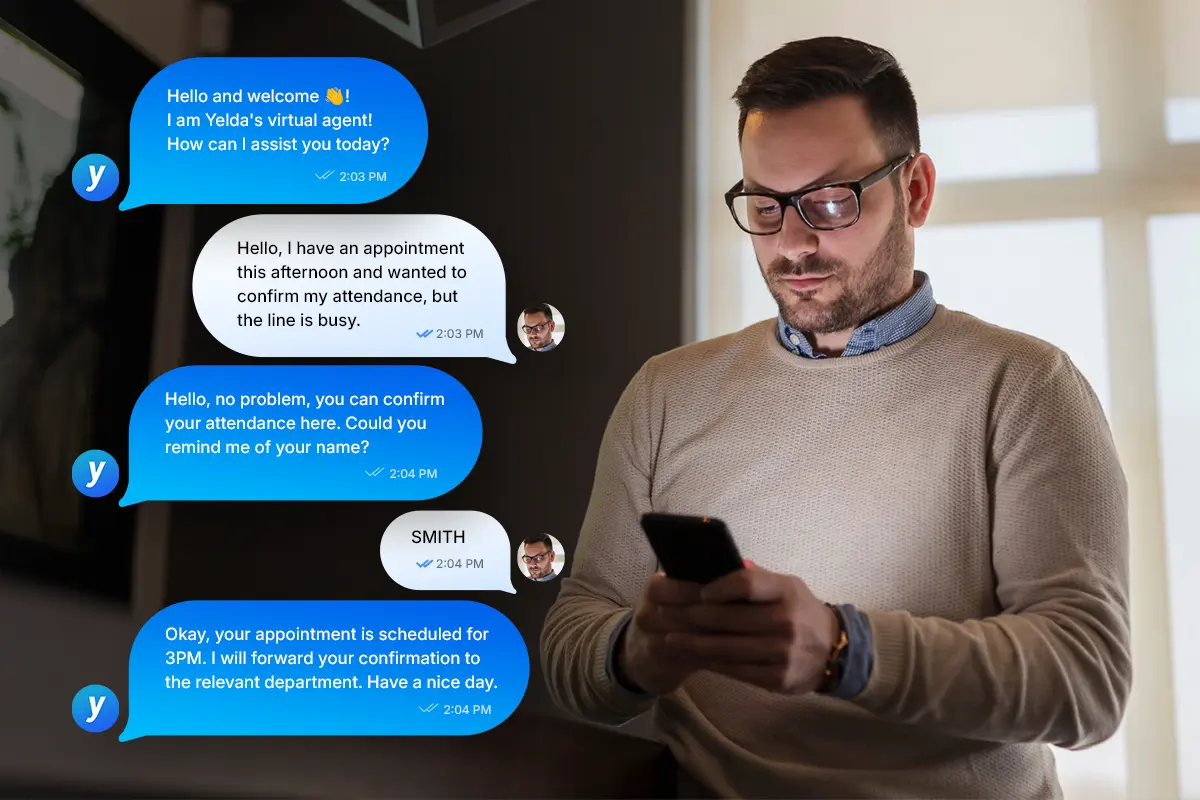
Currently, the best solution for offering answer rate 100% availability, 24/7, with zero wait time, is to implement an AI callbot : a virtual phone agent that answers calls, understands your customers' requests, responds like a human, handles 50% of calls autonomously, and redirects complex calls to a human advisor.
If there is a wait, it is recommended to inform the customer about the delay. A phrase like "The estimated wait time is approximately three minutes." allows the customer to plan accordingly.
Additionally, it is important to offer the customer alternative options. This may include the possibility of a callback or using other service channels. Regardless of the situation, the ideal approach is to be transparent in your explanation.
Script examples:
- "We are currently experiencing a high volume of calls; if you prefer, we can call you back later."
- "Thank you for your patience. In the meantime, you can contact us via our online chat."

2. A welcoming phone greeting
First impressions matter immensely. Therefore, a warm and personalized greeting is the first step toward a successful customer relationship. For example, a simple and courteous phrase like "Hello Mr. Y, welcome to [Company], I'm Morgan, how can I help you today?" invites the customer into the conversation.
The goal of the telephone welcome is to:
- Identify the caller: Last name, first name, email, customer number, case reference, etc.
- Understand the reason for the call: Order tracking, complaints, scheduling an appointment... This point will be discussed next.
PS: Our AI callbot solution can handle customer authentication, identify their needs, and either resolve the issue or transfer the request to the appropriate department.
3. Attentive needs assessment
Clearly understanding customer needs is essential for providing relevant, personalized responses in a timely manner. At YeldaAI, we recommend asking an open-ended question, such as: " Could you please describe your issue in detail?".
However, to ensure better support and reassure the customer that their request is understood, it is recommended to paraphrase their needs. For example: "If I understand correctly, you are experiencing an issue with...".
This approach allows you to confirm every detail of the customer's request before moving to the next step. This helps avoid misunderstandings and ensures an appropriate resolution.
4. Process the request as quickly as possible
Once the request is understood, the next challenge begins: transferring the call to the appropriate department and ensuring prompt handling. To do this:
- Notify the caller that the call will be transferred: Mr. Y, I am going to transfer your call to the sales department. One of my colleagues will assist you in a few seconds. Does that work for you?
- T ransmit all information already collected during the initial greeting to the recipient department automatically : Reason for the call, customer identity, etc. This information is injected in real-time into business tools (CRM, ticketing) to avoid any redundancy. The agent can then handle the request immediately, without making the customer repeat themselves or extending the call duration.
Good to know: callbots or IVRs also perform all these tasks automatically!
Estimate the gains of a voice agent based on your own call volumes with our ROI simulator.
5. Customer solution validation
To confirm the issue has been resolved, invite the customer to express their satisfaction with clear questions such as:
- "Did I resolve your issue to your satisfaction?"
- "Did I address your concern correctly?"
- "Is there anything else I can help you with?"
Obtaining clear and unequivocal confirmation ensures that the proposed solution is exactly what the customer expected. It also helps prevent any future misunderstandings. However, to reinforce this gesture of goodwill, it is wise to leave the door open for future interactions. Phrases such as "Please don't hesitate to reach out again if needed." demonstrate an ongoing commitment to the customer.
6. Closing the call
The goal at the end of a customer phone call is to leave a positive impression of the company. It is therefore good practice to end the conversation on a positive note. To do this, it is essential to thank the customer while personalizing the farewell. For example, you can end the call using phrases like:

- "Thank you for calling [Company]. Have a great day!"
- "Thank you for contacting us, and we look forward to speaking with you again soon!"
- "Thank you for your call. I have noted your feedback to help us improve our services."
It is important to note that the end of the call should not be a final goodbye, but rather an invitation to future interactions. Thus, while a warm conclusion is useful for strengthening the relationship, it is it is best not to be the first to hang up.
Taking call management further
Beyond the fundamentals covered above, there are many ways to optimize incoming call management and provide a better customer experience.
VoIP telephony solutions
You have several options available to automate your customer service :
- Integrating callbots : Callbots, which are AI-powered voice agents, ensure 24/7 availability and handle a high volume of calls simultaneously, significantly reducing wait times. By understanding natural language, they answer simple queries and transfer complex cases to human agents, improving customer satisfaction while keeping costs under control.
- IVR systems : an automated phone system that guides callers through voice menus or keypad options to identify their needs and route them to the right department. It helps filter and qualify calls upfront while reducing the workload on human teams.
- Queue management: technology that organizes incoming calls when no agent is immediately available. It allows you to prioritize calls, announce wait times, offer an automatic callback, and ensure an equitable and efficient distribution of calls among teams.
Leveraging CRM data during calls
Your CRM allows you to centralize all customer information and maintain a complete history of their interactions with your brand. In a context where customer service is omnichannel, this centralization is essential to ensure a unified view of the customer. By having immediate access to preferences, history, and the context of previous exchanges, the advisor can personalize their response, resolve the request faster, and provide a consistent experience, regardless of the channel used.
Following up on requests
To ensure continuous customer satisfaction, it is essential to follow up on requests after the call has ended. This can be done by calling the customer to ensure they are satisfied with the proposed solution, sending them a satisfaction survey, or sending a confirmation email. These methods offer the advantage of gathering valuable feedback and adjusting services accordingly, thereby demonstrating the company's commitment to its customers.
Taking incoming call management further
- Staying human Empathy is essential. Rely on clear scripts to ensure consistency, but give advisors the freedom to adapt their tone based on the customer's context, emotions, and urgency.
- Focus on voice: An agent's demeanor is immediately audible: intonation, pace, articulation, and even smiling while on the phone make all the difference. The voice is the primary vehicle for trust and professionalism.
- Leverage customer feedback: Analyze post-call feedback, verbatims and recordings to identify friction points and continuously improve the phone experience.
- Reduce customer effort: Avoid unnecessary repetition: customers should never have to provide the same information twice. Context transfer is key to a seamless experience.
- Measure inbound call performance: Without KPI, there is no optimization: wait times, answer rates, transfer rates, average handling time, and first-call resolution.
How many calls can your voice agent absorb?
Estimate in one minute the number of automated calls and the savings on your own volumes, with our ROI calculator.