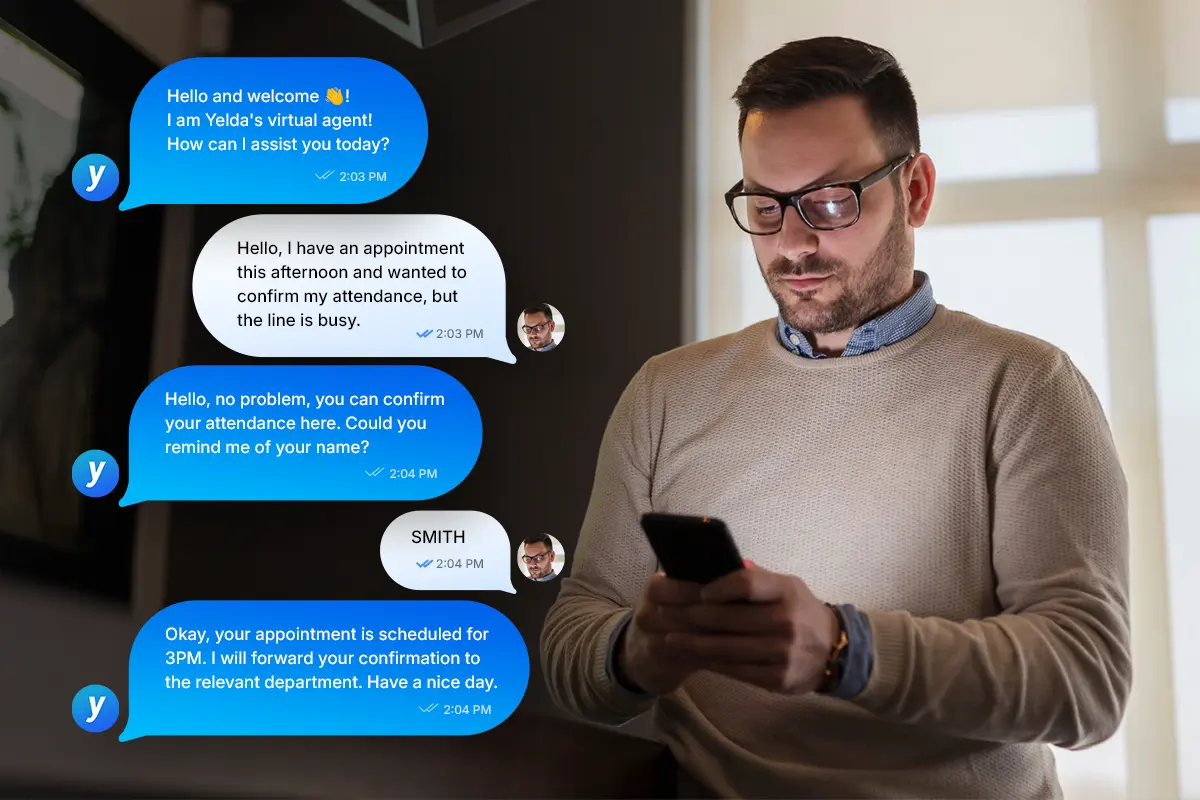
10 examples of companies using AI in customer service
BNP Paribas, Fnac, Prixtel, H&M… 10 real-world examples of companies using AI to improve their customer service, and the results they’ve achieved.


Artificial intelligence is currently redefining customer service standards: 24/7 availability, instant responses, and large-scale personalization.
By automating responses, personalizing interactions, and improving overall efficiency, AI is transforming the way companies take care of their customers. All while reducing customer service operational costs by approximately 30%.
But this revolution isn't just theoretical. Major brands across all sectors (finance, hospitality, insurance, and even the public sector) are already deploying concrete AI solutions in their customer service departments.
Let’s explore ten inspiring examples of AI applications in customer service, each one a genuine success story.
1. BNP Paribas: Simplifying requests with AI
The French multinational bank BNP Paribas faced the challenge of repetitive requests from marketing teams, which hindered their ability to focus on unique, high-impact tasks.

The French multinational bank BNP Paribas solved this problem by partnering with YeldaAI to create a virtual assistant capable of automating responses to frequently asked questions. This NLP-based conversational assistant is connected to internal document databases via secure APIs, using semantic matching algorithms to quickly retrieve requested branding documentation.
The assistant can retrieve specific files, guidelines, and promotional resources from the information system, while ensuring that this content reflects the latest essential instructions for teams working in different regions.
The result? 80% of requests have been automated allowing the brand to focus on more strategic, high-value initiatives. By reducing manual workload, response times have improved and productivity has increased.
Estimate the gains of a voice agent based on your own call volumes with our ROI simulator.
2. Fnac: Voice E-commerce on Google Home
The retail chain Fnac wanted to make shopping more convenient without investing in the development of a custom app. However, it still wanted to allow customers to place orders via voice commands using Google Home.
The solution was to deploy e-commerce and customer service modules integrated with Fnac's APIs, allowing the company to quickly launch a voice app to help customers search for products and make purchases via Google Assistant and Google Home.
The voice assistant has generated millions of interactions. Fnac has thus improved customer engagement and boosted online sales. This voice technology has allowed Fnac to remain at the forefront of AI-driven customer service in Europe.
Fnac has made shopping more convenient while enhancing the user experience with product recommendations, searches, and customer service via voice commands. Voice search and purchasing options have opened up new customer service channels.
3. Steel Shopping Center: Interactive voice assistant for visitor inquiries
Upon its opening, the Steel shopping center in France anticipated a high volume of visitor questions and sought a voice solution capable of handling requests in real time.
With the help of YeldaAI, Steel implemented "Ponpon," a conversational assistant available on the center's website and on interactive kiosks throughout the mall. Ponpon provides immediate answers to frequently asked questions.
By combining the physical shopping experience with digital convenience, Ponpon's physical presence on kiosks allows for more tangible and accessible use.
Ponpon has handled more than 4,500 conversations from its very first month, with a 90% comprehension rate, reducing the burden on on-site teams while increasing overall visitor satisfaction.
4. Prixtel: Voice support for an entirely digital customer service model
Prixtel, an entirely digital telecommunications company , needed to provide high-quality customer support on its mobile site without relying on live agents.

By using YeldaAI’s "FAQ" and "Customer Service" modules, Prixtel was able to automatically handle 80% of written and spoken customer requests from customers.
Thanks to voice recognition, the assistant provides information on mobile plan pricing, usage, and account management, all while maintaining a customer-centric approach.
As an entirely digital company, Prixtel would have otherwise struggled to offer a personalized touch while maintaining the efficiency of AI-driven automation.
Prixtel’s voice assistant achieved an 85% problem resolution rate, providing efficient support without the need for human agents. Results include increased customer satisfaction and a strengthened brand reputation, all while innovating in digital support.
This AI solution could evolve to further reduce reliance on human agents by offering more detailed account management or AI-based solutions, such as mobile data usage forecasting.
5. FrieslandCampina: Voice and text assistant for customer engagement on WhatsApp
FrieslandCampina, a dairy cooperative, wanted to improve its customer relationship management in Asia through customer support and brand engagement on WhatsApp.
With YeldaAI, they deployed a multilingual assistant (Chinese and English) capable of answering product questions and providing general customer support.
As part of a broader customer relationship strategy, the AI system provides nutritional information, answers product inquiries, and directly guides customers on product usage via WhatsApp.
The assistant has helped improve FrieslandCampina's customer relationship management capabilities in Asia and build a more personal connection with customers through a widely used messaging platform.
This solution currently uses only WhatsApp, but FrieslandCampina could expand its AI solutions to other messaging platforms and support channels, thereby leveraging AI in a omnichannel customer service for optimal results.
6. H&M: AI-powered chatbot to assist customer service
Multinational clothing giant H&M turned to AI to handle high volumes of customer service inquiries, particularly during peak shopping periods.

The solution consisted of an AI-powered chatbot capable of handling inquiries regarding orders, product information, and availability. Thanks to machine learning, this chatbot could provide personalized responses based on the customer's history and preferences.
These recommendations can include outfit suggestions or items similar to those viewed by other online customers. The chatbot can also notify customers when items are back in stock or when new products that might interest them become available.
H&M has reduced its response times by 70%. The chatbot not only answered frequently asked questions but also offered fashion advice.
7. Delta Airlines: Automated customer support for flight assistance
Delta Airlines needed to streamline support for frequent customer inquiries, particularly those related to flight bookings, baggage tracking, and other travel services.
The solution was a chatbot capable of assisting passengers with bookings, travel updates, and flight check-ins. Powered by AI, this bot retrieves relevant data, offers personalized assistance, and improves service for travelers.
In addition to flight information, it also helps with inquiries related to loyalty accounts and travel restrictions, thus providing a comprehensive customer service solution.
Thanks to the integration of voice commands, Delta customers can benefit from hands-free customer support, which is particularly useful for passengers on the go or busy business travelers.
The results showed faster service, particularly during peak periods, reduced wait times and increased customer satisfaction. Delta was able to handle a much higher volume of requests than would have been possible with human agents alone.
The most significant effects were seen at airport service counters, where queues became shorter and customer feedback was more positive.
8. KLM Royal Dutch Airlines: Integrating social media for real-time customer support
Another airline, KLM, sought to improve its customer service, but this time by focusing on social media, where many customers expect real-time responses.

KLM used a specialized AI tool integrated into social media platforms like Twitter/X and Facebook. Customers can use it to manage common requests such as booking changes, flight schedules, and baggage policies.
A remarkable example of using AI to provide personalized assistance via social media, KLM's chatbot answers questions by providing real-time information on flight tracking, boarding processes, and even passport requirements. Multilingual, this chatbot can assist international travelers across different platforms.
KLM's chatbot processes thousands of messages every week, thereby reducing response times and improving customer satisfaction through efficient interaction on social media.
9. Uber: Proactive AI-powered support for better customer satisfaction
Uber, the ride-sharing platform, had to manage a high volume of customer service requests, ranging from trip cancellations to billing disputes.
Uber adopted AI-powered solutions to identify potential issues and resolve them automatically and proactively. The system detects patterns in trip data and offers solutions even before customers file complaints.
For example, it can contact users facing pickup delays and offer solutions, such as refunds if necessary. By predicting common issues using past trip data, the system reinforces the sense of value and support for passengers.
The complaint processing times have been significantly reduced, and the customer experience has improved. Anticipating problems before they occur saves customers from having to follow up.
10. Octopus Energy: Managing emails and requests with AI
Octopus Energy sought to improve customer satisfaction by optimizing its email support, specifically by reducing response times and increasing accuracy.
The AI assistant generates detailed responses to customer inquiries while automatically categorizing and prioritizing emails so that human agents can focus on more complex issues.
In addition to ranking requests by priority (urgent, medium, low), the tool retrieves past interactions to provide personalized responses, preventing customers from having to repeat their information.
This solution has led to an 18% increase in customer satisfaction, as requests are handled faster and more accurately, leading to a more satisfied customer base.
As we can see, AI acts as a catalyst for transformation in customer service, without replacing human agents.
It handles repetitive tasks, offers personalized assistance, and anticipates customer issues, allowing customer service agents to focus on the areas where they provide the most value.
As these tools continue to evolve, their integration into other existing systems, beyond customer data and customer service, promises to raise customer service standards even further.
The human element remains essential, however, as AI is used as a tool that enables human agents to excel in their work.
Companies are already using AI in powerful ways in customer service, but the future undoubtedly holds even more innovations!
How many calls can your voice agent absorb?
Estimate in one minute the number of automated calls and the savings on your own volumes, with our ROI calculator.