What is a B2B call center?
Want to know what a B2B call center is? Read our article!


Call centers are found in all types of organizations, whether in B2C or B2B. By centralizing cold calling, customer support, and lead nurturing activities, companies can efficiently manage high volumes of inbound and outbound requests.
A B2B call center thus becomes a strategic asset, helping to optimize communication and improve customer satisfaction.
Why have a B2B call center?
There are many reasons to set up a B2B call center in your company. Without one, you lack the means to track your prospecting comprehensively and in detail, and you risk losing efficiency in your sales volume. Let's take a closer look at the major benefits of integrating a call center into your ecosystem.
Centralizing your cold calling
Prospecting requires time and a rigorous process. Centralizing your prospecting in a B2B call center allows for precise CRM (Customer Relationship Management) tracking, effective follow-ups, and an increased volume of calls.
Your numerous human agents or intelligent virtual agents are indeed capable of managing many outbound calls simultaneously without compromising the quality of the interaction. Combining quantity and quality is the key to successful cold calling.
Qualifying your prospects
Making a large number of phone calls is not enough to succeed in prospecting. In addition to tracking, it is important to qualify your prospects to identify which persona the agents are addressing. You must adapt your pitch to the prospect's profile to optimize the customer journey.
Setting up a telephone switchboard will have the advantage, during this prospect qualification phase, of allowing for better tracking and the selection of qualified agents to:
Segment your customer base.
Achieve a good return on investment.
Acquire a higher sales volume.
Optimizing lead nurturing
Lead nurturing is a strategy that involves maintaining contact with a prospect throughout their purchasing process with the goal of moving them forward in their sales journey.
Cold calling via a call center makes lead nurturing easier to manage. Every agent, whether human or virtual, can track their prospect throughout the entire sales journey and build a relationship of trust between the brand and the future client. It is an effective way to optimize lead nurturing compared to email follow-ups, for example. A tip from the YeldaAI team: use the verbatim feedback from your customers to strengthen the customer relations with your prospect.
Tracking follow-ups
80% of sales require five follow-ups after the initial meeting. A B2B call center is a major asset for carrying out these follow-ups effectively. By centralizing communications, companies can ensure that every prospect is contacted multiple times, thereby increasing the chances of conversion.
Providing customer support
Prospecting is one thing, but after-sales service is just as important in CRM (Customer Relationship Management). A B2B call center is capable of providing customer support, using a significant database derived from the initial customer journey.
How can you deliver a great customer experience with a B2B call center?
Deploying a B2B call center requires preparation. You need:
premises,
trained agents,
reliable data,
software that is compatible with one another.
Training your telemarketers
Customer experience is primarily about relationships. The interaction between a salesperson or a telemarketer and a prospect relies as much on non-verbal communication as it does on the actual words used.
Training your telemarketers is useful for having an optimized CRM. By training your agents, you ensure:
A fluid and effective exchange with the prospect.
A good understanding of their request and their needs.
A precise and helpful response to address their issue.
Verify technological integration
Your B2B call center must be able to integrate with your current digital ecosystem: databases, CRM, software, and on-site systems. To ensure a smooth and operational integration, we recommend hiring a professional. They will be able to assess a call center's compatibility with your existing technology, engage expert providers to carry out the deployment, and support you until the system is fully functional.
Analyze KPIs
Analyzing data and KPIs (Key Performance Indicators) is essential for ensuring a high-quality customer experience in your call center. Closely monitoring these metrics allows you to identify call center weaknesses and improve them continuously as soon as a problem is identified.
As we have seen in this article, setting up a B2B call center offers many advantages. However, if the call center is poorly managed, it can negatively impact your customer experience. This is why it is important to track and analyze metrics that measure customer satisfaction, such as the following:
Customer Satisfaction Score : This measures the level of customer satisfaction following an interaction with an agent, using a satisfaction rating at the end of the call, such as smileys or a scale of 1 to 10.
Customer Effort Score (CES) : This measures the effort a customer must exert to get their request resolved, providing a clear idea of the prospect's level of frustration or ease. It can take the form of a post-call survey asking the caller to rate the level of difficulty or ease encountered on a scale of 1 to 7.
Net Promoter Score (NPS) : This evaluates the likelihood of a customer recommending the company. It is a way to determine if the B2B call center is creating value and trust for callers. Ask customers to rate on a scale of 0 to 10 whether they would recommend the product or service to a friend or colleague. The NPS is calculated by subtracting the percentage of detractors (scores of 0 to 6) from the percentage of promoters (scores of 7 to 10).
First Contact Resolution Rate : This rate indicates the percentage of issues resolved during the first interaction.
Response Rate within 20 Seconds : This indicator measures the time a customer waits before being connected to an agent to determine the call center's responsiveness.
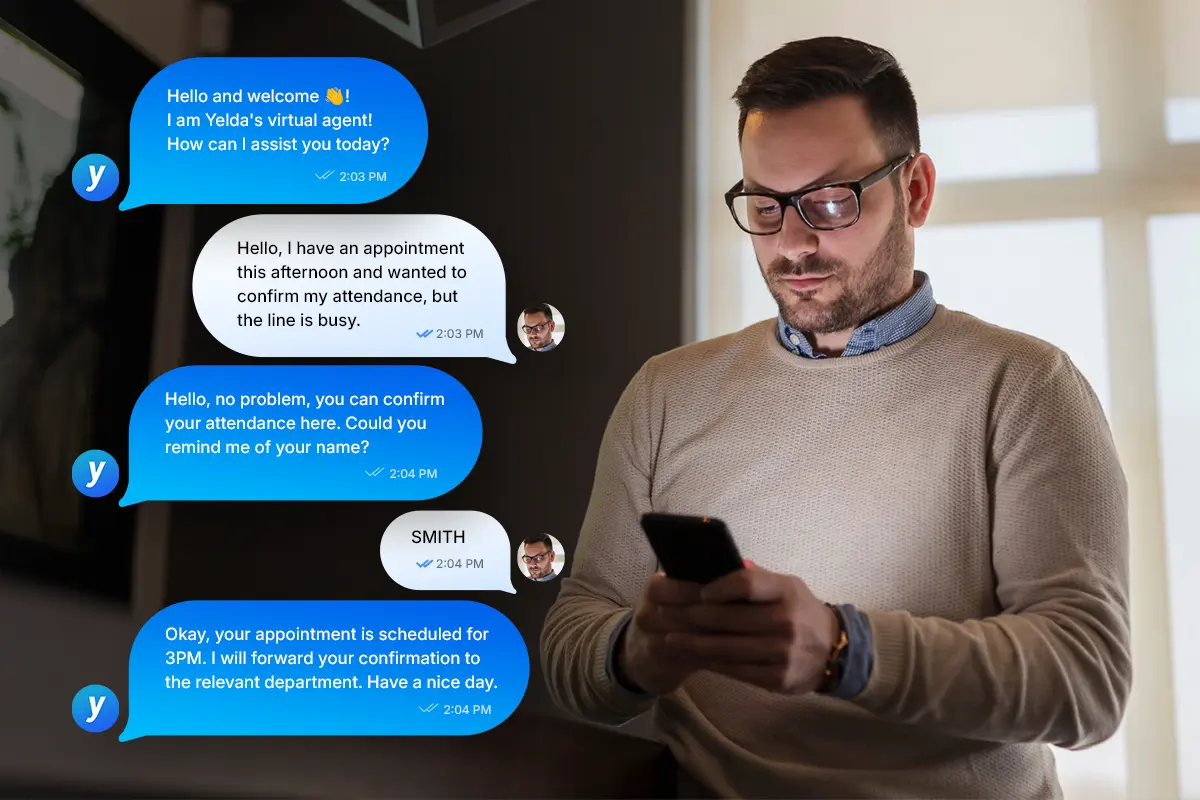
Asynchronous Processing Time : This measures the time taken to process a request via channels other than the phone, such as email, a chatbot, or a voicebot or a callbot. Calculate the average time elapsed between receiving the request and sending the response.
Ensure omnichannel support
Omnichannel support refers to the use of multiple simultaneous channels to contact a brand. For example, a customer might view a product page on their phone while discussing their request over the phone with customer service. This practice meets the expectations of today's hyper-connected consumers.
When deploying a call center in your company, it is essential to offer an omnichannel experience to your prospects and customers to ensure a high-quality customer experience.
How many calls can your voice agent absorb?
Estimate in one minute the number of automated calls and the savings on your own volumes, with our ROI calculator.