
What is a call center?
Discover in detail how call centers work, their diversity, their missions, and the impact of artificial intelligence on the sector.


In France alone, there are more than 3,000 call centers and nearly 30,000 in Europe.
The call centers, contact centers, or call centers allow for the management of customer relations, primarily by phone, but also through multichannel platforms (messaging, email, RSS...). There are outbound call centers, mainly used for prospecting and sales, and inbound call centers, used primarily for customer service.
But while these centers greatly influence customer satisfaction and loyalty, how do they actually work? What are the different types? What factors determine their success?
Article summary
A call center is a centralized contact point where customer requests are received and processed, whether by phone or other channels. It serves support, loyalty, and sales functions, but its performance depends on wait times and routing quality. Automating a portion of calls with callbots can reduce costs by up to 30%.
What is a call center?
A call center is identified as a platform serving as a centralized contact point between a company and its customers. In other words, it is the place where customer requests are received, processed, and resolved. Whether it is an in-house or outsourced call center, these services constitute a strategic hub for companies where every interaction is an opportunity to build long-term customer loyalty.
Although the functions of a call center are diverse, they revolve around three major pillars:
- Customer support : answering customer questions, providing information on products and services, resolving technical issues…
- Customer relations : collecting feedback, conducting satisfaction surveys, building customer loyalty…
- Sales and marketing : generating qualified leads, offering personalized deals, closing sales…
However, it must be recognized that behind the success of a call center relies on a robust infrastructure. This consists of advanced communication networks, customer relationship management software and, above all, a team of professionals trained to respond with empathy and efficiency.

What are the benefits of a call center for businesses?
There are a multitude of reasons to invest in a call center for your business. We can group them into four main categories:
- Improving customer satisfaction: A call center allows you to respond to customer requests quickly and effectively. However, customer service must be optimized down to the smallest detail: 61% of French people will leave a brand if the customer service does not meet their expectations. Reducing wait times, knowing how to handle call spikes, having trained agents, managing routing effectively... the challenges of ensuring efficient call center management are numerous!
- Controlling operational costs: The telephone remains the preferred channel for 61% of French people to contact customer service. However, the average cost of a call is estimated to be between €0.80 and €3, depending on the center's location. Thanks to AI (callbots, voicebots), it is possible to reduce costs by up to 30% while maintaining high service quality. For both SMEs and multinationals, a call center is an expense that can be adjusted to the size and resources of the company.
- Generating revenue: Customer calls are a goldmine for sales and marketing: they allow you to collect data to enrich your CRM, identify needs, suggest complementary products, and win back dissatisfied customers. When well-utilized, a call center will be extremely profitable for your business.
- Strengthening loyalty and brand image: As soon as a customer encounters a significant problem, they contact your customer service, likely via your call center. The call center becomes a strategic touchpoint for resolving customer issues with your brand, conveying company values, and building long-term loyalty.
The different types of call centers
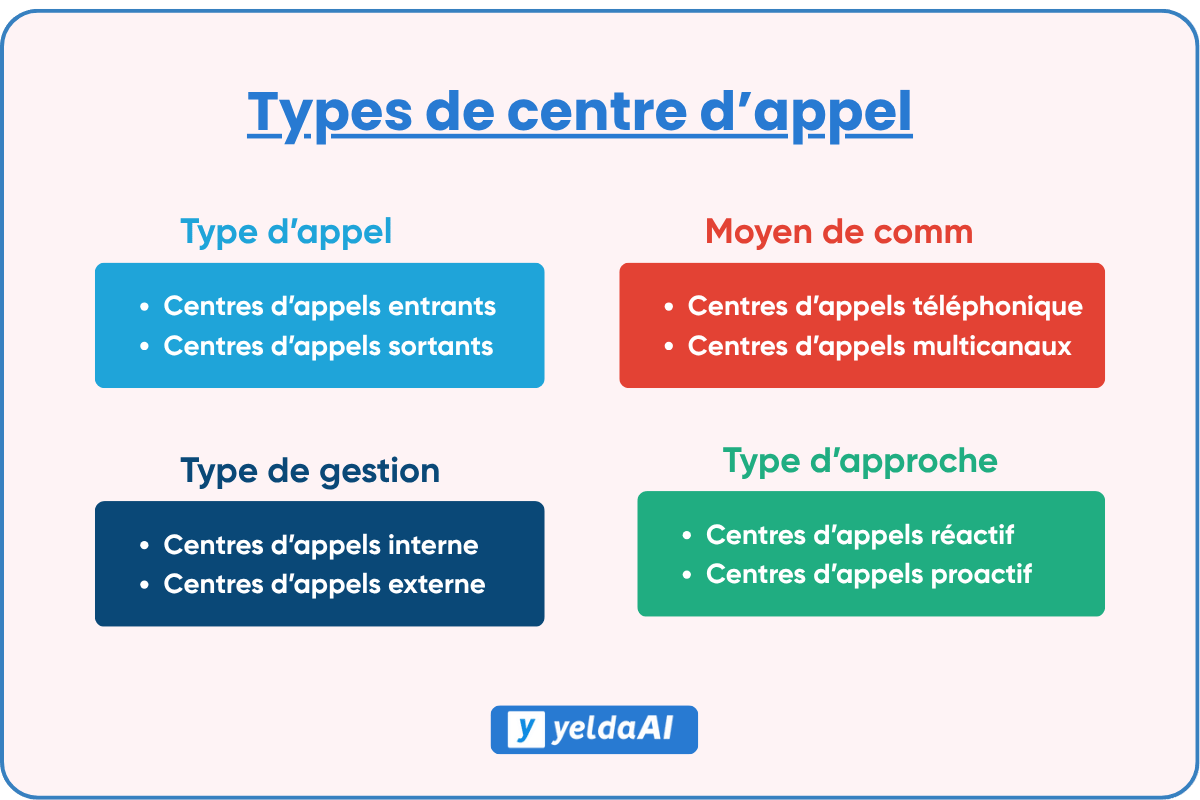
Addressing numerous use cases, call centers come in different types, each tailored to specific needs. However, it is important to note that these categories are not necessarily mutually exclusive. In fact, many call centers combine features from several types to meet the specific goals of each company.
Inbound and outbound call centers
The inbound call centers generally serve as the first point of contact between customers and the company. Here, agents handle incoming customer calls, whether for information requests, technical support, or after-sales service. To provide a positive customer experience, it is essential to be responsive and empathetic during every interaction.
Conversely, outbound call centers focus on the company reaching out to its customers. In this case, teams use automated outbound calls for various activities such as:
- telemarketing campaigns;
- satisfaction surveys;
- important announcements…
The goal behind this approach is to drive direct sales, strengthen the company's brand image, and optimize customer relationships through proactive communication.
In-house and outsourced call centers
The in-house call centers are integrated within the company, where agents focus entirely on the products and services offered. This option promotes data confidentiality and strengthens alignment with the company culture. While this may lead to higher infrastructure costs and a larger headcount, it allows for fluid and personalized communication.
As for outsourced call centers, they are managed by specialized service providers. From recruiting to training agents, the entire management of the call center is entrusted to a separate entity. In this model, outsourcing can generate cost savings, but it can also create a gap between the company's values and the customer experience provided.
Reactive and proactive call centers
The responsive call centers distinguish themselves by their ability to react promptly to customer requests. Their role is essential for providing immediate assistance and quickly resolving issues, particularly those of dissatisfied customers.
As for proactive centers, they anticipate customer needs. Here, it is the agents who take the initiative to contact the customer to inform them of product updates, special offers, or to gather feedback before the customer feels the need to reach out. Clearly, this proactive approach proves decisive for optimize the customer experience and strengthening brand loyalty.
Telephone and multichannel call centers
Telephone call centers focus exclusively on managing incoming or outgoing calls. This historically dominant model remains relevant in many sectors where voice is still the most direct and reassuring medium for customers, especially in the event of a complex or urgent issue.
Multichannel centers, on the other hand, integrate several contact points: phone, email, chat, social media, SMS, etc. This approach meets the new omnichannel habits of consumers, who expect a fast and seamless response, regardless of the channel used. Indeed, more than 70% of customers use at least three different channels to interact with a brand, making a well-orchestrated multichannel strategy essential.
What are the missions of a call center?
Far from being limited to simply receiving calls, call centers play an indispensable role in improving customer relations, with the ultimate goal of consistently offering a positive customer experience.
Customer support
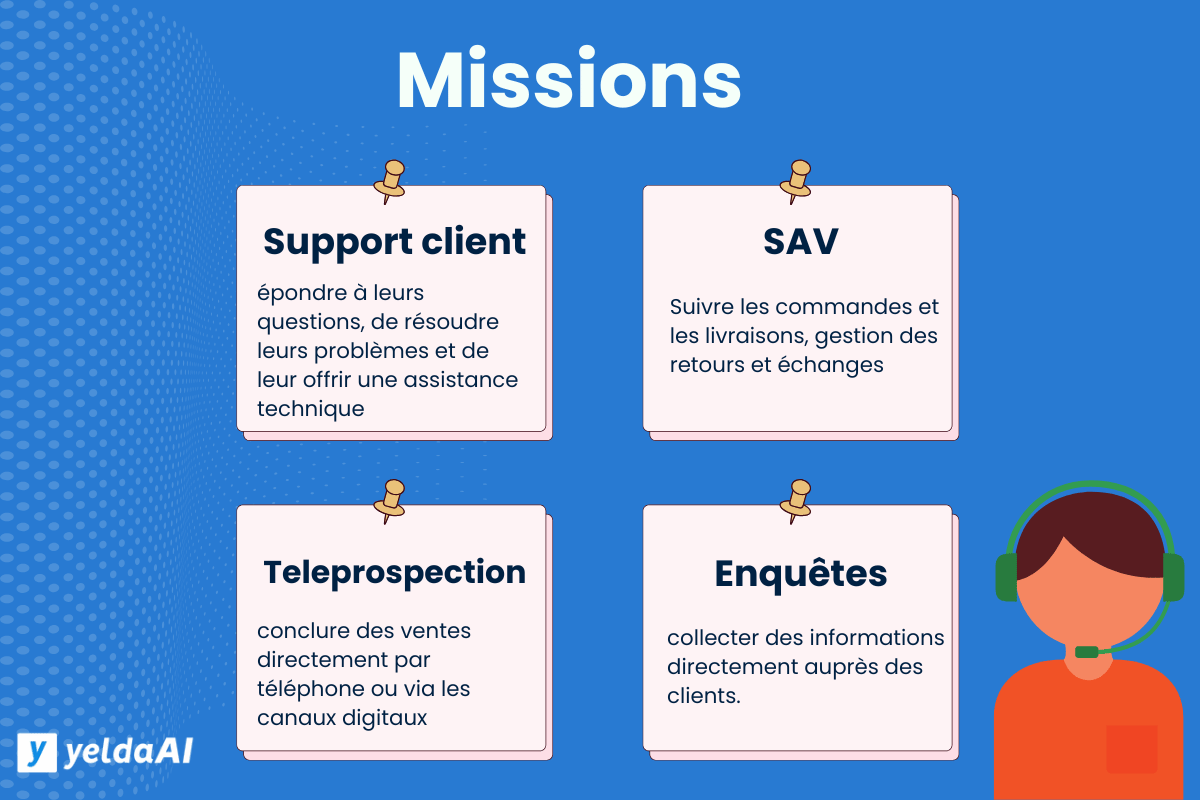
Here, the call center's mission is to establish a direct link with customers, to answer their questions, resolve their issues, and provide them with technical or administrative support. In practice, this translates into:
- Technical support : guiding the customer in the use of the company's products or services, identifying technical problems, and providing appropriate solutions.
- Claims and complaints management : listen carefully to customer concerns, strive to understand the root cause of issues, and find satisfactory solutions.
- Customer retention service : offer personalized service including loyalty programs, special offers, or exclusive benefits.
After-sales service
After the purchase, the after-sales support takes over to ensure a better customer experience. To this end, the call center is committed to:
- Tracking orders and deliveries : provide information on order status, track deliveries, and ensure products or services are received on time and in good condition.
- Managing returns and exchanges : guide the customer through the necessary steps and ensure requests are processed quickly.
Prospecting and sales
Beyond customer service, call centers also serve as pillars for prospecting and sales. Thanks to effective inbound call management, they actually help acquire qualified leads and, consequently, new customers.
At the same time, they can close sales directly over the phone or via digital channels. In addition to presenting the company's products and services, they guide the customer through the purchasing process right up to finalizing the order.
Surveys and polls
To improve the company's offering, call centers prove to be valuable tools for collecting information directly from customers. This is achieved through satisfaction surveys and market research using smart tools such as callbots, chatbots, or voicebots. In turn, this valuable data allows marketing teams to identify customer needs, measure satisfaction, understand market trends, and develop effective commercial strategies.
Appointment scheduling
Saving time and improving sales team efficiency is one of the benefits of call centers. In this regard, their mission is to manage team schedules by booking appointments with clients, confirming them, and ensuring they run smoothly.
The 5 keys to an effective call center

An effective call center is about more than just handling a high volume of calls. It relies on a balanced combination of human skills, responsiveness, and technological tools. Here are the five levers your call center must activate to provide a competitive customer experience.
Well-trained and engaged agents
The quality of customer relations depends directly on the competence and commitment of the agents. Well-trained staff who have mastered the products and possess patience, empathy, and strong interpersonal skills are essential for satisfying customers and handling delicate situations.
A fast and seamless response
Between 5% to 8% of calls are abandoned before being answered by an agent, often due to excessive wait times. Top-performing centers answer 80% of calls in under 20 seconds. Every second your customers spend waiting adds to their dissatisfaction.
High-performance technological tools
An efficient call center relies on a modern, integrated technological environment. CRM, cloud telephony, task automation, voice AI agents... There are a ton of tools that will allow you to automate processes, save time, reduce costs, and focus your teams on complex requests. In fact, 74% of customers prefer to interact with a bot for simple requests rather than wait for an agent.
Management driven by the right metrics
The efficiency of a call center depends on the ability to track and analyze the right KPIs : first-call resolution rate, average handling time, abandonment rate, cost per call, customer satisfaction score, etc. These indicators help identify areas of your center that can be improved, as well as measure the impact of your actions to make informed decisions.
A human and collaborative organization
A high-performing call center relies on a solid internal organization: balanced schedules, fluid communication between teams, peak-time forecasting, and listening to employees. This helps limit turnover, which reaches up to 42% in the sector.
In-house or outsourced call center?
The decision to keep a call center in-house or outsource it is a strategic choice that can have a significant impact on the company. Each option has both advantages and limitations that should be carefully examined before making a choice.

Pros and cons of an in-house call center
As mentioned above, an in-house call center means that the company manages its own call center. This option offers total control over service quality with agents immersed in the company culture. Consequently, this allows them to have a better knowledge of products and services and to respond to customers with great precision. Furthermore, this approach offers increased responsiveness and flexibility in the face of changing customer and business needs.
However, internalizing a call center comes with certain drawbacks:
- High infrastructure and personnel costs : the company must invest in technological equipment and office space, not to mention the recruitment and training of a dedicated team.
- Limited resources for large-scale campaigns : difficulties for the company in coping with peak activity periods or scaling its operations quickly.
Pros and cons of outsourcing your call center
Compared to internalization, outsourcing a call center involves entrusting call management to an external provider. Since the company does not have to invest directly in infrastructure, this option helps reduce operational costs. Among other things, this approach allows for:
- Access to specialized expertise : call center service providers often have in-depth experience and advanced technologies.
- Flexibility and scalability of services : allowing the company to adapt quickly to fluctuations in call volume without the constraints of an internal structure.
However, outsourcing your call center is not without its limitations. Indeed, by entrusting the management of its call center to an external entity, the company loses some control over the quality of the service provided. This is accompanied by risks related to data confidentiality, especially when the provider handles sensitive information.
| Type | Advantages | Disadvantages |
|---|---|---|
| In-house operation |
|
|
| Outsourcing |
|
|
AI: A revolution for call centers?
While they can already facilitate the relationship between companies and customers, call centers, bolstered by artificial intelligence, allow for further improvement of the customer experience. In other words, the combination of human agents and virtual assistants is proving to be a winning formula for call centers. As an example, callbot or AI-powered voice assistants are capable of handling simple, repetitive requests such as common questions or order status updates. This allows teams to focus on more complex, high-value tasks.
At the same time, these intelligent virtual agents offer 24/7 availability, allowing customers to get instant answers at any time. This increased availability also reduces wait times, while automated responses speed up request processing. Naturally, having assistance at their fingertips fosters customer satisfaction and loyalty.
However, installing AI-based tools in call centers is not without its challenges. Algorithmic bias can influence system decisions and compromise the fairness of customer service. Similarly, integrating AI with existing solutions can prove complex, requiring process adjustments and additional investment.
How many calls can your voice agent absorb?
Estimate in one minute the number of automated calls and the savings on your own volumes, with our ROI calculator.