Artificial intelligence and customer relations: the guide
Chatbots, voicebots and callbots now support advisors. The benefits of AI for customer relations, the main solutions, the challenges and real examples.


Artificial intelligence is now a powerful lever to optimize processes and strategies across the company. AI tools can be used in every department, and customer service is one of the areas adopting them fastest.
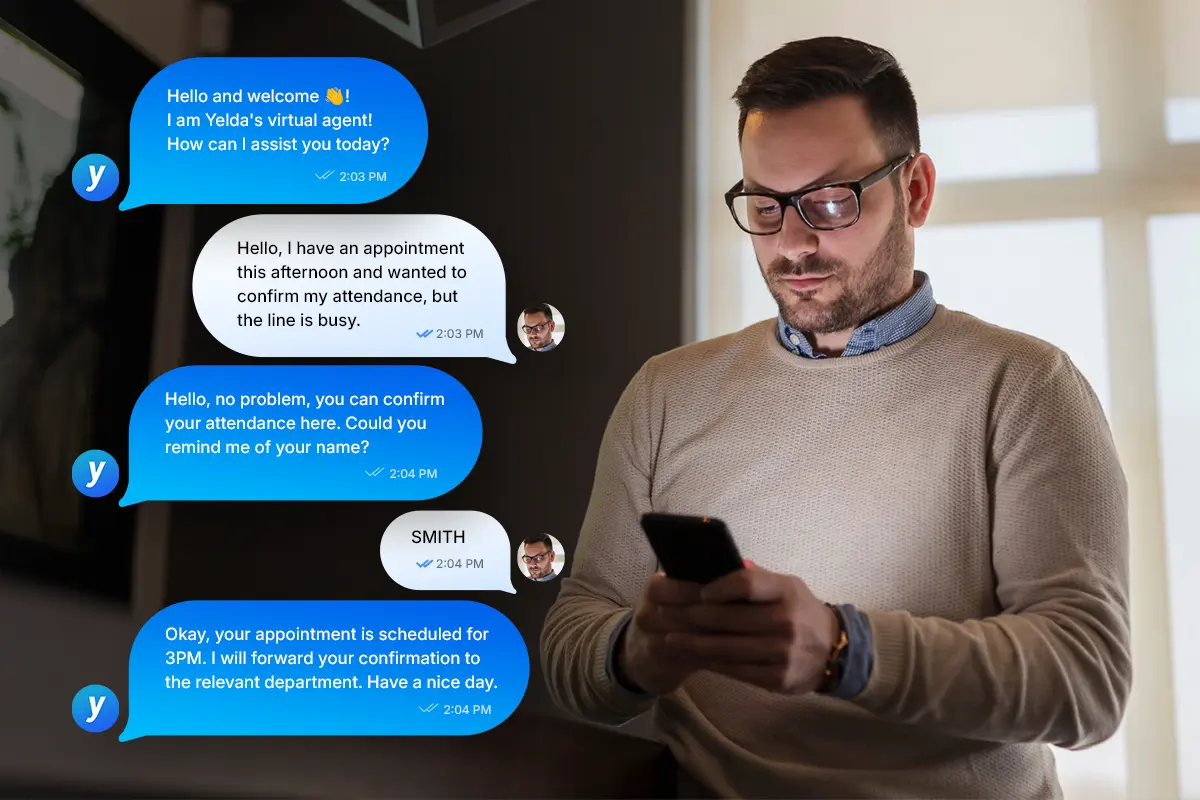
Conversational AI is now at the heart of customer relations: chatbots, voicebots and callbots support human agents in customer care.
In this article, we look at how AI improves customer relations and share concrete examples of organizations that have successfully integrated AI into their customer service strategy with YeldaAI.
In short: conversational AI is now part of customer relations, where chatbots, voicebots and callbots support advisors. The effects show quickly: smoother journeys, personalized exchanges, problems anticipated before they escalate and lower support costs. Many companies have already made it part of their customer service strategy.
The benefits of AI for customer relations
Virtual agents such as voicebots, chatbots and callbots have become central to customer relations. Here is why conversational AI brings so many benefits.
A better customer journey
AI is already transforming the customer journey:
- intelligent virtual agents (voicebots) driven by advanced algorithms give prospects personalized answers and 24/7 assistance, which helps remove barriers to purchase;
- callbots help customer service relieve its call center and reduce prospects' waiting time on the phone;
- chatbots on company websites answer prospects' questions faster and more precisely, whether they are warm or cold leads, without systematic employee intervention, while increasing overall satisfaction.
Optimized operational processes
Automating repetitive tasks and efficiently handling high volumes are at the core of AI's benefits for customer relations: AI can handle around 40% of customer requests autonomously (McKinsey, Future of Work).
A personalized customer experience
The old saying that the customer is king is truer than ever: many consumers want companies to offer more personalization.
Contrary to what one might think, AI is a major asset for personalizing interactions. Use cases are numerous, and a chatbot or voicebot can adapt to many environments and services. By tailoring services to individual preferences, AI delivers a more immersive and engaging experience.
Advanced customer data analysis
Using AI to extract relevant insights from customer data is a strategic advantage. It supports better-informed decisions and a deeper understanding of individual needs.
Proactive problem solving
According to a study by the National Bureau of Economic Research, agents using an intelligent conversational assistant resolve 14% more issues per hour.
Early detection of problems with AI also lets you anticipate customer expectations and put solutions in place before customers even report them. For example, you avoid the risk of an overloaded call center.
Lower operating costs
Automating processes with AI brings substantial savings compared with traditional customer support. You free your staff from recurring tasks, so you can reduce labor costs or have them focus on more strategic work.
Deploying a voice bot in your call center also improves customer satisfaction. Combined with all the other benefits above, AI clearly contributes to the overall satisfaction of prospects and customers.
AI-based solutions for customer service
Chatbots
Chatbots are programs that can hold a written conversation with a person. An AI-powered chatbot combines several technologies:
- RPA (robotic process automation): automation of repetitive tasks;
- machine learning: the bot learns automatically and continuously improves with use;
- data mining: analyzing data from different angles and turning it into useful information by finding relationships and patterns.
A concrete example: Bacardi used YeldaAI's chatbot builder to deploy Fabio, a conversational assistant on WhatsApp promoting responsible drinking among young adults.
Voicebots and callbots
Voicebots are programs that can hold a spoken conversation with a real person. A callbot is a voicebot that uses the phone as its channel.
By converting speech to text and back, they can carry out automated voice interactions. They use the same technologies as a chatbot, plus voice-specific ones, following this process:
- Input: the user speaks and the bot receives the request.
- Automatic speech recognition (ASR): the voicebot converts the audio into text (speech-to-text).
- Intent understanding: once the input is transcribed, the bot understands the request.
- Processing: the voicebot handles the request.
- Answer generation: the text answer is converted into speech (text-to-speech).
- Output: the bot delivers the spoken answer to the user.
For example, the Best Western hotel group's callbot handles customer bookings and questions on weekends and public holidays, when staff are not available. The voice bot has improved the customer experience.
The challenges of AI in customer relations
The growing use of AI in customer relations also comes with challenges that companies must consider.
First, AI is complex and evolves constantly, which requires agility from the companies that adopt it. Keep up with the latest versions of AI tools, follow AI news to anticipate risks and study the technology in depth to understand what is at stake. This will bring lasting value to your business rather than following a passing trend. Just as with the arrival of the web, companies need to adapt and make AI a tool that serves their business.
Second, pay particular attention to privacy and data security, where the risks are higher. Work with experts to analyze data security and the applicable rules on copyright, GDPR and more. Learn more in our Trust Center.
Examples of AI serving customer relations
Here are three concrete examples of organizations that used AI to transform their customer relations with YeldaAI.
The town of Plaisir
The town of Plaisir, west of Paris, has transformed its citizen support with the benefits of a callbot. In a video testimonial (in French), an employee describes the positive changes since the conversational agent was introduced at the town hall.
The AI voice agent now handles 50% of calls, so the municipal team can focus on more complex tasks.
This technology reflects the town's commitment to offering residents a better experience and strengthening the link between the administration and the community.
Admiral
A subsidiary of the Admiral insurance group took a strategic step by adding a voice bot to its websites. Designed to improve the user experience, this voicebot acts as a true virtual assistant and helps prospects choose the right plan.
Vachette
Vachette, an industrial expert in locks and padlocks, chose a versatile virtual assistant called Eva. Designed to improve the experience on its website, its voicebot and chatbot guide prospects in choosing products and efficiently solve customers' problems.
How many calls can your voice agent absorb?
Estimate in one minute the number of automated calls and the savings on your own volumes, with our ROI calculator.