
Conversational AI in insurance
Claims, policy questions, identification of policyholders: how conversational AI automates first-level insurance requests and how to deploy it in 6 steps.


An intelligent conversational agent is a technology that interacts with people through language, including in professional settings such as insurance. As a voicebot, chatbot or callbot, conversational AI is an effective way to interact with policyholders and prospects in customer service, for example to take out a policy or report a claim. In this article, discover the benefits of conversational AI in insurance and a step-by-step method to integrate it into your customer service.
In short: in insurance, conversational AI automates part of the most common requests, such as claims reporting, questions about coverage or policyholder identification. Virtual agents like YeldaAI can handle this first level of contact, reducing team workload and leaving the most complex or sensitive cases to advisors.
The benefits of conversational AI in insurance
Personalized 24/7 support
An intelligent conversational agent can offer round-the-clock support, answering frequent questions about taking out a policy, coverage conditions, types of insured claims and more. Supporting customers at any time increases their satisfaction: you show you are available, involved and listening.
Fraud detection
Intelligent agents help detect fraud attempts and limit the resulting losses. By integrating conversational AI into your call center, you detect suspicious behavior faster and help your security team prevent more attacks.
Higher agent productivity
Process automation significantly reduces the time needed to handle customer requests. Your AI can transcribe calls, route them to the right department, classify tickets and collect caller data. Human agents become more productive because they focus on high-value tasks.
Automated handling of common requests
Intelligent callbots and voicebots can handle around 80% of repetitive tasks without human help. Automating customer service processes still requires precise steps:
- identify the recurring tasks to automate;
- choose automation tools: CRM software, call management systems, a callbot and so on;
- set up automated scripts;
- integrate the tools into your existing setup;
- train staff on the new tools and on AI.
Lower operating costs
Investing in an intelligent conversational agent may seem expensive, but your operating costs drop as soon as the AI is in place: call center handling times decrease and you need fewer resources for routine requests.
Better customer experience
As an insurer, you may be wary of adding a callbot to your customer service, out of concern for satisfaction and loyalty. Yet according to a US study by Replicant, 80% of customers would be willing to talk to a bot to avoid waiting. Whatever the method, reducing waiting times on the phone increases customer satisfaction.
Use cases of conversational AI in insurance
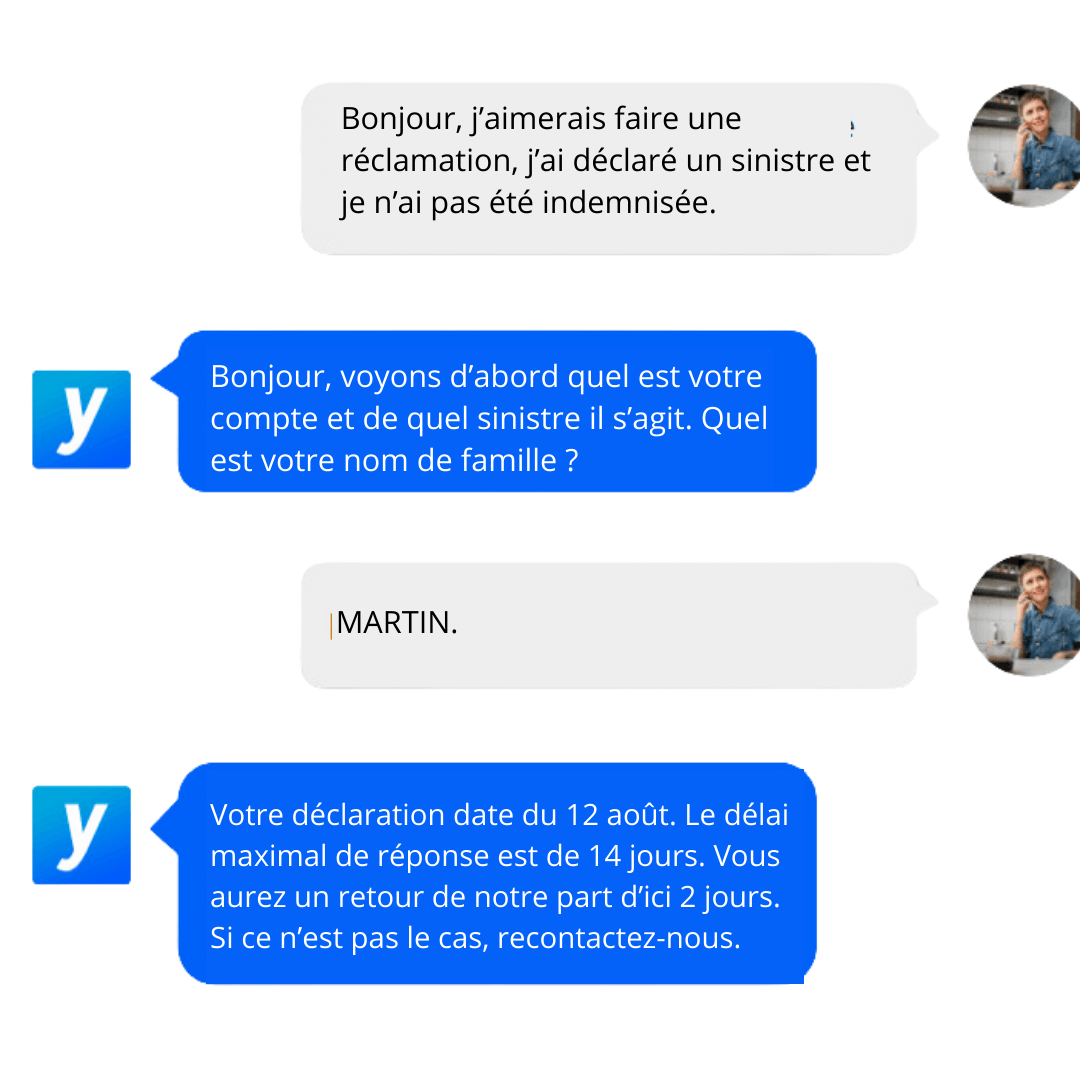
Claims handling
A customer contacts you through your chatbot to file a claim. Conversational AI answers her.
Billing and payments
A customer contacts you to pay an overdue bill. Your conversational AI handles the payment for a fast, secure transaction.

Call reception and transfer
A prospect wants to speak to an advisor to take out home insurance for her new home. Your virtual agent handles authentication securely, then transfers her to the right department. The advisor only has to guide her through the subscription.

Fraud detection
A customer contacts you through your website chatbot to reset her password. Your conversational AI asks the right questions to make sure she is who she claims to be and that this is not a fraud attempt.

Case follow-up
A customer has several policies with you for all his rental properties. The AI can manage all these files at the same time, kept continuously up to date.
How to bring conversational AI to your customer service
In insurance, voicebots, chatbots and callbots improve productivity, support profitability and increase customer satisfaction. Here are the steps to deploy conversational AI in your customer service.
1. Identify your touchpoints
Before deploying conversational AI, define your needs:
- What are customers' most frequent questions?
- Which channel do customers use most to contact you?
- What are your customers' top 3 channels?
- For each channel, what kind of exchange do you have (short, open or closed questions)?
- Is your customer service omnichannel or multichannel?
- Which teams can answer frequent customer questions?
- Which channels most need automation?
2. Identify where AI applies
Now define all the use cases where conversational AI will be:
- useful for your growth as an insurer;
- compatible with your existing customer service setup;
- appreciated by your current customers.
You can automate many processes; the key is to choose those that are useful and profitable. For example, use AI for:
- customer authentication;
- routing to another department;
- appointment booking;
- post-call or post-order feedback for the continuous improvement of your customer service.
3. Choose an AI model
You can deploy an AI voice agent in your call center, a chatbot on your website or a voicebot on another platform. To choose, ask yourself:
- Which platform do customers turn to first for information and to share their issues?
- Which platform is currently ready to integrate AI?
- On which channel will conversational AI be most useful for your insurance customer service?
Work with conversational AI experts such as YeldaAI to choose the best model. YeldaAI offers a latest-generation no-code callbot platform that meets the needs of insurance companies. For example, L'Olivier Assurance, a subsidiary of the Admiral group, deployed a YeldaAI voice assistant on its websites to help prospects choose the right offer and guide them through their declarations.
4. Train the conversational agent
Once these practical questions are settled, train your conversational agent in real conditions. The goal is to give customers precise, accurate answers. Tone matters: if human and virtual agents address customers differently, you risk damaging your brand image, especially in insurance where relationships are key.
5. Test and deploy
Finally, test your agent in real conditions with your customers:
- Does the AI meet the initial need and follow the specifications?
- Is the customer experience good, or better than before?
- Is customer feedback satisfactory? If not, why?
If the tests meet the specifications, you can launch your conversational AI. One last step remains.
6. Measure results
Monitor results continuously to detect issues and optimize your virtual agent's performance. You can, for example, track call center quality monitoring through:
- first contact resolution (FCR);
- average handle time (AHT);
- abandonment rate.
Conversational AI is transforming the customer experience and optimizing processes in insurance. By automating recurring tasks, it lets agents focus on complex issues, makes fraud detection more effective and lowers operating costs. With a structured approach, insurers can strengthen customer satisfaction. Conversational AI is no longer optional: it is a real lever to stay competitive in insurance.
How many calls can your voice agent absorb?
Estimate in one minute the number of automated calls and the savings on your own volumes, with our ROI calculator.