
Call center AHT: how to measure and reduce it?
Looking to further optimize your call center's AHT? Read our article!


The phone remains the preferred channel for 59% of customers when contacting a company. However, 36.8% of customers consider slow response times to be a poor experience, and 92% believe that customer service should respond quickly to their questions and issues.
Providing fast and relevant answers is therefore essential to ensure customer satisfaction. But how can you optimize call handling time without compromising the quality of the customer experience? It all starts with measuring one KPI : average handle time, or AHT.
In this article, we explain how to measure and optimize AHT while maintaining an impeccable customer experience. Ready to improve your customer service? Let's get started!
Article summary
Average handle time measures everything a call actually consumes: hold time, conversation time, and the wrap-up work that follows. Each of these three components reveals a different aspect of the center's organization. Reducing AHT without degrading customer satisfaction is achieved through the levers described in the article: automating simple requests, training agents, better resource allocation, and more.
What is a call center's AHT?
The acronym "AHT" stands for Average Handle Time, and it is one of the main KPIs for a call center. AHT measures the average time an agent spends handling a customer interaction, from start to finish.
AHT goes beyond simply measuring the time spent on an incoming call. It also encompasses talk time, any time spent on hold, and post-call work, such as updating customer records and processing follow-up tasks. If you were to track only one indicator to monitor your contact center's performance, it would definitely be AHT.
Analyzing AHT provides a macroscopic view of the efficiency of your call center, whether in terms of profitability, operations, or customer experience. The challenge for centers is therefore to reduce AHT without compromising service quality. Consequently, it is recommended to pair it with other customer satisfaction KPIs.
How do you calculate Average Handle Time (AHT)?
Let’s look at how to calculate AHT for a call center.
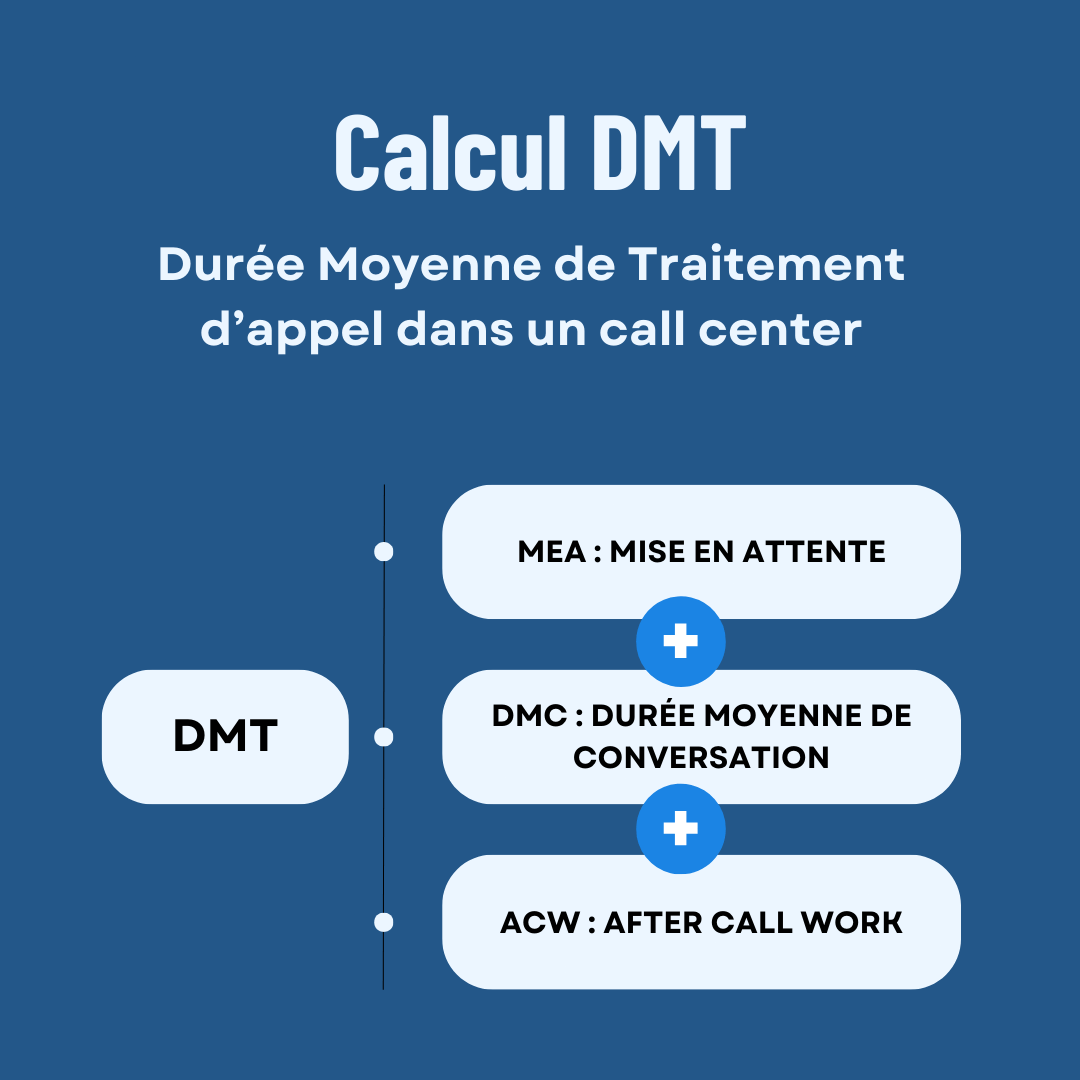
AHT is the sum of three other indicators representing the entire call process in a call center (before, during, and after the call):
AHT = Hold Time + Talk Time + ACW- Hold Time : this represents the time spent by the caller before being connected to an agent.
- Average Talk Time : this represents the time actually spent resolving the caller's request during the phone conversation.
- After Call Work (ACW) : this is the time required for agents to complete post-call tasks.
Why is it important to monitor AHT?
Monitoring your AHT offers many benefits :
More accurately estimate the productivity of your call center staff to meet inbound volume demands and improve employee well-being.
Optimize the caller experience, and therefore customer satisfaction, by reducing AHT as much as possible without sacrificing quality.
Make your call center more profitable through better allocation of human and technological resources.
- Process optimization by identifying inefficiencies in interactions.
This indicator is very comprehensive because it takes into account all time-related factors of a contact center call. This allows you to continuously analyze the operational efficiency of your call center and, ultimately, to estimate your staffing needs with increasing accuracy based on incoming demand volume.
Indeed, each of the three indicators in the AHT formula provides valuable information for better managing your call center:
Hold Time (HT) Prolonged hold time can lead to a decrease in customer satisfaction. By minimizing wait times, call centers can improve the overall caller experience and ensure responsive service. Using virtual agents and proper human resource allocation is key to reducing HT.
Average Talk Time (ATT) measures the direct efficiency of call resolution. A short ATT indicates that agents are able to handle requests effectively, contributing to increased productivity and optimal customer satisfaction. Training is a key lever for improving ATT.
After Call Work (ACW) managed well is essential for the proper closure of an interaction. This includes updating records, documenting exchanges, and preparing for the next interaction. Effective ACW contributes to long-term service quality. Agent training and automation are trending levers to implement in your call center.
How can you effectively optimize your AHT?
Now that we have explored the components and importance of AHT, let's address this crucial question: how can you reduce AHT without compromising the quality of your services? It is necessary to gain a fine understanding of the potential fluctuations of the AHT indicator to truly optimize it.
1. Understand the different AHT fluctuations
It is important to note that your strategic choices following your AHT analyses must take into account that modifying one factor may lead to an increase in another. For example:
You might be tempted to ask your agents to get straight to the point during their exchange with the user in order to optimize ATT (minimalist processes, short request handling, etc.). But this makes no sense if this time reduction implies more time spent in after-call work (ACW). Automate your ACW with AI tools and RPA (Robotic Process Automation) technologies to reduce this factor in the long term.
You can have the best agents handling calls efficiently with automated after-call work, but if the customer's wait time is very long, the AHT indicator will still remain high. Instead, increase your staffing levels in your workload estimates.
Similarly, if you focus your efforts on reducing caller wait time, for example by implementing a voice AI agent, AHT could still remain high if your call center agents have a high average talk time. Instead, think about optimizing the request handling process during the agent-caller conversation.
To optimize AHT in the long term, the goal is to optimize each of the three performance sub-indicators mentioned above.
Above all, by prioritizing the reduction of the entire call chain, you ensure an excellent customer experience, efficient use of your human resources, and a strong return on investment (ROI).
Variations in AHT can result from factors such as query complexity, agent skill levels, and peak call periods. Analyzing these variations helps identify opportunities for improvement.
2. Actions to monitor for sustainable AHT reduction
As we have seen earlier in this article, reducing AHT while maintaining customer service quality requires well-thought-out strategies.
To optimize it, be sure to rigorously follow these actions:
Provide initial training to call center agents and support them with ongoing professional development.
Automate tasks in your call center that can be automated to lighten the load on your agents.
Implement conversational AI such as voicebots, chatbots, and callbots whenever possible.
Closely monitor fluctuations in hold time, talk time, and ACW to continuously adjust AHT metrics.
Estimate the gains of a voice agent based on your own call volumes with our ROI simulator.
How many calls can your voice agent absorb?
Estimate in one minute the number of automated calls and the savings on your own volumes, with our ROI calculator.