
How much does a phone system cost?
Discover the costs of PABX, IPBX, and virtual phone systems to optimize your company's communication with flexibility and efficiency.


In the era of artificial intelligence and digital transformation, companies are looking for increasingly high-performance and flexible communication solutions. Programs like callbots are currently in high demand on the market due to their ability to handle large volumes of calls and provide automated responses.
However, the phone system, while more traditional, remains a decisive tool for communication. It retains its full relevance, particularly for managing incoming calls, ensuring a professional image and facilitating team collaboration.
However, to choose the solution best suited to your company, it is essential to know the costs associated with each type of phone system. Whether for a traditional PABX system, a modern IPBX or a virtual phone system, each option has specific advantages and costs that are important to understand to achieve the desired results.
The cost of a physical phone system (PABX)
PABX, an acronym for Private Automatic Branch eXchange, is an internal corporate telephone communication system used to manage incoming phone calls and outgoing calls. It consists of a telephone exchange, connected to a network of compatible phones and sometimes additional equipment such as voicemail servers. Although this system relies on a traditional PSTN network, it remains a viable solution for many businesses.
Acquiring a PABX represents a relatively low investment. On average, you should expect to pay between 2,000 and 3,000 euros to purchase a PABX. This price is primarily influenced by several factors, including:
- The desired features;
- The model of the telephone handset chosen;
- Installation and networking;
- Configuration of company-specific settings;
- Maintenance contracts.
This price range does not include the installation or maintenance of the switchboard. In addition, there is the cost of the telephone handsets, which is between 50 and 100 euros per phone.
Compared to modern solutions, PABX, while reliable, is often less flexible and less scalable. While it is particularly well-suited for companies with stable and predictable communication needs, it may be less appropriate for those experiencing rapid growth or requiring advanced features.
The cost of an IP telephone system (IPBX)
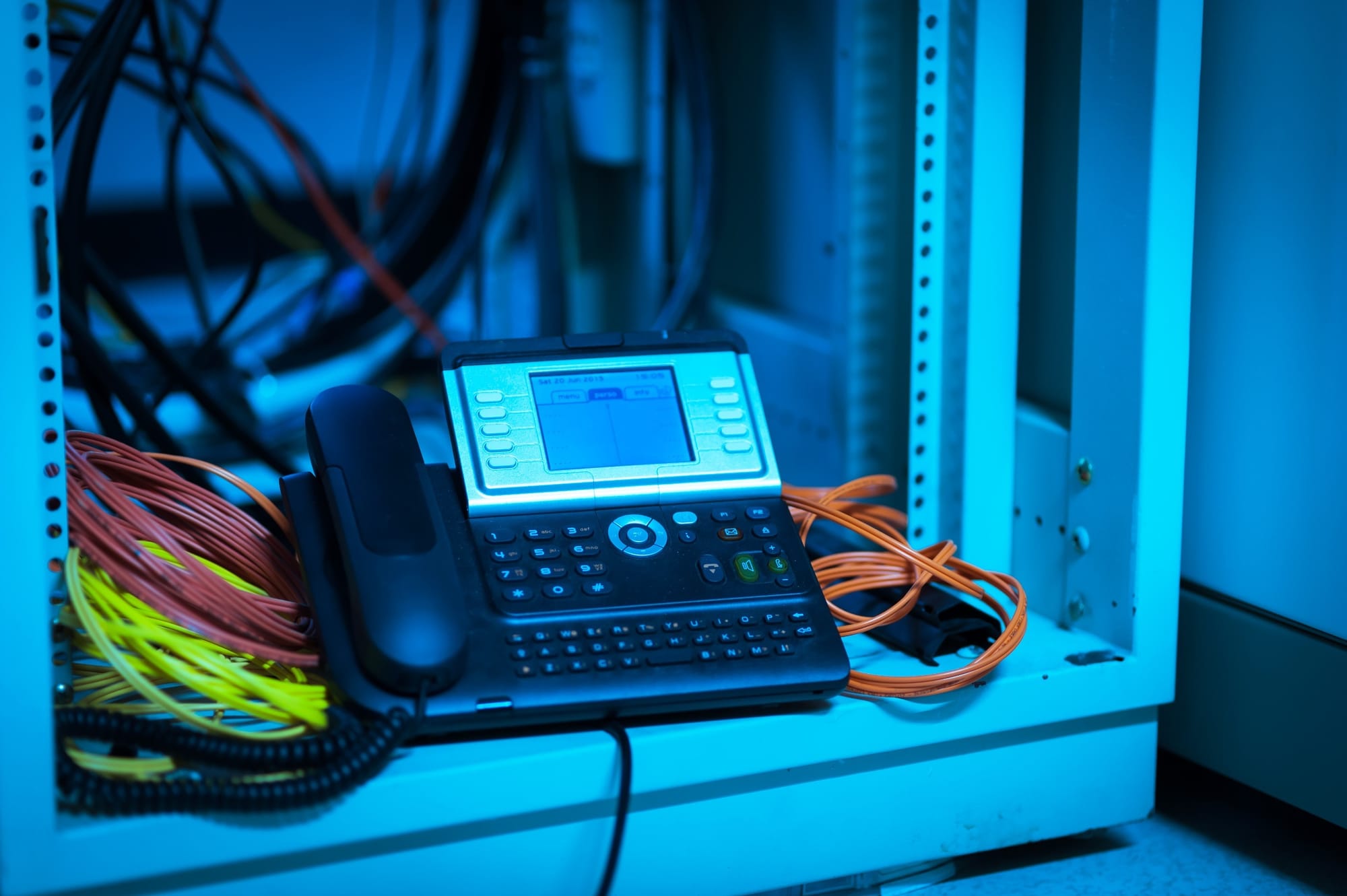
The IP telephone system or IPBX (Internet Protocol Branch eXchange), represents a significant evolution compared to traditional PABX. In other words, it offers greater flexibility, better integration with modern technologies, and far superior features. Its operating principle involves converting voice into digital data, which is then transmitted via the Internet.
Naturally, installing this telephone system comes with several advantages:
- Flexibility : users can connect to the system from anywhere, whether from an office, a home, or a mobile device, regardless of the tool used (phone, computer, tablet, etc.).
- Scalability : it is easy to add new lines or features to an IPBX simply by adding users or modifying the system configuration.
- Advanced features : IPBX systems offer a wide range of features, such as unified messaging, conference calling, call forwarding, customized hold music, and more.
- Cost savings : communication costs are generally reduced thanks to the use of VoIP (Voice over IP).
- Integrations: can integrate with tools such as CRM, ERP, or collaborative platforms like Teams or Slack.
Regarding pricing, an IPBX system costs up to 30% more expensive than a traditional PBX system. In terms of figures, this price ranges between 3,000 and 5,000 euros. This is justified by more advanced technology and a faster return on investment.
The cost of a virtual phone system

Also known as cloud PBX (Private Branch Exchange), a virtual phone system is a communication solution that relies on cloud technology to manage a company's phone calls. Unlike PABX and IPBX systems that require physical equipment, cloud PBX operates entirely online.
With a virtual system, telephony services are hosted on remote servers and accessed via the internet. This allows companies to benefit from advanced features without having to invest in expensive infrastructure. Likewise, cloud-based operation offers appreciated flexibility, allowing users to connect from any compatible device, wherever they are. Among other things, system configuration and management are generally simple and fast.
Regarding the price of a virtual phone system, it varies according to several factors, including:
- The chosen provider;
- User licenses;
- The number of users;
- The number of hours of call reception;
- Additional features and the desired level of customization.
Depending on your needs, you can find monthly subscriptions starting from 10 euros. For a plan that includes unlimited incoming calls, this price increases to 20 euros on average, and to 60 euros for a more comprehensive package. This solution is often more cost-effective for small businesses with fewer than 10 lines.
Criteria that influence the price of a business phone system
The cost of a telephone system is a deciding factor when choosing a communication solution for a business. Several often interdependent criteria influence this price. Here are a few of them!
Company size
A company's size is directly linked to its telephony needs. A small business with a few employees will not have the same requirements as a large corporation with thousands of staff members spread across multiple sites. This selection criterion includes:
- The number of lines required
The larger the number of employees, the higher the number of lines required. For a small business with about ten employees, a simple system with a dozen lines may suffice. Conversely, a large company with several hundred employees will need a system capable of managing hundreds, or even thousands, of lines.
- The number of features required
Small businesses can get by with basic features such as internal and external calls, voicemail, and call forwarding. On the other hand, large companies will need more advanced features like conference calling, virtual queues, call centers or integration with other existing systems.
Specific features
The features chosen for a telephone system have a direct impact on its cost. Some features are standard and included in all subscriptions, while others are optional and must be paid for as an add-on.
Basic features generally include voicemail and automated attendants. However, more advanced features such as interactive voice response (IVR) systems, AI-based solutions (callbot chatbot, voicebot, etc.), call recording, and integrations with customer relationship management ( customer relations CRM) software can significantly increase the cost.
Keep in mind that every additional feature requires extra resources, whether in terms of hardware, software, or technical support, which is reflected in the final price.
Maintenance and technical support
Specific technical support needs can vary depending on the complexity of the system and the company's internal expertise. Some companies may require 24/7 technical support, while others may be satisfied with support during business hours.
Regarding regular system updates, these are necessary to ensure security and performance. This maintenance work may be included in the maintenance contract or billed separately, which can obviously lead to additional costs.
The type of switchboard chosen
The choice between a PABX, an IPBX, or a virtual telephone system also impacts the total cost. Each of these systems has its own advantages and disadvantages, as well as different associated costs.
As a general guide, PABX is often less flexible and scalable than other solutions, but it can be more reliable for companies with stable communication needs.
IPBX, on the other hand, offers greater flexibility and scalability, but may require a larger initial investment. Conversely, a virtual phone system is generally the most economical in terms of upfront costs, but may involve monthly subscription fees.
Installing and configuring the phone system
The labor cost for installing and configuring a phone system depends on several factors, including the complexity of the system and integration with existing systems. For example, setting up a PABX or IPBX system often requires the intervention of qualified technicians to handle cabling, networking, and the configuration of specific settings. This service can, of course, lead to high costs.
Furthermore, the complexity of integrating with the company's existing systems, such as computer networks and management software, can also influence the cost. Clearly, a phone system that integrates easily with existing infrastructure will generally be less expensive to install than a system requiring significant modifications.
How many calls can your voice agent absorb?
Estimate in one minute the number of automated calls and the savings on your own volumes, with our ROI calculator.