How do you set up a phone system for your business?
Want to know how to set up a business phone system? Read our complete guide.


Nearly 100% of interactions with prospects and customers still take place over the phone, according to a study by Salesforce. In fact, the business phone system, more commonly known as a call center, is a cornerstone of any company's ecosystem.
It also ensures efficient management of incoming and outgoing calls to improve the customer experience, optimize agent productivity, and strengthen both internal and external communication. In this article, we will look at why and how to set up a business phone system, with detailed steps for a successful installation.
Article summary
A business phone system centralizes calls and directs them to the right department, which reduces wait times and missed calls. Setting one up primarily involves choosing the right type: a physical system (PBX), an IP system, or a virtual cloud-hosted system, which is less expensive. An intelligent virtual agent can then automate routing and handle frequently asked questions.
Why set up a business phone system?
Installing a business phone system offers several advantages. You will see improvements in:
Communication efficiency: a phone system allows you to centralize calls and route them quickly to the right department. This reduces wait times, keeping in mind that 56% of consumers consider long wait times to be the most common form of a poor customer experience (US survey by Replicant).
Your sales: a study by Velocify states that 50% of prospects never receive a second phone call from sales representatives. With a business phone system or a B2B call center, you ensure better follow-up with your prospects and can reach out to 100% of them.
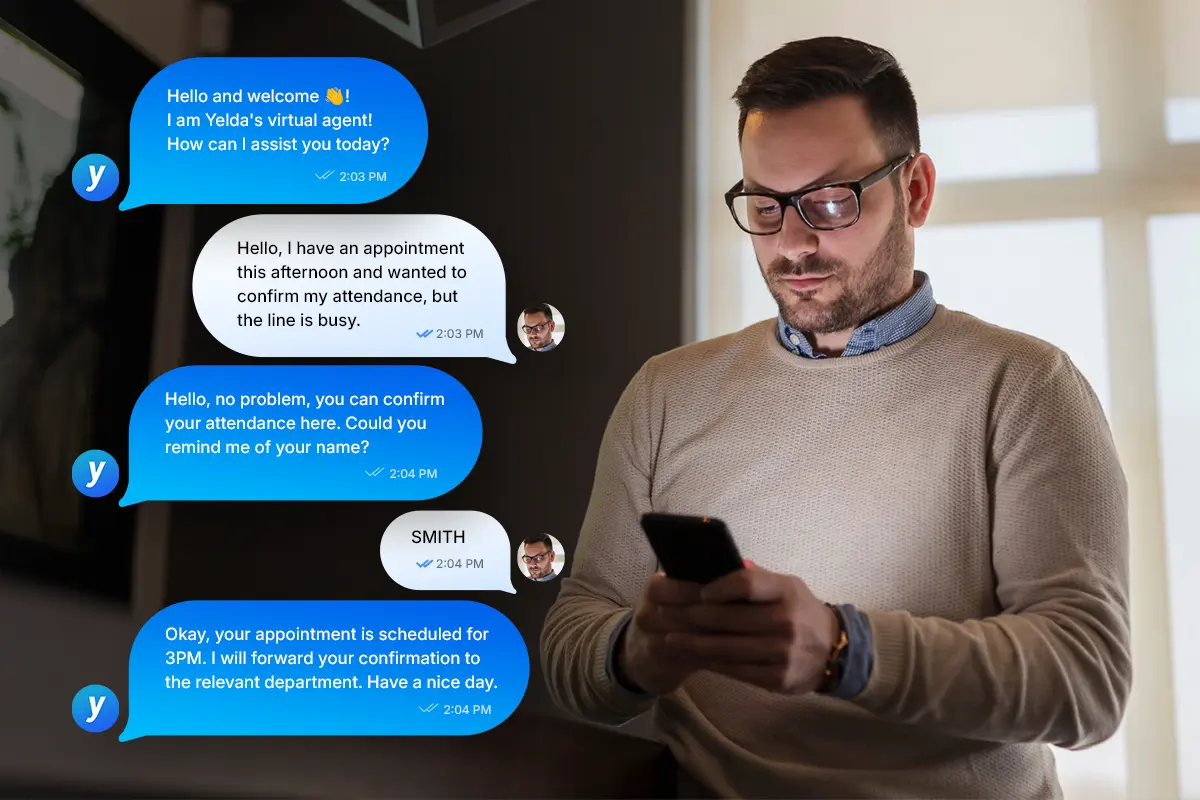
Call management and productivity: an optimized system is capable of handling a large volume of calls simultaneously, as well as automating certain processes like call routing or providing automated answers to frequently asked questions (with an callbot or a voicebot integrated into the system). It is essential for companies with high call volumes to optimize their call management.
Costs: modern solutions, particularly virtual phone systems, can reduce the costs associated with traditional telephone infrastructure.
Types of business phone systems
There are different types of outsourced phone systems or internal, each with its own characteristics and advantages. Here is an overview of the main options.
Physical telephone system (PABX)
A PABX (Private Automatic Branch Exchange) is a private telephone system used within an organization that manages internal and external calls autonomously, without going through the public telephone network.
Capable of total control over internal communications, a PABX can integrate advanced features (conference calls, call transfers) as add-ons and is known for its reliability and call quality (sound, transmission).
However, you must budget for significant installation and maintenance costs, as well as the rental of physical space to house the equipment.
IP telephone system (IPBX)
The IPBX (Internet Protocol Private Branch Exchange) is a modernized version of the PABX. The main difference lies in the system that manages the calls: the internet handles the protocol. This allows for reduced rates on international calls and greater flexibility when adding new lines or integrating with other tools like messaging services.
However, since calls are transmitted via the internet, the IPBX system depends on your internet connection. Additionally, an IPBX requires technical expertise for installation and maintenance.
Virtual telephone system
A virtual telephone system is hosted in the cloud, which is a major advantage as it eliminates the need for on-site servers and the associated costs of renting extra space. Other benefits include:
Low installation and maintenance costs.
High geographical accessibility, making it compatible with remote work.
Automatic feature updates.
However, keep in mind:
The same dependence on a stable internet connection as the IPBX, which makes call quality dependent on bandwidth.
Security risks associated with the internet.
The intelligent virtual agent, the new solution for telephone systems
Intelligent virtual agents, such as voicebots or callbots, represent a major advancement in the field of telephone systems. They are powered by artificial intelligence capable of automating and optimizing call management, handling simple tasks without human intervention.
While installation and integration require an initial investment and technical expertise, the ROI is very attractive and offers numerous long-term benefits:
The 24/7 availability and responsiveness of the callbot is the notable difference compared to other telephone systems : you provide continuous customer support for exponentially higher customer satisfaction, in a digital age where customer service must be more responsive than ever to remain competitive. Furthermore, without the intervention of a human agent during the phone call, the voice AI agent takes less than 3 seconds to understand your customer's spoken request and respond to them.
The ability to handle a large volume of calls simultaneously and without wait times is a major asset for your company : the customer's request is filtered upstream by the bot to reduce processing time. It is therefore possible to absorb a higher volume of calls while reducing caller wait times. Operational productivity increases significantly. According to a study by Siècle Digital, the implementation of a callbot actually reduces the time spent on customer relationship processes by 29%.
Personalizing interactions with your customers through data analysis and customer feedback by the virtual agent. This significantly enhances the customer experience.
Estimate the gains of a voice agent based on your own call volumes with our ROI simulator.
How do you set up a phone system?
Setting up a phone system requires rigorous planning, as it must be integrated into your existing ecosystem. Here are 4 key points to keep in mind.
Agent training
Training agents is essential to ensure optimal use of the phone system. Make sure to provide agents with:
Comprehensive initial training on how the system works, call procedures, tracking performance indicators, and best communication strategies.
Ongoing training in the form of regular sessions or workshops to keep agents informed about system updates and the evolution of the deployed tool.
24/7 support and maintenance to provide resources and technical assistance in case of issues.
Technological integration
Technological integration covers all the key points that must be addressed to ensure the normal operation of a B2B call center:
Compatibility : existing systems and software must integrate with the newly implemented phone system, including the internet network and office hardware.
Security Furthermore, the implementation of the telephone system must comply with security measures to protect sensitive databases and ensure the confidentiality of both callers and agents.
To address these two main points, a testing and validation phase is necessary. This must be carried out before the call center goes live.
Data analysis
Data analysis helps optimize the performance of your telephone system and continuously improve the customer experience. Therefore, be sure to:
Collect reliable data to track regularly: use monitoring and reporting tools to gather data on incoming and outgoing calls, wait times, conversion rates, etc.
Analyze figures and KPIs : analyze data to identify trends, pain points that were not discovered during the market research, as well as opportunities for business improvement.
Implement improvements based on observations: use the conclusions drawn in the previous step to adjust processes, train agents, and improve service quality.
Omnichannel approach
An omnichannel approach means using multiple channels simultaneously to contact a brand. It serves to improve the customer experience. Integrating a telephone system—an additional channel—therefore requires verifying the company's omnichannel communications. Be sure to check:
That the connection between the telephone system and other channels works : emails, instant messaging, social media, etc.
That data synchronization is ensured : customer information must be shared and updated in real time across the different channels.
That the customer experience is consistent and seamless : prospects and customers must be able to switch easily from one channel to another without any loss of information.
Implementing a telephone system in your company is a strategic move that can significantly improve communication and customer satisfaction. By choosing the type of system that suits your needs and following the installation and integration steps, you can ensure your telephony system operates optimally. Consider also integrating technologies such as intelligent virtual agents, if your company is open to them. AI offers innovative opportunities in the call center sector thanks to its diverse possibilities for automating and optimizing CRM (Customer Relationship Management).
How many calls can your voice agent absorb?
Estimate in one minute the number of automated calls and the savings on your own volumes, with our ROI calculator.