What are the differences between a voicebot and a chatbot?
Struggling to choose between a chatbot and a voicebot? Read our article!


On average,25% of French people have used a chatbot (BVA Customer Service Observatory, 2022) to contact customer support in 2022, and this figure is rising every year. Intelligent virtual agents have become essential for businesses, regardless of their field of activity.
Artificial intelligence (AI), whether deployed via a voicebot or a chatbot, is a widely used solution in the world of customer relations. But you are surely wondering: voicebot vs. chatbot? Which one should you choose for your business to optimize agent productivity and improve customer satisfaction? That is what we will explore in our article.
What is a voicebot?
A voicebot is a virtual conversational agent that uses voice to receive and transmit information exchanged with the user. This robot is capable of converting a voice request into text, processing it, and then responding to the user via voice command. It most often uses AI technologies such as natural language processing (NLP), speech recognition, or machine learning.
For example, Google Assistant and Siri are voicebots.
What is a chatbot?
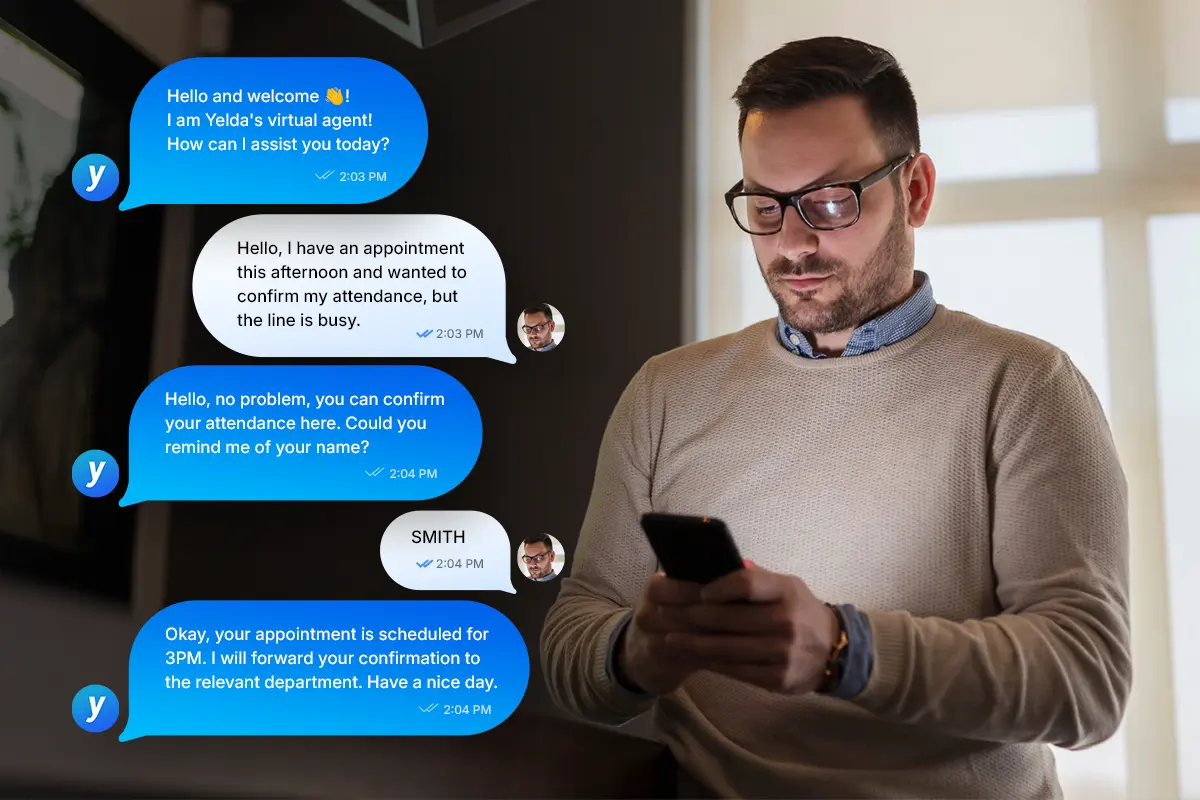
A chatbot has the same functionality as a voicebot, with the main difference being that it receives and transmits information textually rather than orally. We are seeing more and more chatbots on websites as support to improve customer relations. The main benefit is that a chatbot is available 24/7 and can answer a question or handle a complaint outside of your employees' working hours.
For example, Sodebot is the name of the chatbot for Sodebo, designed by YeldaAI. It handles all recurring customer inquiries for the brand.

Source: 2017 Chatbot Observatory by Do You Dream Up
What are the differences?
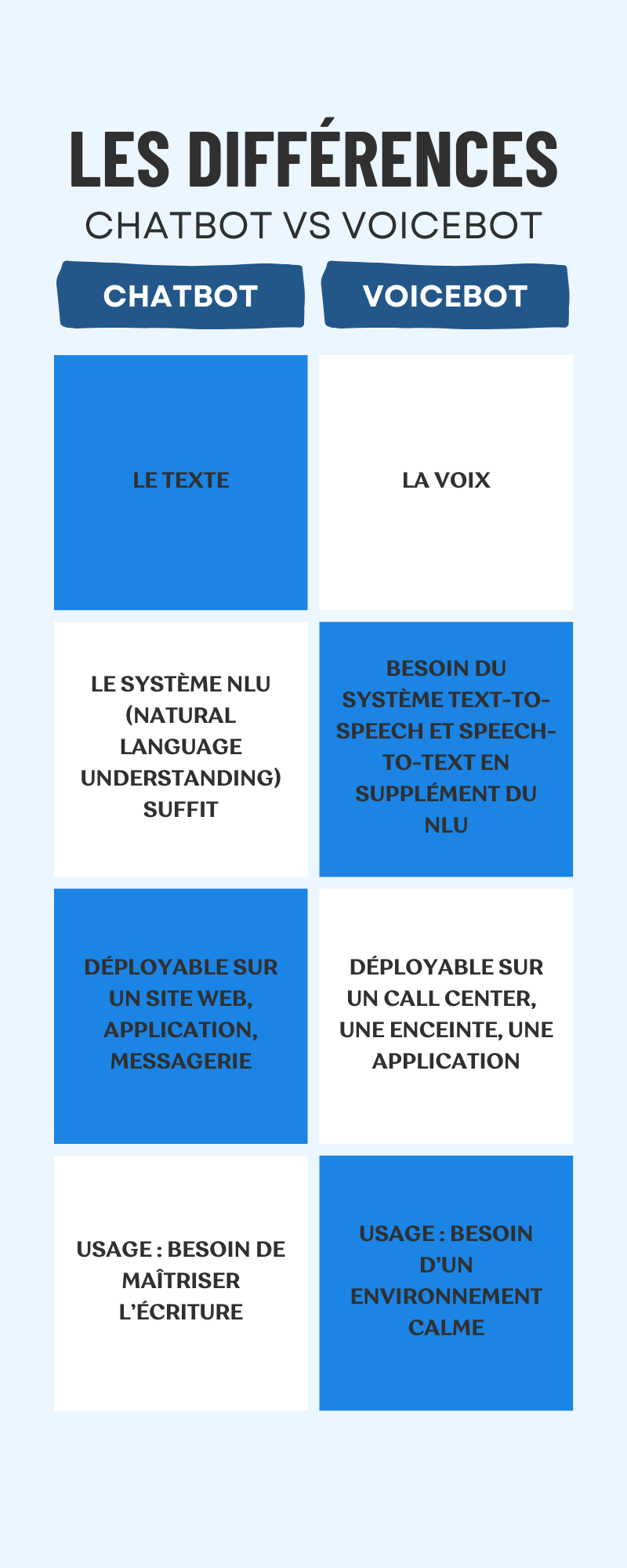
The mode of interaction: speech vs. text
"Voicebot" is a compound word made up of "voice" and "bot" (robot). Meanwhile, "chatbot" includes the word "chat." This is indeed the main difference between these two robots: their mode of interaction.
The voicebot receives a voice request and does the same to respond. Its interface is equipped with speech recognition to understand the user's spoken words.
As for the chatbot, it interacts with its user via text commands and responses, in a messaging format.
The technologies used
Compared to a chatbot, a voicebot requires additional technologies to function.
A chatbot uses NLU (Natural Language Understanding) to analyze text and then triggers a selection of responses.
A voicebot uses the same technology but requires functionality both before and after the NLU: Speech-to-Text (STT), which transforms the user's spoken request into text, and Text-to-Speech, which converts the robot's text response into a voice command to be transmitted to the user.
Platforms where they can be deployed
Implementation platforms differ depending on whether it is a chatbot or a voicebot.
Let's look at the platforms where voicebots are found:
In call centers: voice bots are commonly implemented in call centers to supplement human agents by handling recurring customer requests autonomously.
On smart speakers: voicebots are integrated into devices such as Alexa or Siri, allowing for voice interactions in a living space or public area.
On mobile applications: integrated into certain mobile apps, the voicebot offers a voice command option to users.
As for the chatbot, it is most often found on:
A website: their role is to provide near-instant assistance to website visitors. They are mainly found at the bottom of pages in the form of a chat bubble.
Messaging apps: chatbots are deployed on messaging platforms such as Messenger. This is another way to converse with a chatbot!
Mobile applications: chatbots can also be integrated into mobile applications to assist users via text messages.
The user experience is completely different
The user experience when using a voicebot or a chatbot differs in:
- the mode of communication : chatbots use text, which requires some writing skills (clear, error-free, and precise requests). Voicebots, on the other hand, use voice: the interaction is more natural and easier.
- interactivity : voicebots offer real-time voice interactivity, unlike chatbots, which are limited to text-based exchanges. The experience feels more dynamic with a voicebot.
- context : a voicebot is better at interpreting the context of a conversation thanks to auditory cues like tone of voice. Chatbots rely more on the specific words chosen by the user, which can sometimes lead to misunderstandings.
Accessibility
In terms of accessibility, a voicebot is better suited for visually impaired users, while a chatbot is more practical if the user is in a noisy environment or is hearing impaired.
What do they have in common?
So, voicebot vs. chatbot: how do you choose? These two robots are often pitted against each other, but did you know they also share several similarities, both in terms of their functionality and the value they provide?
Both are conversational agents
Voicebots and chatbots are both conversational agents that use similar technologies. Bots are generally based on:
rules : these chatbots choose their responses based on predefined rules in a database. They can recognize user input, and the response is extracted from templates manually entered into the database by the bot's owner.
retrieval : these robots are more comprehensive and flexible because they can access systems beyond just a database to provide answers to the user, thanks to Application Programming Interfaces (APIs).
a generative system : this AI uses deep learning to produce highly versatile and sometimes unpredictable conversational responses. Generative AI analyzes a vast amount of training data and then algorithmically generates the response most likely to match the input query. It’s a bit like the predictive text on your phone, but on a much larger scale. This is how ChatGPT works.
Highly customizable
Both voicebots and chatbots share a common benefit: they are infinitely customizable during implementation and can adapt to any business function, including customer relations, e-commerce, human resources, healthcare, lead generation, marketing, internal organization, and more.
Both improve the customer experience
Whether it's a voicebot or a chatbot, an intelligent virtual agent significantly improves the customer experience. In fact, it provides:
Significantly reduced response times: a voicebot or chatbot takes less than 3 seconds to respond to your customer's request (Siècle Digital).
24/7 accessibility: customer satisfaction increases by 8% (Siècle Digital) with the simple deployment of a bot.
A personalized experience: according to the 2022 BVA Observatory of Customer Services study, 69% of French people believe that access to customer service in France is a factor that encourages them to purchase a product or service.
Chatbot vs. voicebot: which one should you choose?
Choosing between a chatbot and a voicebot depends on several factors, such as your business needs, your customer base, and your budget. Let's explore these different factors together.
Assessing your business needs
Depending on your company's needs, a voicebot may prove to be a more relevant choice than a chatbot, and vice versa.
We recommend opting for a chatbot if:
your company primarily handles written messages within your customer service department (complaints and new customer onboarding via email, after-sales service via website forms, etc.);
you already have a website used by your customers, a messaging app, and/or internal processes that rely on text.
On the other hand, prefer a voicebot if:
voice interactions are crucial to your customer relationships;
you have a call center in your company for customer complaints and lead generation.
Costs and ROI: a comparative analysis
To deploy a chatbot or voicebot in your call center, you have several options:
A free version (often open source) that offers basic chatbot features. Customization is limited: a reduced number of user licenses, limited integration capabilities with other systems, and text request quotas. Furthermore, deploying the chatbot requires technical expertise.
A paid version (monthly subscription or commission fees). The benefits and advantages compared to a free version include: multi-channel support, numerous integration possibilities, unlimited session time, data analytics, higher request capacity, etc.
If you decide to go with a free version of a chatbot, remember to take into account all the associated hidden costs:
the cost of developing and deploying the bot: licensing, integration costs, and server hosting costs;
human resource costs: development team, project management team, and UX design team;
data costs: data collection and storage;
maintenance costs: updates and bot monitoring tools;
data protection costs;
employee training costs.
The price of a chatbot ranges from 800 to 1,200 euros per month, depending on the provider and the features offered.
The price of a callbot (or voicebot) varies more. However, here is a rough estimate: for 200,000 calls per year, expect to pay 40,000 euros for setup costs.
To make an informed choice, be sure to calculate the return on investment. Considering only the implementation cost of a bot is not representative. If you invest in a voice bot that generates double the profit, then the return on investment is very good.
Calculating the return on investment of a callbot (ROI):
ROI = Gain from investment / Investment cost
The gain comes from:
customer satisfaction (better coverage during evenings and weekends, reduced wait times, etc.)
savings achieved on overflow to call centers
Determining factors: target audience and platform
Think about your target audience; they are the people directly affected by your choice between a voicebot and a chatbot. Do your users prefer text-based or voice-based communication? Would they be satisfied with a voice assistant in your call center?
Also consider the platforms where you want to deploy your bot:
Chatbots are ideal for websites and messaging apps.
Voicebots (or callbots) are particularly well-suited for voice-based environments such as call centers and smart speakers, provided the room is quiet.
Conclusion
In conclusion, the choice between a chatbot and a voicebot depends on the nature of your interactions, the costs involved, your target audience, and your deployment platforms. Carefully analyze these aspects to make an informed decision that meets the unique needs of your business.
How many calls can your voice agent absorb?
Estimate in one minute the number of automated calls and the savings on your own volumes, with our ROI calculator.