Hotel call center: The complete guide to efficient customer service
Discover how to optimize your hotel call center to provide efficient, personalized customer service with our comprehensive guide.


The hospitality industry operates in an environment with particularly high standards for customer relations. 24/7 customer service has become the standard, especially to meet the needs of international travelers often dealing with time zone differences. Added to this is the management of peak activity periods, which requires rigorous organization and the ability to adapt during busy times.
At the same time, customer expectations have evolved significantly. Beyond instant responses, they want tailored services and the ability to contact the hotel through their preferred channels (phone, email, chat, WhatsApp, social media).
Faced with these demands, it is imperative for any hotel establishment to master the key uses of a call center, make the right choices between in-house and outsourced operations, and, above all, integrate the latest technologies, such as artificial intelligence.
Why does a hotel need a call center?
In the hospitality industry, 24/7 availability is no longer a luxury, but a necessity. According to the INSEE, 34% of overnight stays are by non-residents, with arrivals at all hours. A call center becomes essential to handle these requests around the clock, including during periods of high demand (tourist seasons, events, etc.).
A study by HotelTechReport also reveals that 80% of travelers consider the first phone contact to be a deciding factor in their booking decision. Consequently, every call represents a critical business opportunity, capable of turning a simple prospect into a loyal customer.
Among other things, a call center well-structured call center helps better manage the unexpected. Whether it's a booking issue, a lack of front desk staff, or an emergency, a quick and professional response always reassures the guest. Similarly, having a trained, responsive, and attentive team allows for handling incidents professionally while fostering positive word-of-mouth.
What are the use cases for a hotel call center?

The utility of a call center in the hospitality industry is evident across multiple scenarios that optimize both operational management and business development. Key examples include:
Booking and modification management : handling remote check-ins/check-outs, date changes, and specific requests (accessible rooms, upgrades, etc.).
Responding to information requests : information on services offered, availability, rates, cancellation policy, location, upcoming events, etc.
Emergency handling and real-time incident management : technical incidents, medical emergencies, security issues; responsiveness is crucial here.
Overflow management : during peak periods (holidays, trade shows, festivals), the call center absorbs a significant portion of the volume of incoming phone calls.
Call qualification and routing : call routing based on the profile (loyal customer, VIP, group) or urgency, for a faster and more personalized response.
Multilingual support : on average, French city hotels handle calls in 6 languages, which requires appropriate language skills.
The call center can also manage bookings for ancillary services (spa, restaurant, meeting rooms), a way to contribute to the growth of additional revenue.
Should you choose an in-house or outsourced call center?
The choice between in-house or outsourced management depends on several factors: call volume, budget, seasonality, and the desired level of personalization.
In-house call center
This model allows for direct management. The teams are integrated into the establishment, know its values, its processes, and its clientele. This fosters consistency in the customer experience and personalized service.
However, this choice involves significant fixed costs: recruitment, training, technical infrastructure, HR management, etc. This model remains ideal for luxury hotels or high-end chains that wish to maintain full control over the customer relations.
Outsourced call center
Entrusting call management to a specialized provider can reduce personnel costs by 30% on average. Outsourcing also offers 24/7 availability, trained and multilingual agents, and high-performance tools.
However, the hotel must ensure the quality of service provided and the accurate representation of its corporate culture. Loss of control is a real risk if the provider is not properly supervised.
Comparison table
| Criteria | In-house call center | Outsourced call center |
|---|---|---|
| Process control | Full control and a high level of customization | Less control and dependence on the provider |
| Costs | High initial investment and fixed costs | Variable costs and savings on training and infrastructure |
| Flexibility | Less flexibility during busy periods | High flexibility and rapid adaptation |
| Multilingual skills | Internal training required, with a slower setup | Immediate access to multilingual teams |
| Technology integration | Direct integration with PMS/CRM systems is possible | Depends on the provider and requires collaboration |
| Data privacy | Greater security within the company | Increased risks requiring contractual guarantees |
| Cultural alignment | Strong knowledge of company culture | Risk of cultural differences |
Hybrid models
The current trend is moving toward a blended solution. The hotel handles strategic calls (VIP guests, peak hours), while a service provider covers off-hours or technical support. This approach optimizes costs while maintaining quality.
What are the best practices for an efficient hotel call center?

To ensure high-level telephone service, several operational recommendations should be implemented:
Recruiting multilingual staff : essential for building a relationship of trust with an international clientele from the very first contact.
Ongoing staff training : employees must be trained on the establishment's specific requirements, the use of hospitality software (PMS/CRM), and communication techniques.
System synchronization : real-time updates between the call center, PMS, and CRM allow for personalized interactions based on customer history.
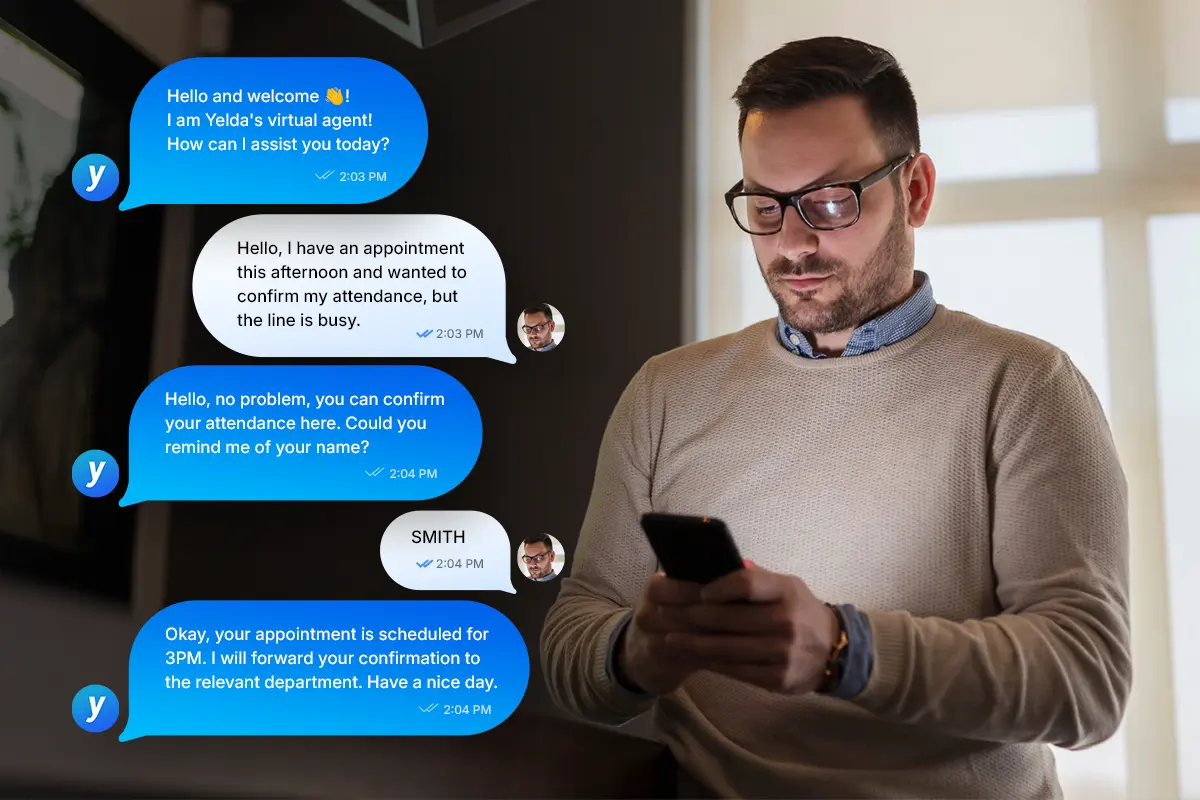
Targeted automation : tools such as callbots allow for the automatic handling of simple tasks (scheduling appointments, reminders, etc.), freeing up time for agents.
Flexible and contextualized scripts : these ensure consistent quality while allowing for adjustments based on the customer's profile.
Intelligent call routing : prioritizing urgent requests or loyal customers through an automated sorting system.
Performance tracking : monitoring KPIs such as FCR (First Contact Resolution) or the CSAT (Customer Satisfaction Score) allows for procedure adjustments.
Omnichannel approach Integrating telephony with other channels (email, SMS, chat) is essential for a seamless experience.
Proactive management Automatic confirmation notifications, appointment reminders, or welcome messages help reduce incoming calls and boost satisfaction.
➡️ Easily estimate your project's profitability with a personalized simulation that gives you a clear view of your return on investment.
Estimate the gains of a voice agent based on your own call volumes with our ROI simulator.
How is artificial intelligence revolutionizing the hotel call center?
The artificial intelligence and specifically conversational AI is profoundly transforming call center management, but its deployment must be carefully managed.
The benefits of AI for hotel call centers
Thanks to powerful tools like callbot solutions, AI improves performance,customer experience and operational efficiency across several areas:
Automating routine responses: via voicebot and chatbot solutions, AI automates answers to frequently asked questions, freeing up agents for more complex requests.
Predictive routing: it enables intelligent call routing by analyzing the caller's intent within the first few seconds to direct them to the most qualified agent.
Personalizing interactions: by analyzing customer history, AI enables tailored recommendations, which is expected by 71% of customers.
Real-time agent assistance: AI assists agents by providing suggested responses and detecting customer emotions to help them adapt their tone.
Schedule optimization: predictive analytics helps anticipate call spikes and optimize staff schedules for better resource management.
Quality analysis and monitoring: AI analyzes conversations (speech analytics) and promotes continuous quality monitoring by identifying friction points or opportunities for improvement.
Integration with hotel systems: integrating AI with PMS and CRM systems is important for a seamless experience and a comprehensive view of the guest.
Limitations and caution regarding AI
Despite its many advantages, AI must be used with caution:
Preserving the human touch in service: it is imperative to maintain the human contact that remains at the heart of hospitality.
Ensuring data security: the security and confidentiality of data processed by AI are an absolute priority.
Ensuring human oversight: human oversight remains essential for handling complex cases, correcting AI errors, and ensuring that technology continues to serve the guest experience.
How many calls can your voice agent absorb?
Estimate in one minute the number of automated calls and the savings on your own volumes, with our ROI calculator.