What is a callbot and what are the benefits for customer service?
Our experts explain everything you need to know about callbots, AI-powered conversational agents that are transforming customer service.

Is your customer service team overwhelmed by calls, whether for complaints or inquiries? It’s no surprise! According to the Customer Service Observatory.
However, did you know that our callbots can independently handle 40% of customer requests? Powered by artificial intelligence, callbots are the best way for your call center to automate customer intake, improve the customer experience, and reduce the workload on your agents! We explain it all in our article.
What is a callbot?
A callbot is a voice-based conversational agent that uses artificial intelligence to understand and respond to customer requests during phone calls in a natural, autonomous way.
How a callbot works
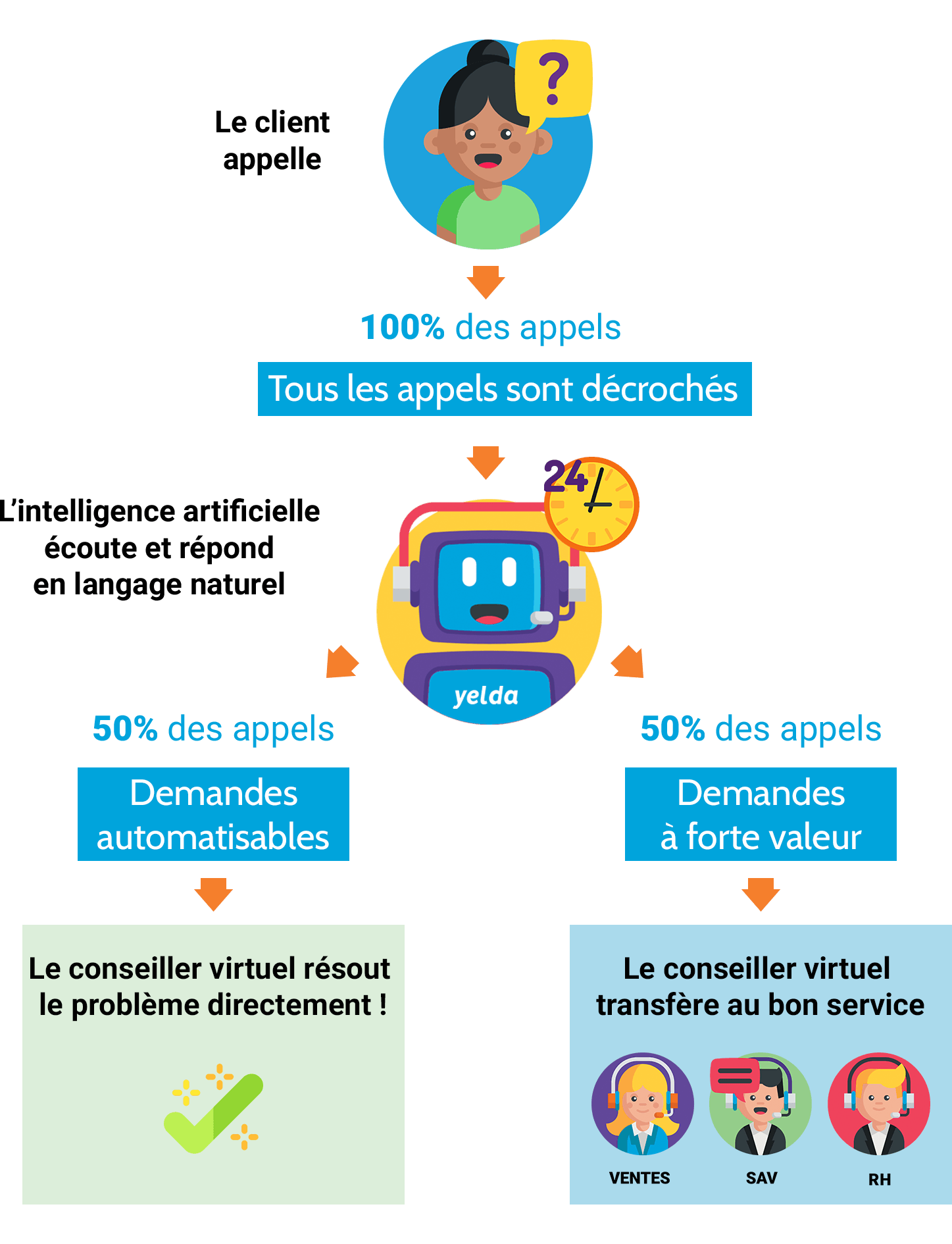
The callbot uses two main technologies: speech recognition and natural language processing. The robot uses these technologies to:
- Understand the user's spoken request
- Convert it into text to analyze and process it
- Formulate a response in text format and convert it back into speech for the person on the other end of the line.
What are the differences between a callbot, a voicebot, and a chatbot?
It is easy to confuse a callbot with a voicebot. The only difference lies in the communication channel: if it is a telephone channel, it is called a callbot. If the channel is something other than a phone, such as "Ok Google," it is called a voicebot.
As for a chatbot, it involves communicating in writing without using speech processing technologies like TTS (Text-to-Speech).
The benefits of a callbot for customer service
Let's discover the main advantages that integrating a callbot can bring to your customer service team:
24/7 availability
Unlike a traditional phone system where your customer service employees have fixed working hours, a callbot is available to your customers every day, at any time of the day or night. Without the need for human intervention during the call, the callbot will take less than 3 seconds to understand your customer's spoken request and provide an answer.
Reduced wait times
Your customer benefits from immediate phone support with the callbot. Even if human intervention is required later to resolve complex issues, the customer's request will be filtered beforehand by the robot. This helps reduce the average handling time by approximately 40%.
Automated management of common customer requests
The main advantage of a callbot is its autonomy in answering customer requests. Common inquiries can be handled entirely by the robot, without needing to speak to a member of your customer service team. At YeldaAI, more than 50% of calls can be handled via self-service!
Lower operational costs for the company
A callbot increases operational productivity by 59%, which in turn reduces your company's costs. You can reinvest your company's budget elsewhere, for example, by improving your customer experience!
Estimate the gains of a voice agent based on your own call volumes with our ROI simulator.
Improved customer experience
According to Siècle Digital, 90% of customers in France appreciate the quality of conversational agents, and companies that have adopted a bot have seen their customer satisfaction increase by 8%. This is not surprising, given that 72% of internet users prefer to resolve their issues independently, without resorting to customer service.
Customization options based on company needs
At YeldaAI, you have the ability to customize your callbot so that it perfectly matches your company's brand identity and addresses both the common and specific requests of your customers. Discover our callbot creation tool at YeldaAI!
What are the common uses for callbots?
Here are the most frequent uses for callbots:
- Call qualification : an incoming call can be qualified based on the type of request from the customer on the line. The callbot can take care of qualifying each call and redirecting your customer to the right person.
- Access to self-service information : your customers likely don't need to speak with an agent to access information about your products and services. A callbot can provide them with accurate, up-to-date data through a satisfying self-service experience.
- Answering simple questions : you can program a list of frequently asked questions from your customers that a callbot can answer independently during a phone call. This allows your customer service team to focus solely on complex requests that require human intervention.
- Handling complaints : managing complaints often involves a time-consuming, standardized process. By delegating this entire workflow to a callbot, you can significantly boost your productivity.
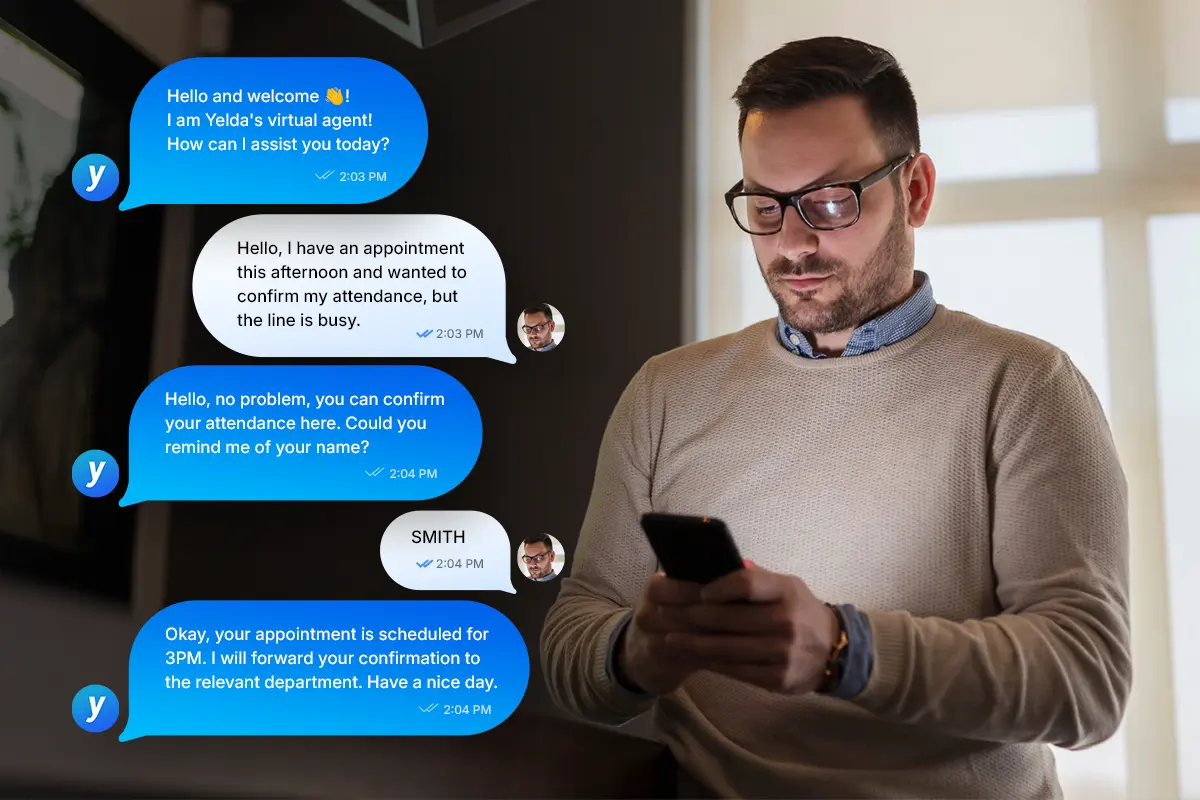
- Managing appointments, reminders, and alerts : the same principle applies to managing appointments and alerts, which are easily automated using a tool like a callbot.
- Call routing : your agents add no value when they simply answer the phone to redirect a customer to another department. A callbot can handle all call routing, ensuring your employees are only interrupted when truly necessary.
- Tracking files : a callbot can track your customers' ongoing files via voice assistance, acting as a conversational assistant.
- Updating records : your customer records need to be updated regularly, and a callbot can handle this task for your agents during incoming calls.
- Satisfaction surveys : delegate the automation of your satisfaction surveys to a callbot to continuously improve your company's customer experience.
- Managing call overflow : to relieve pressure during high call volumes, a callbot can handle a portion of the requests and route the customer to the appropriate agent.
As you can see, callbots have a wide range of uses. They can generally be divided into two categories: transactional callbots and routing callbots.
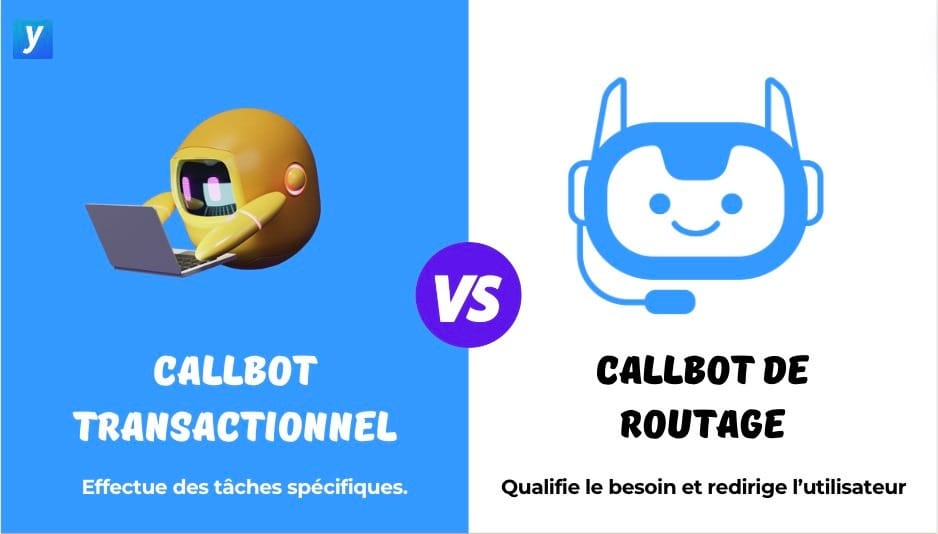
The transactional callbot is designed to perform specific tasks, such as booking an appointment or completing a purchase, for example. The routing callbot, as its name suggests, is primarily used to qualify customer needs and redirect incoming calls to the appropriate department.
How do you integrate a callbot into your company?
Integrating a callbot into your call center is not necessarily a complicated process, especially when choosing a tool like YeldaAI, which allows you to configure, deploy, and adjust the robot without coding and in just a few clicks.
- Define your company's goals and needs : they will help you better determine common customer queries, priority use cases to implement, and how to deploy this solution so that the callbot is useful and effective for your business.
- Select the right callbot provider : there are various solutions for implementing a callbot within your organization, such as our YeldaAI callbot platform. Our priority? To guarantee you a no-code platform that is quick to set up and highly customizable.
- Plan the implementation : this is a crucial step to ensure that the deployment of your future callbot is viable in the long term and meets all your needs on time.
- Customize and configure the callbot : thanks to our no-code platform on YeldaAI, customize your use cases from numerous modules such as Frequently Asked Questions, customer service, Human Resources, marketing, leads, and more. You can also connect your voice conversational agent with your existing customer relationship solutions (Salesforce or Zendesk).
- Test and adjust the callbot : the testing phase is necessary to ensure that the callbot's production launch satisfies your customers from the very first AI-powered call!
- Launch the callbot and inform customers : before launching your callbot, make sure to inform all your customers so they aren't surprised during their next phone call.
- Monitor performance and gather feedback : track precise performance indicators provided by your YeldaAI platform to verify user satisfaction.
- Continuously improve and optimize the callbot : in line with step 7, remember to always collect customer feedback regarding the callbot to ensure a 100% satisfying customer experience.
How much does a callbot cost?
When considering equipping your customer service department with an intelligent voice bot, the first question that often arises is that of the price.
Generally speaking, the cost of setting up a callbot includes a setup fee, which can typically range from €15,000 to €250,000.
In addition, you should also factor in running costs, starting at €0.50/minute and decreasing from there. The average price is around €0.15 per minute of communication. On average, this is 2 to 3 times lower than the cost per minute of communication with a human agent!
How many calls can your voice agent absorb?
Estimate in one minute the number of automated calls and the savings on your own volumes, with our ROI calculator.