Public Services: optimizing your relationship with users
Are you in the public sector and looking to improve your user relations? Read this article!


Citizens, whether acting as customers or users, have increasingly high expectations of public institutions and businesses: responsive after-sales service, a polished user experience, and quality user support.
In an era where 60% of citizens prefer online interactions in their private lives, public services must adapt to the new demands of their users by simplifying administrative procedures, improving user relations, and establishing active listening. This has been one of the goals of the Interministerial Directorate for Public Transformation (DITP) since 2017 with the launch of its Services Publics +.
program. In this article, we will explore 6 effective strategies to strengthen the relationship between public services and users in order to address the new challenges facing the public sector.
Article summary
Public service users now expect quick answers, simple procedures, and easy access to the right information. To improve their experience, administrations can leverage several tools, from optimizing journeys to automating recurring requests. Voice AI solutions like YeldaAI, for instance, allow for the autonomous handling of some requests, reserving more complex cases for agents.
1. Understand your user's needs
The first step is to gain a deep understanding of your users' needs. Since the goal is to meet their new expectations in user relations, it is impossible to optimize the process without knowing what users actually want.
Let's examine the recurring issues encountered by users to identify their needs:
Ease of access to information: when users visit your website or want to contact your service, they are always looking for specific information. They need to know the right channel to access that information, and they need it quickly.
Simplification of procedures: according to INSEE, 1 in 3 French people reported giving up on an online procedure at least once during 2021. Users need simple and intuitive procedures when completing administrative tasks online.
Reduction of processing times: on average, an internet user will not wait more than 3 seconds for a webpage to load before leaving the site. Similarly, on the phone, according to a survey by BVA Group 59% of users (or customers) expect a response time of less than 1 minute. In the digital age, this need must be taken seriously to improve user relations.
In short, according to the Complexity Barometer – Individuals (BVA, 2022), the main expectations of the French public regarding public services that should be prioritized are:
faster processing times (35%);
access to a knowledgeable contact person and personalized service (32%);
streamlining of procedures (25%);
simplification of communication and forms (20%).
One way to meet these expectations (reducing delays, streamlining, and simplifying requests) is to deploy a specific CRM application. This solution centralizes requests and makes their processing smoother, while ensuring the best experience for citizens and users.
2. Enriching your website: a source of relevant information
According to INSEE, "67% of people aged 18 or over living in metropolitan France reported having completed at least one administrative procedure online during 2021." This means nearly three-quarters of the French population are affected and need to use your website to complete a procedure. Enriching it with relevant and clear content is an effective solution, and it also helps you avoid an overloaded call center.
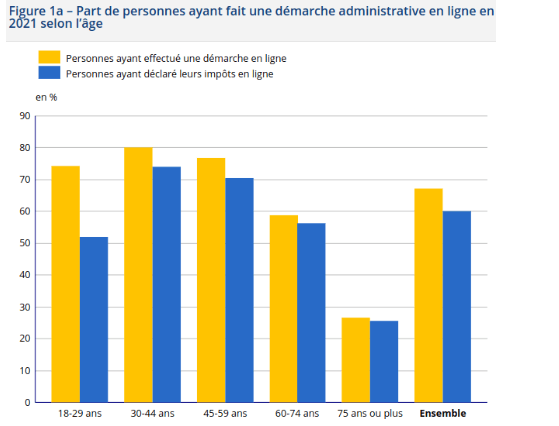
Source: INSEE (https://www.insee.fr/fr/statistiques/6438420#graphique-figure1_radio1)
To enrich your website, here are some essential elements to include:
Seamless user experience: ensure that site navigation is intuitive and offers an optimal user experience.
Detailed information for every procedure: provide comprehensive guides and Frequently Asked Questions to lead users through every step of their procedures.
Blog for regular news: maintain a blog with high-quality, regularly published articles to share frequent updates that will inform users about changes, new services, and ongoing improvements.
3. Integrate chatbots or voicebots to optimize user relations
Integrating chatbots, voicebots or callbots offers significant advantages for improving relations with users. These are AI-powered robots capable of holding written or spoken conversations with humans.
In fact, for a public service call center, 100% of incoming calls can be handled by a voicebot, significantly reducing wait times for users.
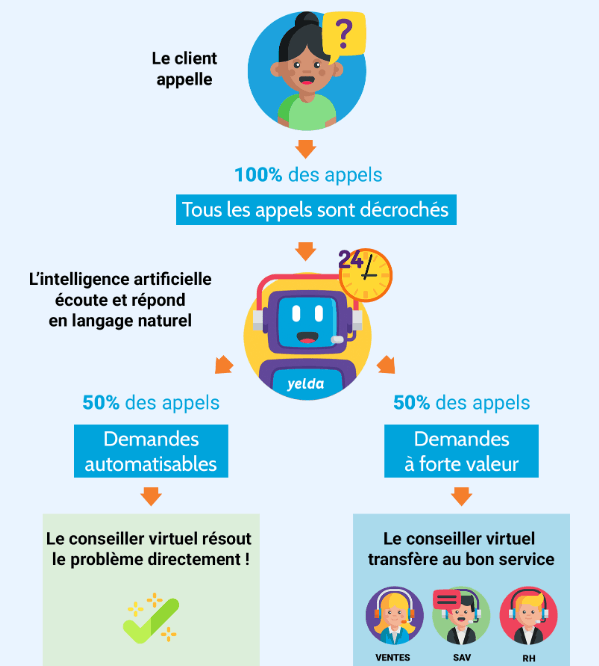
Whether it's a voicebot or a chatbot, conversational artificial intelligence plays a key role in improving user relations by providing:
A significant reduction in response time: a voicebot or chatbot responds to a customer request in less than 3 seconds (Siècle Digital).
Increased accessibility at any time of day or night: customer satisfaction increases by 8% with the simple deployment of a bot (Siècle Digital).
A personalized experience: according to the 2022 Observatory of Customer Services study by BVA, 69% of French people consider access to customer service in France an influential factor in purchasing a product or service.
For example, YeldaAI assisted the city of Plaisir, which was receiving nearly 400 calls per day. Their town hall call center was overwhelmed, leading to increasing dissatisfaction among residents. Implementing a voice AI agent made it possible to reduce the number of requests handled by agents by a factor of 4 and significantly improve user relations.
Estimate the gains of a voice agent based on your own call volumes with our ROI simulator.
4. Promote digitization and asynchronous communication
According to the IPSOS institute, "75% of French people believe that digital transformation should be one of the State's priorities." To drive this digital transformation, the digitization of administrative processes is one of the first levers to implement.
Here are some essential points to follow for successful digitization:
Formalize service commitments and obtain certifications such as Qualivilles or ISO 9001.
Diagnose workflows and processes, then implement corrective actions step by step.
Establish a new culture focused on service quality, requiring continuous training at all levels.
Adopt a multichannel strategy with a single point of contact, promoting the digitization of documents and processes.
However, it must be kept in mind that digitization fuels the digital divide (inequalities in the use of and access to information and communication technologies); this concerns 15.4% of the population is digitally illiterate (INSEE, 2021).
5. Establish a service culture within your administration
The Services Publics + program, offered by the Interministerial Directorate for Public Transformation (DITP), aims to support all public services in adopting a service culture focused on the user experience and the continuous improvement of the relationship between the administration and its users. 3.7 million public agents are committed to their stakeholders to better manage user relations.
Here is the program breakdown :
1. Public service commitments;
2. Transparency regarding results;
3. Listening to users;
4. The continuous improvement process;
5. Service quality certification (on a voluntary basis).
By adopting Services Publics +, you enable your agents to handle user requests with empathy and professionalism while engaging in a continuous improvement process for user relations, in order to meet future user expectations.
6. Collect and analyze user feedback
This feedback collection process, while often overlooked, is essential for the continuous improvement of user relations. It relies primarily on direct user input and requires the implementation of effective feedback collection mechanisms.
So, how can you practically go about collecting user feedback?
Implement listening tools across your communication channels: testimonial platforms on your website, satisfaction surveys sent via email after a user completes an online process, and regular satisfaction surveys conducted by phone.
Combine quantitative and qualitative feedback to deepen your analysis. They are complementary.
What information should be collected to improve user relations?
The user's overall experience, using the EPIC method. This model allows for the collection of experience based on the emotion felt, focusing on memory drivers rather than satisfaction drivers. EPIC is an acronym for Elevation, Pride, Insight and Connection. That is Elevation, Pride, Vision and Connection in English.
Quantifiable data that can be analyzed later and is useful for year-over-year comparative studies: expected telephone response time in seconds, number of online procedures completed, primary communication channel used, etc.
Suggestions for improvement: users always have relevant ideas for areas of improvement to share.
Once feedback has been collected, analyze these responses to identify trends, quickly resolve emerging issues, and plan for continuous improvement.
How many calls can your voice agent absorb?
Estimate in one minute the number of automated calls and the savings on your own volumes, with our ROI calculator.