
CSAT: Definition, what it's for, and how to calculate it?
The CSAT evaluates satisfaction after every customer interaction and guides companies in improving the user experience and optimizing their operations.

When it comes to optimizing the customer experience, the Customer Satisfaction Score (CSAT) stands out as the most widely used tool in business. Indeed, this customer satisfaction score allows for a targeted and immediate measurement of customer sentiment after a specific interaction (a call, a chat exchange, or an online purchase).
For any company looking to measure customer satisfaction, the CSAT stands out as a simple and quick indicator to adjust processes, train teams, and improve customer service. But what are the precise mechanisms behind this tool? And how can it be deployed effectively to reap all its benefits?
What is the Customer Satisfaction Score?
The performance of a customer service department cannot be effectively evaluated without reliable indicators. Among them, the CSAT holds a central place due to its ability to provide a simple and direct measure of a customer's immediate satisfaction.
Definition of CSAT
The CSAT, or Customer Satisfaction Score, is a survey tool that assesses a customer's immediate sentiment following an experience with a company.
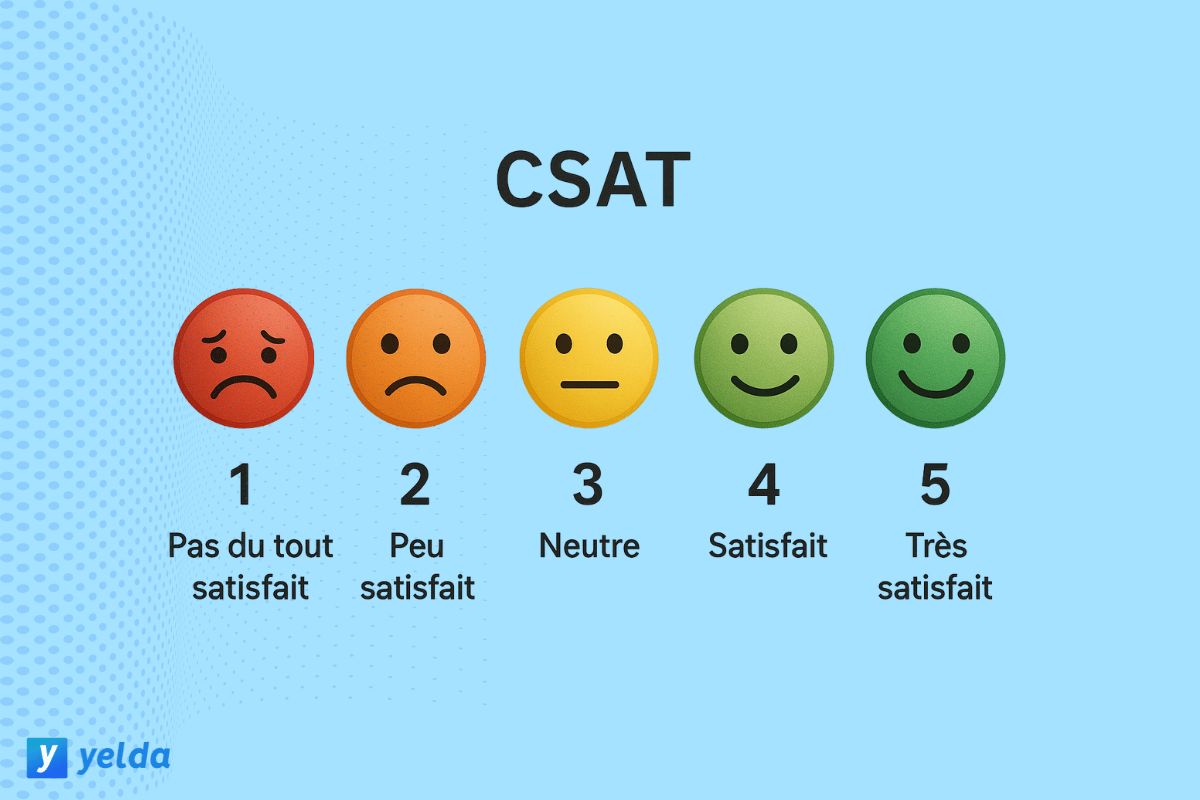
Generally, it is based on a simple question such as « Are you satisfied with our service? », « How would you rate your purchase? », "Are you satisfied with the response provided by our team? rated on a scale of 1 to 5. Naturally, each rating represents a level of satisfaction:
| Rating | Description |
|---|---|
| 1 | Not at all satisfied |
| 2 | Not very satisfied |
| 3 | Neutral |
| 4 | Satisfied |
| 5 | Very satisfied |
In other words, the score, calculated as a percentage, reflects the proportion of satisfied customers (ratings of 4 or 5) as well as those who still need to be won over. The formula to obtain this percentage is as follows: CSAT (%) = (Number of positive responses / Total number of responses) × 100
As a guide, if 80 out of 100 customers give a rating of 4 or 5, then the CSAT is 80%, which reflects an experience considered positive overall.
Other response formats:
CSAT can also be requested on a 3-point scale for simplicity (dissatisfied, neutral, satisfied, 😊 😐 😞) or a 10-point scale for greater granularity.
How does it differ from NPS and CES?
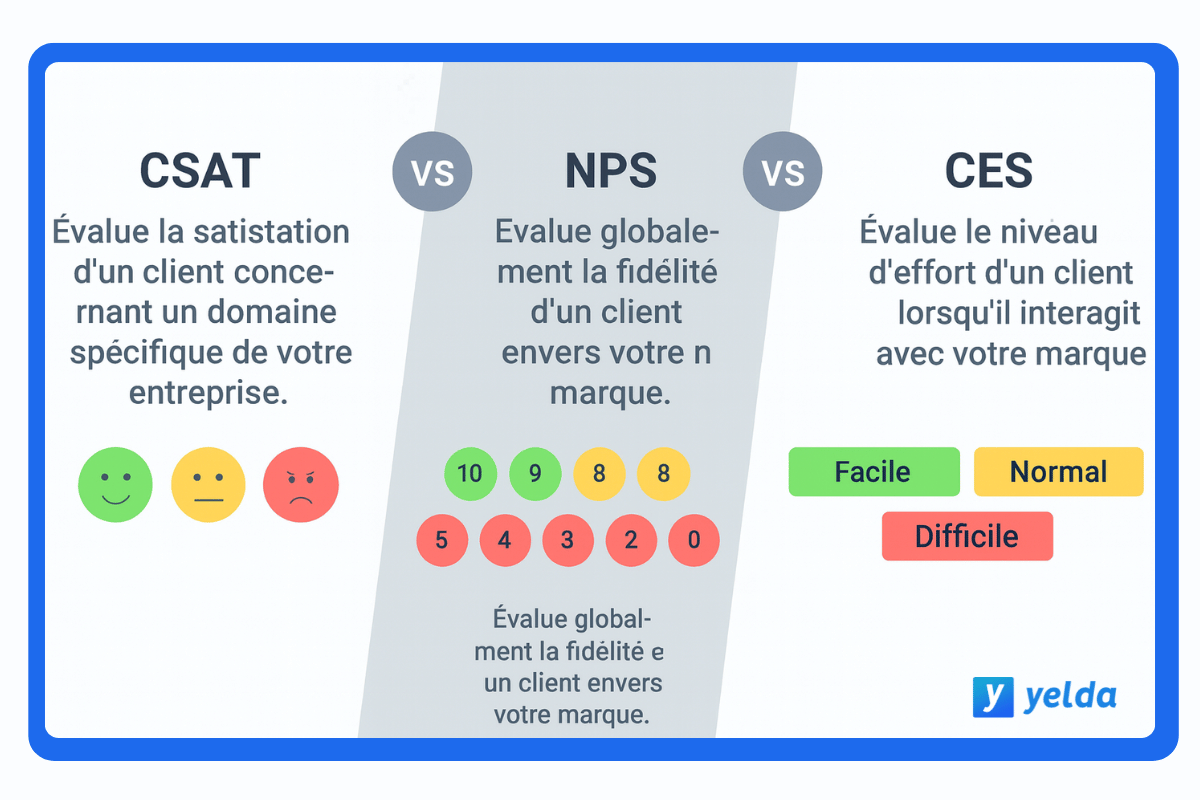
CSAT stands out from other KPIs because it focuses on an interaction that has just concluded, unlike the Net Promoter Score (NPS) which measures long-term customer loyalty. In this sense, a high CSAT, particularly after a call, does not guarantee a strong NPS if the overall experience is inconsistent.
On the other hand, there is the Customer Effort Score (CES) which is an indicator that evaluates the effort a customer had to put in to resolve an issue (for example, " Was it easy to contact support ?"). While complementary, this indicator does not measure the level of satisfaction, but it can help analyze it. In other words, all these customer service KPIs are complementary: CSAT captures point-in-time satisfaction, NPS captures loyalty, and CES captures ease of experience.
How is CSAT calculated?
CSAT is calculated by measuring the proportion of satisfied customers out of the total number of responses.
CSAT formula:
CSAT (%) = (Number of customers who answered 4 or 5 / Total responses) × 100
Out of 100 responses, 80 customers give a rating of 4 or 5. CSAT = (80/100) × 100 = 80%. This indicates high satisfaction.
It is also possible to calculate the average CSAT = sum of all ratings / total responses. So, out of 100 responses totaling 398 points, the average CSAT would be 3.98. Or you could use the median. These other methods are less common, but they can help mask extremes.
What is a good CSAT score?
A CSAT score of 75% to 85% is considered good, and anything above 90% is exemplary, according to NPS Calculator standards. However, it should be noted that these thresholds vary by industry:
| Industry | Average CSAT |
|---|---|
| Software / SaaS | 78 |
| E-commerce | 80 |
| Finance / Banking | 78 |
| Insurance | 76+ |
| Social media | 73 |
| Travel | 76 |
However, beyond comparing yourself to industry averages, the most important thing is to track your score over time to assess whether your actions are improving or harming customer satisfaction.
Why is measuring CSAT essential for your business?
CSAT is a management tool that allows you to turn every customer interaction into actionable data to continuously improve service quality. Here is why:
Identify friction points : a low CSAT score after a chat session may reveal wait times that are too long or a lack of clarity in the responses.
Optimize customer support : the results guide improvements to procedures, such as shortening processing times.
Target team training : a declining score may signal a need for training in active listening or conflict management.
Validate changes : a modified script or a new feature can be evaluated by tracking changes in CSAT.
Sell more effectively : a satisfied customer is more receptive to loyalty offers or cross-selling.
Adapt your offering : a gap between marketing promises and perceived reality often manifests as a low score.
Create a feedback loop : integrated into a Voice of Customer (VoC) strategy, CSAT becomes a daily management tool.
Benchmarking : the ability to compare your scores with those of your competitors or between different internal teams.
Enhance brand image : a CSAT score above 90% is an excellent marketing asset.
Another point to highlight is the high response rate for CSAT surveys, which is due to the minimal effort required from the customer to complete them.
Best practices for improving your CSAT score

To boost your CSAT, it is wise to adopt targeted practices that optimize every interaction:
Collect feedback at the right time : For customer service, send the survey immediately after the interaction to capture real-time feedback. For a product, you can wait up to 48 hours after delivery. For contract renewals, aim for 6 months before the renewal date.
Personalize the customer relations : use customer history for tailored surveys. For example, mention the customer service agent's name or the product purchased.
Integrate artificial intelligence : callbots or chatbot solutions help improve responsiveness and, consequently, increase customer satisfaction.
Offer self-service solutions : FAQs or customer portals allow for quick problem resolution.
Train your teams : focusing on active listening, empathy, and clarity significantly improves scores.
Analyze verbatim feedback : Open-ended comments help identify the root causes of dissatisfaction. Following the CSAT question, it is recommended to include an optional field so the customer can share their thoughts on their experience.
Segment your data : by analyzing CSAT by product, channel, or age group, you can better target corrective actions.
➡️ Simulate your project in a few clicks and get a clear estimate of your return on investment.
Estimate the gains of a voice agent based on your own call volumes with our ROI simulator.
Acting on CSAT scores
To take things further, it is recommended to respond to customer feedback to get the most out of your CSAT. The goal is not just to measure satisfaction, but to trigger specific scenarios based on the responses received.
- When a customer gives a high rating (4 or 5/5), it represents an opportunity to capitalize on their satisfaction. It may be worth encouraging them to recommend your brand, share their opinion on social media or review platforms, or even invite them to join a loyalty program to strengthen the relationship.
- Conversely, a low rating (1 or 2/5) should trigger a quick response. An alert can be sent to the customer service team so that a manager can contact the customer as soon as possible. The goal is twofold: to understand the source of the dissatisfaction, resolve the issue, and attempt to turn a negative experience into a retention opportunity.
Limitations of CSAT
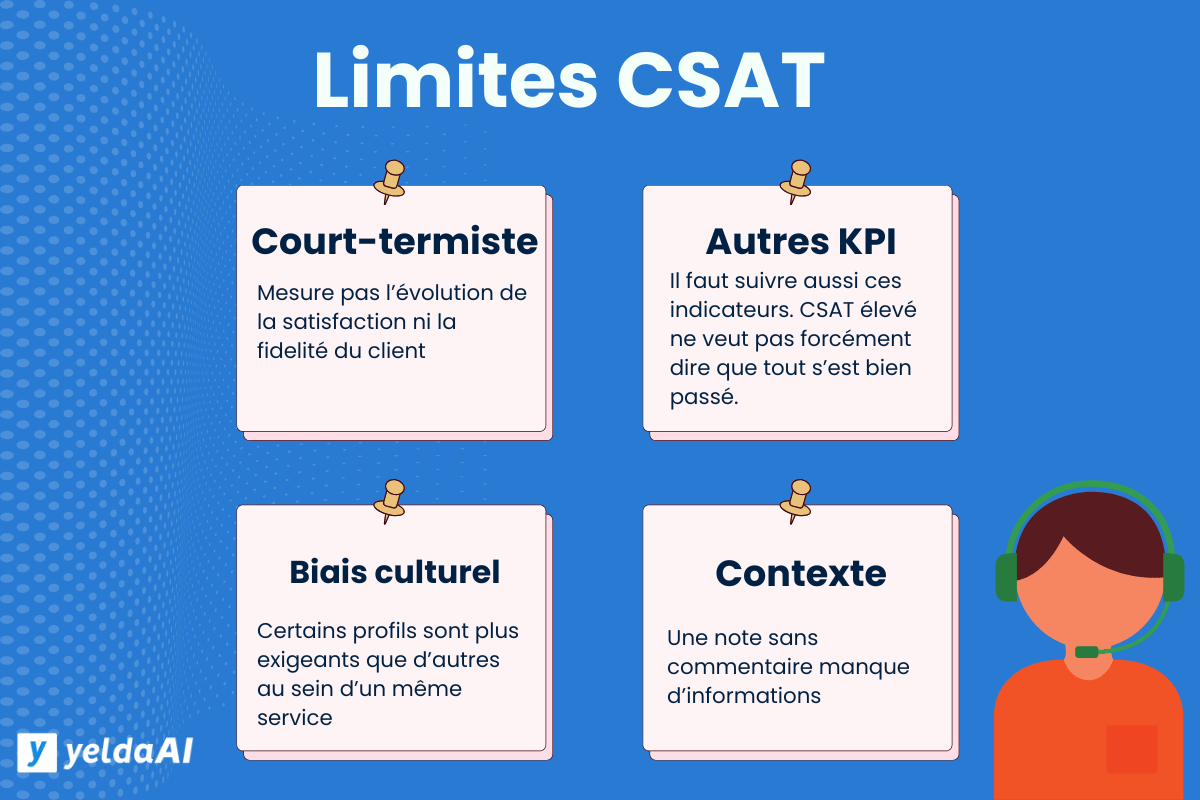
To fully leverage CSAT, it is useful to also understand its limitations. The main pitfall would be to consider it an absolute indicator, which it is not. These limitations include:
A short-term perspective : CSAT measures satisfaction at a specific moment, but not long-term loyalty. In other words, a customer who is satisfied after a call may still not return.
Complementarity with NPS and CES : a Low NPS despite a high CSAT can reveal underlying dissatisfaction, just as a low CES can highlight excessive effort despite good service;
Cultural bias : the perception of satisfaction varies by region. Some cultural profiles are more demanding or reserved when it comes to giving ratings;
A lack of context : a rating without a comment is not enough to understand the true sentiment. Analyzing verbatim feedback is essential.
For a truly strategic vision, combine CSAT with other KPIs (such as resolution time, complaint rate, or repurchase rate). This cross-analysis will allow you to turn data into concrete actions and deeply refine your customer relationships.
How many calls can your voice agent absorb?
Estimate in one minute the number of automated calls and the savings on your own volumes, with our ROI calculator.