Automated outbound calls: how to set them up?
Looking to automate your outbound calls? Read our expert article.

Call centers are undergoing a major transformation thanks to the democratization of AI and the integration of automation processes.
When a sales representative can make between 50 and 100 calls a day, AI-powered outbound call automation solutions remove all limits. They allow you to reach more contacts at the most opportune moments, and at a lower cost! This translates into a 30% to 50% increase in call center efficiency.
In this article, we will look at why and how to implement an effective automated outbound calling solution in your company.
What is an automated call?
An automated call is a call originating from a call center, launched or personalized automatically using a database of predefined numbers,artificial intelligence and computer programs such as solutions for callbot.
Depending on the strategy and objectives set by the company, an automated call can be:
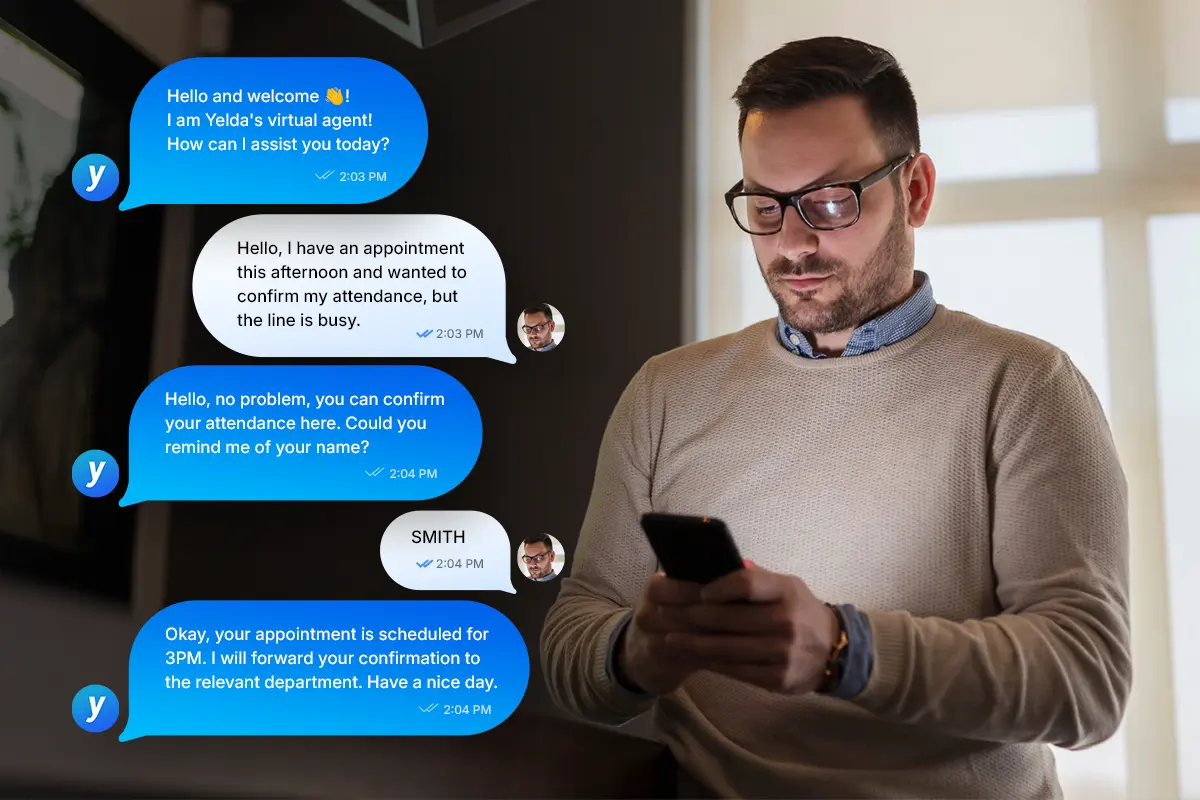
a one-off call at a specific point in the customer journey (e.g., appointment confirmation)
a mass calling campaign.
Estimate the gains of a voice agent based on your own call volumes with our ROI simulator.
How do automated outbound calls work?
Here is an overview of the main dialers used for automated outbound calls, along with their pros and cons.
Automatic Dialer
The automatic dialer, or auto-dialer, sequentially dials numbers from a predefined list and connects answered calls to available agents, or can play a pre-recorded message.
Pros:
- Increases call volume by eliminating manual dialing.
- Reduces wait time between calls.
Cons:
- Can lead to abandoned calls if no agent is available to answer immediately.
- Risk of reaching inactive numbers or voicemails, which reduces efficiency.
- It dials one contact at a time.
This method is effective when looking to reach large volumes of contacts at a low cost.
Predictive Dialer
The predictive dialer uses algorithms to anticipate agent availability and dials multiple numbers simultaneously, connecting only answered calls to agents.
Pros:
- Maximizes agent talk time by reducing idle periods.
- Significantly increases the volume of calls handled.
Cons:
- Can generate abandoned calls if a call is answered without an agent being available. Since it relies on AI prediction, it is not perfect.
- Risk of agent burnout due to the fast pace of calls.
This type of solution is practical for high call volumes.
Progressive Dialer
The progressive dialer only dials a new number when an agent is available, ensuring that every connected call is handled immediately.
Pros:
- Reduces the risk of abandoned calls, improving the customer experience.
- Allows agents to prepare between calls, offering a more personalized interaction.
Cons:
- Less effective for campaigns requiring a very high volume of calls.
- May lead to a slight decrease in productivity compared to predictive dialers.
This is relevant when your agent resources are more limited.
Why should you use automated calling?
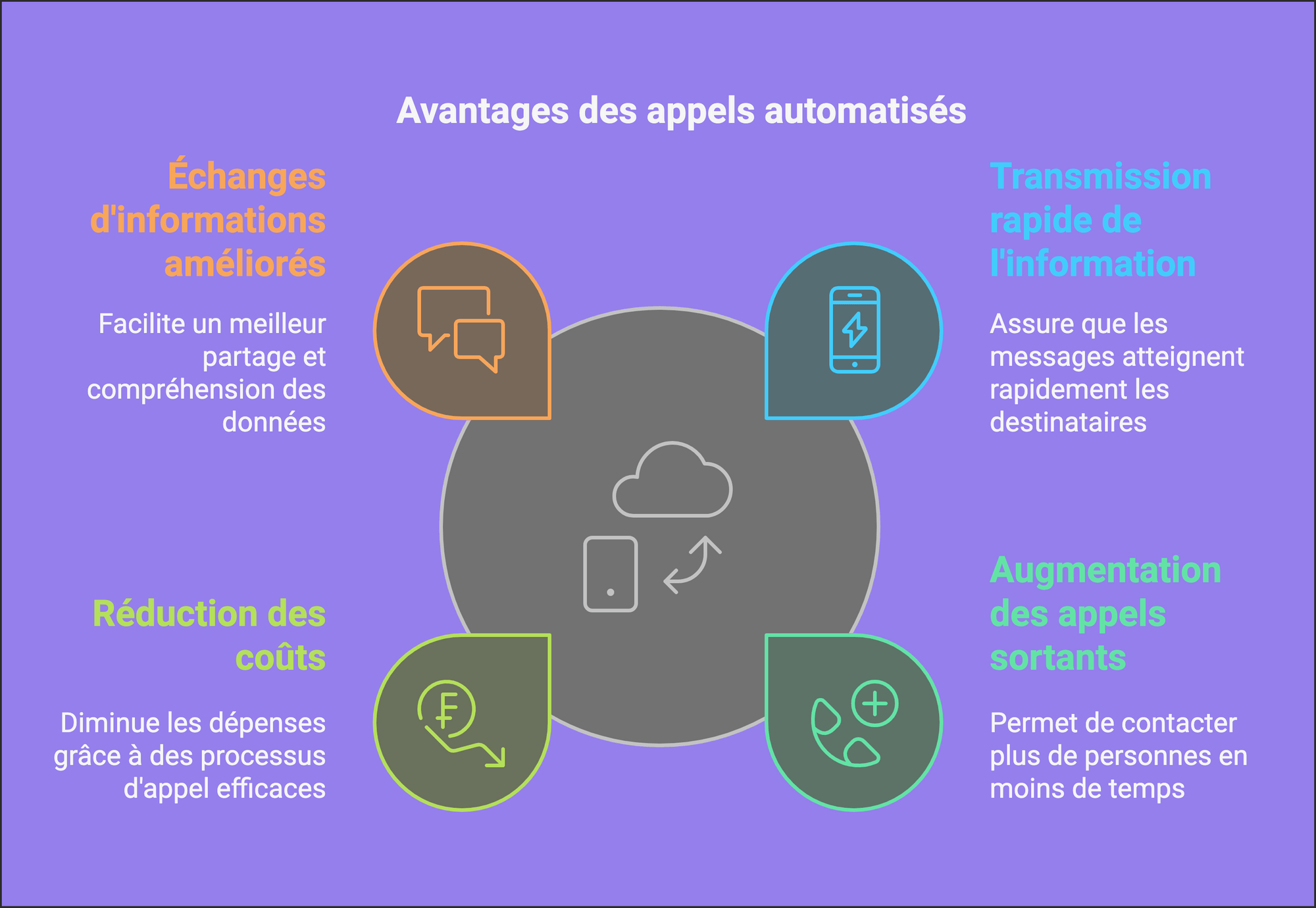
Automated calling offers many benefits:
Speed of information delivery via telephone.
Increased outbound calling: call automation allows you to contact a large number of prospects or customers in a very short period of time.
Reduced communication costs thanks to time savings from pre-programmed and automated call scripts.
Easier information exchange, leading to improved communication between teams and customers.
You can leverage outbound call automation to:
sell goods or services to prospects,
conduct market research,
provide information on an urgent situation,
launch a marketing campaign,
conduct satisfaction surveys for your customer support.
How do you automate outbound calls?
Automating outbound calls is simple if you follow a few essential principles. Automating a process requires preliminary work on your existing ecosystem, your call automation needs, and the structuring of the workflows that will be at the heart of your customer service automation.
The steps to follow to effectively automate your outbound calls are as follows:
Choose an appropriate auto-dialer : various technologies are available, such as predictive dialing (to maximize connection rates) or preview dialing (for better preparation by human agents), answering machine detection (AMD), etc.
Import existing data : the idea is to first import your current contact lists and take the opportunity to update them using data cleansing tools that remove duplicates and errors, among other things.
Classify your database : segment contacts based on criteria such as industry, geographic region, or sales potential, which are useful for targeting prospecting campaigns, for example.
Configure call scripts : they guide human agents during phone conversations and should include responses to common objections, smooth transitions between topics, and clear calls to action.
Build tailored automated sequences : whether for reminders, customer follow-ups, or sales campaigns, setting up automated sequences is useful for saving time and improving structure. For example, an automated reminder could be sent to a customer after a missed call, or a series of follow-up calls could be scheduled after a successful sale.
Integrate an automated calling system with your existing tools : connect your calling software to your CRM to ensure data synchronization and interaction tracking. This will allow agents to have a complete history of conversations with each customer. Also, ensure that the calling system can send data to analytics tools for tracking performance, sales, or customer service metrics.
Train your staff on the new calling system : every human agent must fully understand the new automated calling system that has been implemented, including the scripts and workflows.
Test and adjust the automated calling system : it is recommended to conduct pilot tests to identify necessary improvements and, above all, to ensure that the system is functioning correctly.
Legal aspects of call automation
However, take precautions regarding current laws concerning automated calling systems: according to the CNIL, "advertising via automated calling systems is permitted provided that individuals have explicitly given their consent before being contacted." This means that:
Prior consent is required: it must be specific, unambiguous, and freely given.
The process must comply with the current standards of the GDPR (General Data Protection Regulation).
The advertiser must state their identity at the beginning of the call.
The advertiser must provide a simple way to opt out of receiving future automated calls.
How many calls can your voice agent absorb?
Estimate in one minute the number of automated calls and the savings on your own volumes, with our ROI calculator.